Most kids’ clothes are all about plastic and bright colors. A children’s steampunk outfit is different. It’s a rebellion against the usual. It asks, what if the Industrial Revolution was funny and designed by Willy Wonka?
This style isn’t just about adding cogs to clothes. It’s a way to show off ideas. We mix Jules Verne’s hope with Charles Dickens’ gritty realism. We aim for the spirit of invention, not just history.
Imagine a mix of brass and leather. Picture colors from an old map of a world that should exist. Gears, goggles, and vests tell stories of adventure and discovery.
Steampunk is like a mix of fantasy and history. It’s a world where wonder meets practicality. This look turns simple clothes into a tale waiting to be told.
Color palette, textures, motifs
Steampunk costumes are like a color wheel with a twist. They’re not about primary colors. Instead, they’re a mix of weathered machinery and adventure gear.
The colors are rich and worn. Imagine burnished bronze and oxidized copper. Deep walnut browns and charcoal grays add a touch of workshop soot and midnight oil. Creamy ivories remind us of aged parchment and starched collars.
This color palette tells stories of libraries, leather-bound journals, and long journeys by train. It’s not just about old-fashioned costumes. It’s about learning mechanical engineering and exploring the world.
Textures are key in steampunk. They tell the story of your character. Faux leather is a favorite, as it’s ethical, washable, and suggests rugged travel. Corduroy adds a touch of Victorian elegance with its fine ridges.
Burlap or heavy cotton canvas feels like a workshop or an airship cargo hold. These materials are great for Steampunk Clothing DIY projects. They take paint and glue well, adding depth to your costume.
Motifs are the heart of steampunk. Stylized gears and cogs show off ingenuity. Watch faces hint at time and precision. These symbols create a visual language.
Keys, compass roses, and porthole shapes add to the story. They’re not just decorations. They’re part of a semiotic playground where each symbol tells a tale of adventure and discovery.
| Element | Key Characteristics | Common Materials & Examples | Mood Created |
|---|---|---|---|
| Color Palette | Antiqued metals, earthy tones, muted contrasts, avoidance of pure white or bright primaries | Bronze, copper, walnut brown, charcoal gray, cream, olive drab | Historical, mysterious, inventive, well-traveled |
| Textures | Tactile variety, visual weight, suggestion of wear, functional appearance | Faux leather, corduroy, burlap, canvas, tweed, boiled wool | Rugged, academic, workshop-ready, adventure-worn |
| Motifs | Mechanical symbolism, navigational elements, Victorian ornamentation, symbolic shapes | Gears, cogs, watch faces, keys, compasses, portholes, blueprints | Ingenious, precise, exploratory, puzzle-solving |
| DIY Integration | Easy to replicate with accessible crafts, forgiving for beginner projects | Cardboard crafts for gears, felt for pins, fabric paint on cotton, paper clay for details | Creative, hands-on, personalized, resourceful |
A charcoal gray corduroy vest with brass-colored gear pins tells a story. It shows this young person doesn’t just wear clothes—they interface with them.
This approach turns simple elements into character armor. It makes a Cardboard Crafts project into a statement piece. The look becomes cohesive, thoughtful, and deeply immersive. That’s the steampunk promise.
Safety & Comfort Standards
Let’s take a break from airship blueprints for a moment. Every great idea needs a solid base that won’t fail on its first test. For our young Victorian inventors, that base isn’t just any material—it’s safety.
We’re making things for real, living, breathing inventors, not just for display. A part that hurts, blinds, or trips is not cool; it’s a big mistake. We must think clearly and not just be creative.
Think about goggles. In a steampunk world, they’re full of gears and smoked lenses. But for real use, those lenses need to be crystal clear. Is that “old-timey” look really clear, or is it just a painted-on block? It’s not about stopping your imagination; it’s about keeping it safe.
Comfort goes hand in hand with safety. An itchy, slipping, or too-tight item can turn a focused inventor into a risk. It’s like the OSHA rules for the imagination. Every part, from buckles to lenses, needs a strict check before use.
The aim is simple: make accessories strong for adventure but comfy enough to forget they’re there. When goggles for kids really work for the kids, that’s when the real fun starts.
Non‑shattering goggles, soft belts, lightweight props
Forget Victorian restraint; the real innovation in kids’ steampunk is designing gear that’s dramatic yet drop-proof. We’re not just accessorizing—we’re engineering a world where imagination meets impact resistance. This is where pragmatism and whimsy shake hands.
Let’s start with the quintessential piece: the goggles. Every junior airship captain needs a pair, but glass lenses belong in a museum, not on a seven-year-old’s face. The solution is acrylic. Clear, durable, and completely shatter-resistant, it’s the workhorse of safe costuming. For the frame, think light: craft foam you can shape with scissors, or lightweight plastic from repurposed safety glasses.
The strap is equally critical. A rigid band is a recipe for complaints and abandonment. An elastic strap provides a secure, gentle fit that adjusts during play. It’s the difference between a prop that’s worn and one that’s discarded on the floor after five minutes.
Next, the belt. That oversized, heavy metal buckle might look authentic, but it’s a hazard waiting to happen—a source of pinches, snags, and uncomfortable weight. We’re vetoing it. Instead, opt for a plastic buckle or, even better, a soft fabric belt that closes with Velcro or a simple knot.
This isn’t about cutting corners; it’s about understanding physics. A child in motion shouldn’t be anchored by their costume. A soft belt with a plastic clasp maintains the aesthetic without the risk or the drag.
Lastly, the props. That “etheric resonator” or “brass rivet gun” shouldn’t have the heft of the real thing. Our materials of choice? Cardboard, foam, and pool noodles. Yes, pool noodles. They’re lightweight, easy to cut and shape, and inherently safe. A coat of metallic spray paint can transform a noodle into a convincing copper pipe or elaborate tool.
The goal is visual detail without physical danger. A prop should survive a spirited duel with a sofa dragon and be ready for the next adventure immediately after. It should have presence in a photo but feel like a feather in a child’s hand.
This approach—acrylic over glass, foam over metal, Velcro over clasps—is what I call pragmatic whimsy. It respects the fantasy while honoring the reality of how kids play. The best kids costume isn’t the most historically accurate one; it’s the one that gets worn all day, fuels endless stories, and comes home in one piece.
DIY Pieces Step‑by‑Step
Welcome to the workshop. Here, Pinterest dreams come to life. We move from “what if” to “what’s next.”
Forget about perfection. In this space, a wobbly cardboard gear is a feature. It shows the human touch in a world of mass production.
We’re using the most forgiving materials. Cardboard is the go-to for creativity. It’s cheap, easy to find, and can be changed in many ways. Craft foam is easy to cut and holds paint well. Felt is great for projects without sewing.
The magic is in the making, not just the end result. Seeing a cereal box turn into a working dial teaches us about design. This is where gears & cogs craft meets practical philosophy.
Let’s create some cardboard accessories with a story. The journey teaches us to be resilient. When things don’t work, we adjust. That’s the main lesson.
So, let’s get started. We’re going to make something truly ours. The small flaws will be our unique touch.
Paper‑foam top hat, felt gear pins, no‑sew vest, faux leather cuffs
Steampunk accessories are best made from everyday items with a touch of Victorian flair. This guide shows how to make four key pieces in under two hours. You’ll need minimal tools and maximum creativity.
The paper‑foam top hat is a masterpiece. It starts with a cardboard cylinder for the crown and a larger circle for the brim. Cover it all with black craft foam.
This hat is both light and strong, perfect for a hat-tip. It’s like architectural millinery.
Felt gear pins add instant style. Cut out cog and wheel shapes from different felt colors. Glue them together for depth.
Add a pin back, and you have wearable machinery. These pins turn any lapel or hat band into a workshop. They’re the easiest way to show “inventor” status.
The no‑sew vest is a thrift store magic trick. Look for an oversized adult vest. Cut it down the back center seam.
Use fabric glue or iron-on hem tape to make new side seams. This way, you avoid sewing machines. Add felt details like pocket welts or gear motifs for steampunk texture.
Faux leather cuffs add a rugged touch. Cut pleather or vinyl strips for arm wraps. Use Velcro dots for an adjustable fit.
Decorate with bottle caps, washers, or more felt gears. Each cuff tells a story of adventure and repair.
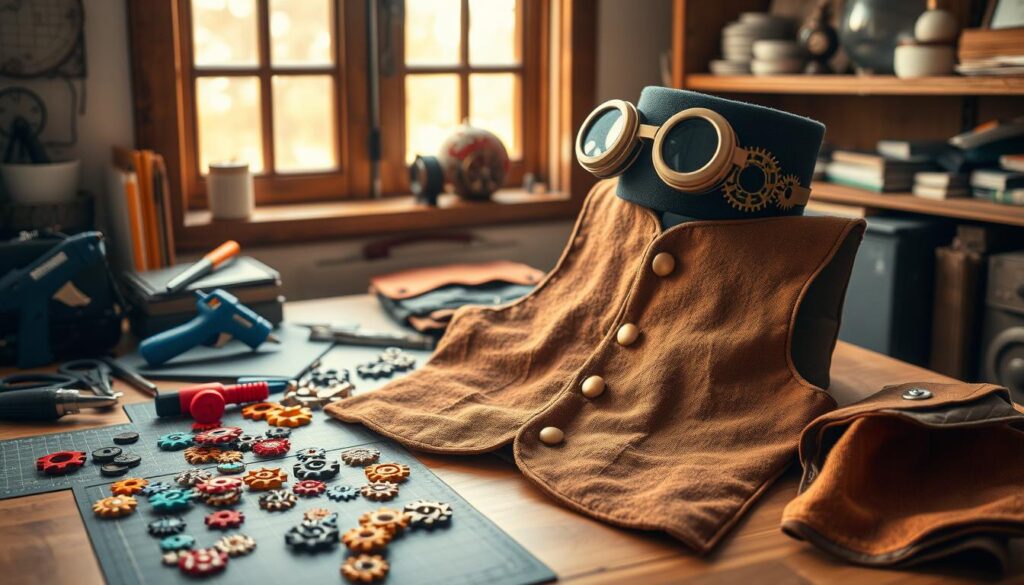
These projects share a common goal: imagination over complex construction. You’re not just making costumes; you’re creating characters. The hat teaches form, the pins detail, the vest adaptation, and the cuffs adornment.
Together, they offer a complete toolkit for young inventors. The best part? Each piece can withstand playtime. That’s true engineering success.
Learning Tie‑Ins
Let’s be honest about our secret agenda. We’re sneaking education into the dress-up box.
Think about the inventor’s outfit. It’s more than just clothes and accessories. It’s method acting for the scientifically curious. When a child puts on goggles and picks up a wrench, they’re not just playing. They’re doing real research.
The link to STEM play is clear. That wrench is not just a prop. It teaches about levers. A drawing of pulleys on “blueprint” paper shows mechanics. Seeing gears makes kids wonder how things work.
This opens the door to history, too. Who are you dressed as? This question leads to learning about famous people. Maybe it’s Thomas Edison and his light bulb, Ada Lovelace and her code, or Nikola Tesla?
The costume asks: “Who are you, and what have you invented?” Playtime turns into project-based learning. It’s learning disguised as fun.
We’ve made the dress-up corner a hands-on lab. History and engineering aren’t just book subjects. They’re tools for the imagination. That’s the magic of STEM play.
Simple machines, Victorian inventors, journaling prompts
The real magic of steampunk isn’t in the brass goggles. It’s in the gears turning in a child’s mind. The costume is just a doorway.
Play becomes something more than fun. We’re building a story world. It’s like educational world-building 101.
Decoding Simple Machines is the first lesson. That papier-mâché gear on their wrist isn’t just for show. It links to real-world mechanics, like a pocket watch or industrial loom.
Create a “Field Engineer’s Guide” card. One side shows their prop. The flip side shows the simple machine it mimics. A belt becomes a pulley system. A lever on a prop tool shows mechanical advantage.
Now, they’re not just wearing a costume. They’re carrying a toolkit of basic physics. The connection is clear and real.
The Victorian Inventor Hall of Fame adds a human touch. History comes alive with faces, failures, and breakthroughs.
Give brief, engaging bios. Not long stories, but character sketches:
- Thomas Edison: The relentless tinkerer. See him as the master of the industrial lab, not just the “light bulb guy.”
- Ada Lovelace: The visionary poet of numbers. She was the first computer programmer, blending art and analysis.
- Nikola Tesla: The enigmatic showman of alternating current. He was Edison’s rival in the current empire.
- The Wright Brothers: The bicycle mechanics who conquered flight. Their story is a steampunk dream come true.
This list does more than teach. It gives archetypes. Is your child like Edison, the meticulous planner, or Tesla, the dreamer?
Then, we use Structured Journaling Prompts. Give them a small, “distressed” notebook. It’s their log, blueprint, and captain’s diary.
The prompts inside are like mission orders:
- “Blueprint your greatest invention. What problem does it solve for the city?”
- “Log your first airship voyage: coordinates, weather, and one strange creature spotted.”
- “Interview a famous inventor from your guide. What one question would you ask them?”
This isn’t just busywork. It’s secret missions in creative writing, systems thinking, and empathy. The costume is the what. These prompts are the why and how.
The goal is to connect everything. The gear on the cuff links to the pulley in the diagram, which was invented by someone in the bio. This inspires an entry in the journal. The loop is closed. The play has depth.
You’ve moved beyond dress-up. You’ve created a curriculum. And the best part? They’ll never call it learning. They’ll call it an adventure.
Budget Tiers
Let’s talk money without getting Victorian about it. The search data shows we’re all about saving money. It’s not about being cheap. It’s about maximizing imagination per dollar.
Imagine you’re a project manager for a unique startup. Your strategy is key. A new look might not be the most exciting. The real fun is in the challenge.
There are three main ways to approach this. Are you a scavenger, searching for hidden gems? A strategist, planning a thrifted costume mission? Or an investor, choosing a few special pieces?
Your budget isn’t a limit. It’s a guide for creativity. This mindset makes the search exciting. The aim is to find a look with history and character, all while saving money.
Under $20, $40, $75 kits with item lists
Creating a steampunk look for kids doesn’t need to be expensive. I’ve divided the process into three budget tiers. Each offers a unique way to enjoy the craft.
Think of these tiers like levels in a game. You pick based on what you have, how much time you have, and what you want to achieve. The best part? Every tier lets you create a real, ready-to-play inventor.
This tier is for the MacGyver type. It’s for parents who see the world in a cardboard box and spray paint. The idea is to repurpose, reinvent, and raid the closet.
- Base Layer: Begin with a classic: brown pants or a skirt and a white shirt. These are probably in your closet already.
- Key Piece: Find an adult vest at a thrift store. A few cuts and stitches make it fit a child. An old vest is your best friend.
- Props & Accents: Cardboard is your best friend. Make goggles from clear plastic and paint them bronze. Add felt gear shapes and cuffs.
- The Finisher: A faux leather belt from a discount store ties everything together. Often, you can find this for under twenty dollars.
The Artisan: Under $40
This tier is for those who love crafting. You’re investing in quality items. It’s about building a costume that lasts and looks great.
Start with the Scavenger’s plan, then upgrade key pieces. It’s like moving from a sketch to a detailed drawing.
- Enhanced Base: Buy dedicated pieces: kids’ brown cargo pants and a puffy-sleeved blouse. This gives a solid start.
- Signature Layer: Add a faux leather apron. It’s practical and looks great, perfect for future crafts.
- Headgear Upgrade: Modify a simple hat or helmet. Add watch parts, gears, and more for a unique look.
- Complex Prop: Create a detailed gadget. Think a “geared calculator” from cardboard and foam, painted with metallic finishes.
The Couturier: Under $75
This tier is for creating a timeless pretend world. You’re not just making a costume; you’re crafting a character. The focus is on quality pieces that stand alone.
Here, you mix ready-made items with custom touches. It’s about perfecting the look, not making everything from scratch.
- Centerpiece Garment: Invest in a high-quality, ready-made piece. A detailed jacket, a steampunk dress, or tailored trousers. This piece does the heavy lifting.
- Professional Accessories: Find resin-cast gear accessories, a proper pocket watch, or well-made leather-look items. These look authentic and last long.
- Head-to-Toe Vision: Craft a detailed hat or customize footwear. Every element is intentional.
- The Result: A costume that feels like a character’s wardrobe. It has presence and lasts, becoming a treasured item for years.
The choice isn’t about money. It’s about where you want to spend your creative energy. The Scavenger finds joy in the hunt. The Artisan loves the build. The Couturier enjoys the curation. All paths lead to a fantastic adventure.
Inclusive & Adaptive Ideas
True innovation must be for everyone. If it’s not, it’s just a fancy toy for a few.
When we dream up fantastical worlds, we often forget to check the accessibility ramp. The most brilliant contraption is useless if you can’t reach the controls.
This is where design pivots from mere aesthetics to genuine empathy. We must ask the uncomfortable questions mainstream patterns ignore.
Can the gearwork be appreciated from a seated position? Are the textures soothing or sensory landmines? Does the iconic headpiece play nice with glasses or hearing aids?
An empowering children’s steampunk outfit isn’t about restrictive authenticity. It’s about providing the tools—adapted to the individual—so every young inventor can captain their own airship. The vessel’s specifications shouldn’t limit who gets to fly.
Sensory‑friendly fabrics, seated designs, glasses‑compatible hats
Creating a costume that meets sensory needs, mobility, and eyewear is a big challenge. It’s not about making it less exciting. It’s about making it better for everyone.
Imagine combining human-centered design with Victorian fantasy. The goal is to make a costume that feels as good as it looks.
The Fabric of Reality: Tactile Diplomacy
Let’s talk about the basics: what touches your skin. Many classic fabrics are tough on the senses. Wool, taffeta, and nylon might look great but can be uncomfortable.
Switch to brushed cotton or soft fleece for a better feel. These fabrics are soft and comfortable. For seams, use flat-felled or French seams, or turn the garment inside out. This small change makes a big difference in comfort.
Another smart move is weighted elements. A sash with fabric-covered gears can be calming. Make sure it’s optional and securely attached.
| Fabric Type | Tactile Profile | Ideal For | Pro Tip |
|---|---|---|---|
| Brushed Cotton | Soft, warm, breathable; no scratch | Vests, trousers, skirt overlays | Feels like broken-in flannel; dyes well for muted steampunk tones. |
| Fleece | Plush, lightweight, quiet | Capes, linings, simple cuffs | Excellent for no-sew projects; provides warmth without bulk. |
| Avoid: Taffeta/Nylon | Stiff, noisy, can be irritating | — | The rustle might sound “fancy,” but it’s a major sensory distraction for many. |
A great costume doesn’t need constant movement to impress. For seated designs, focus on the upper body.
Imagine a detailed collar, a vest with pocket watches, and ornate arm cuffs. Goggles are a must. The lower half can be simple, like trousers or a skirt. The eye is drawn to the upper body.
Props must also work for seated wear. A “multi-tool” from cardboard and bottle caps should be light. A “blueprint” scroll can be used on a lap. Function comes first, then flair.
Eyewear Integration: The Goggle-Glasses Detente
Here’s a common problem: goggles versus glasses. It’s bad design to force a choice. A little mechanical thinking solves this.
For top hats, use a wide, sturdy headband as the base. This fits behind glasses arms. Decorate the band with gears, feathers, and fabric. You get the iconic look without the head clash.
Goggles are harder. The standard strap often clashes with glasses. Solution one: make the strap elastic and long enough to go over glasses. Solution two: create integrated goggles.
Take old glasses and glue gear details, tiny bolts, and brass mesh onto them. You’ve made a hybrid that works for vision and style. It’s a steampunk genius move.
This way of making glasses-compatible hats and gear is not a compromise. It’s an improvement. It shows that the best design adapts to the user, not the other way around.
Quick Classroom Activity
Imagine this: forty-five minutes, twenty young minds, and a lot of recycled materials. It’s not just an art project. It’s like a flash mob in the classroom.
The mission is to make a gadget to solve a silly problem fast. Think of the Headmaster’s tea getting cold. The urgent task is: “Build a tea-warming gadget!”
The goal isn’t to make something perfect. It’s about the fun, inventive rush. Kids learn to be resourceful and understand design quickly. They feel the joy of creating something from almost nothing.
This is the Maker Movement in one messy class period. For more hands-on steampunk activities, the web has lots of ideas. The real win is the creative spark it lights.
Build‑a‑Gadget cardboard challenge
Forget Silicon Valley; the next big thing might be your classroom. It’s powered by cardboard and creativity. Our Build-a-Gadget cardboard challenge is about making a story, not just a machine.
We split our young creators into inventor teams. Each team gets a bin of materials. This is their chance to dream big.
- Cardboard tubes and egg cartons (the structural foundation)
- Bottle caps, string, and aluminum foil (for detailing and mechanics)
- Markers, tape, and a handful of pipe cleaners (the connectors and decorators)
We give them a problem to solve. It’s fun and a little wild. Imagine making a hamster-proof space suit or a pencil sorter.
The rules are simple. Use only the materials given. Name your invention and explain its purpose. Most importantly, it must have a moving part.
This rule sparks creativity. It makes them think about how things move. A lever isn’t just a stick; it’s special.
The last part is presentations. Each inventor team shows off their gadget. They tell a story with their invention, making it come alive.
The room fills with excitement. It’s a place where solving problems is fun. You see amazing inventions that tell stories of their own.
Photo & Play Prompts
A great outfit is more than just fabric. It’s a script waiting for its actor. The worst photos happen when we treat it like a museum exhibit. “Stand straight. Smile.” That’s not performance, it’s just documentation.
We need direction and motivation. The right prompt unlocks everything. It changes posture, expression, and tells the whole story.
Is your young protagonist a daring explorer, mapping unknown skies with a brass sextant? Maybe they’re a harried engineer, frantically patching a critical boiler leak with a wrench. Or perhaps they’re the captain, barking orders to a crew of very attentive stuffed animals.
The outfit sets the scene. The prompt tells the story. It’s like giving them a character bible. Suddenly, it’s not just a kid in a costume. It’s an airship captain or an inventor on the brink of a breakthrough.
This change makes all the difference. The stiffness goes away. The camera captures a moment, not just a pose. You’re not just taking a picture. You’re capturing a scene from a movie only they can see.
Airship captain, engineer, explorer
Once your child puts on the goggles and vest, they’re not just dressing up. They’re stepping into a world of adventure. The right steampunk costume tells a story, not just covers the body.
Each role—Captain, Engineer, Explorer—has its own way of moving and speaking. It’s not just about looking good. It’s about being that character. The right pose and words can spark hours of play.
Let’s look at the different roles like lenses for the same steampunk costume. A leather cuff means something different for each character. For the Captain, it’s a symbol of power. For the Engineer, it’s protective. The Explorer might use it to carry something.
The Airship Captain exudes confidence. They stand tall, with one hand on their hip and the other holding a “spyglass.” Their eyes scan the horizon, looking for signs of danger.
They give orders that sound urgent. Try saying: “The horizon line is wrong. Calculate the new heading!” This teaches kids about leadership and problem-solving, all while looking stylish.
The Engineer looks focused and a bit worried. They’re hunched over, working on a gadget. Their face shows they’re trying to prevent a disaster.
They’re all about fixing things fast. Their prompt is: “The primary phlogiston regulator is jammed! You have 30 seconds before we lose altitude!” It’s about solving problems quickly, turning everyday objects into critical parts.
The Explorer is all about curiosity. They’re on their knees, studying something interesting. Their face shows they’re excited to learn.
They’re all about observing and documenting. Their prompt is: “This cog… it’s not brass. It’s not from around here. Make a note in your journal.” It’s about exploring and discovering, making the ordinary seem extraordinary.
| Role | Core Pose | Signature Prop | Character Prompt |
|---|---|---|---|
| Airship Captain | Standing tall, hand on hip, scanning horizon | Spyglass (paper tube) | “The horizon line is wrong. Calculate the new heading!” |
| Engineer | Crouched, fixing a gadget with tools scattered | Wrench or multi-tool prop | “The phlogiston regulator is jammed! We have 30 seconds!” |
| Explorer | Kneeling, examining a specimen closely | Magnifying glass & journal | “This cog isn’t from around here. Make a note.” |
This setup is more than just for photos. It’s a way to play. The Captain gives orders, the Engineer fixes things, and the Explorer discovers new things. It lets kids switch between roles, creating their own stories.
The real magic happens after the photo shoot. The living room becomes a bridge, the garden a jungle. A simple steampunk costume opens up a world of imaginative play. The adventure continues, and the child is fully engaged.
Care & Storage
Every great performance needs a proper curtain call. The final bow matters as much as the opening act.
Think of it like a Broadway show’s closing night. The costumes don’t just get tossed in a bin. They receive systematic care for possible revivals.
That hastily shoved-in-a-bag creation becomes a tragic tangle of detached gears and broken dreams. It’s the post-production phase nobody glamorizes but everyone needs.
With a little methodical attention, we preserve the integrity of each piece. This makes them ready for an encore performance at the next school Book Week or neighborhood Halloween.
Consider this your personal archival work. You’re not just storing fabric and brass. You’re curating possibilities for future adventures.
Even a rainy Saturday can transform into something extraordinary with well-maintained gear at the ready.
Labeling, spot cleaning, reuse box
Every great invention needs a maintenance manual. Your child’s DIY steampunk costume is no different. Think of this final step not as an end, but as the clever engineering that ensures future adventures.
Start with archival-grade labeling. A strip of masking tape inside a cuff or hat brim holds key data. It shows the creator’s name and the event’s date. This isn’t just practical. It’s curating a personal history museum. Future you will decode it with a smile.
Spot cleaning is your first line of defense. Most handmade costumes hate the washing machine. Attack a fresh stain with a damp cloth and mild soap. For felt gear pins or paper-foam hats, remember this rule: dabbing is an ally, rubbing is a villain. Let everything air dry completely. Patience preserves the paint.
The real genius lives in the reuse box. Designate one container as the costume archive. Disassemble what you can. Store goggles and faux leather cuffs in small bags. Hang the vest. Flatten cardboard props. This box becomes a portal to past exploits and a toolkit for new ones. That engineer’s cuff from last year can become an archaeologist’s detail tomorrow. Sustainable play is the most ingenious invention of all.