Let’s be honest – we’ve all seen that magical moment when a child puts on a crown. Instantly, they become royalty. That simple felt circlet isn’t just fabric; it’s a coronation ceremony, leadership training, and medieval politics lesson all in one.
These props are like psychological sparks, turning ordinary playrooms into worlds of endless possibility. From Glinda’s wand to Gandalf’s staff, these aren’t just decorations. They’re tools that help tell stories and grow our minds.
The right enchanted accessories can make any Tuesday afternoon feel like an epic quest. They’re not just toys; they’re tools that help us think creatively and solve problems. Don’t we all need more of that in our busy lives?
Safety Checklist: rounded tips, elastic fits, hypoallergenic materials
Nothing can ruin a magical quest like a safety hazard. I’ve seen many poorly designed play accessories. That’s why we need the Three Pillars of Enchanted Safety.
First, rounded tips are key. Some makers think kids should play with sharp objects. I choose foam armor instead of sharp plastic – it’s safer and just as cool.
Next, elastic fits are important. Kids grow fast, and adjustable elastic keeps crowns in place. It’s the perfect fit, not too tight or too loose.
Lastly, hypoallergenic materials are a must. Allergic reactions are not magical. I avoid fabrics that might cause rashes.
Here’s my quick safety checklist:
- No small parts that could become choking hazards
- Flexible materials that move with the child
- Breathable fabrics that won’t overheat
- Non-toxic paints and finishes
- Durable construction that withstands imaginative battles
The best foam armor is safe and tells a story. It protects kids while they have fun adventures. The only thing that should hurt in playtime is a child’s wit, not their skin.
Smart design means thinking like an engineer and a seven-year-old. This way, we get accessories that are safe and spark imagination.
Crowns & Circlets: felt + elastic, bead alternatives
Not all crown crafts are the same. While cheap tiaras are fun for one day, a DIY crown is special. It’s made with safe, creative materials.
The Felt Revolution: Democracy in Headgear
3mm craft felt is the top choice for making crowns. It’s sturdy but bends easily. Add ¼-inch elastic for a crown that fits any head.
Anyone can make a crown with basic skills. It’s like a monarchy that changes with the wearer.
Bead Alternatives: Sparkle Without the Risk
Traditional crown-making gets a fresh twist. Instead of beads that could be a choking hazard, try these:
- Punched felt shapes that create dimensional texture
- Fabric paint applied with precision for gem-like effects
- Heat-sealed vinyl designs that withstand even the most active reign
These options sparkle like jewels but are safe. You can make crowns that look like Sofia the First’s or something more simple. The only limit is your imagination.
| Material | Safety Advantage | Creative Possibilities | Durability Score |
|---|---|---|---|
| 3mm Craft Felt | No sharp edges | Easy to cut into shapes | High (lasts through many plays) |
| ¼-inch Elastic | Adjusts without pins | Many color choices | Excellent (stretches well) |
| Fabric Paint Gems | Stays put | Endless color options | Medium (depends on how it’s applied) |
| Heat-Sealed Vinyl | Stays on forever | Looks like glitter | Very High (safe in the washer) |
The magic of these DIY crown alternatives is more than safety. It’s about letting kids create. When they make their own crowns, they learn that imagination is more valuable than money. That’s a lesson worth celebrating.
Wands & Scepters: foam stars, ribbon streamers, dowel safety
Wands turn little hands into magic makers. But what makes them special? It’s not just about looks. It’s about how they’re made.
These aren’t just sparkly sticks. They’re tools for imagination. Poorly made wands can ruin the magic. So, what makes a wand great?
Foam Stars: The Tip of the Magical Iceberg
Forget sharp tips that could hurt. Today’s kids wand craft starts with foam stars on dowels. These stars are safe and magical.
Foam stars vary in softness. Start with 2-inch stars for safety and fun. They come in many colors, but gold and silver are classics.
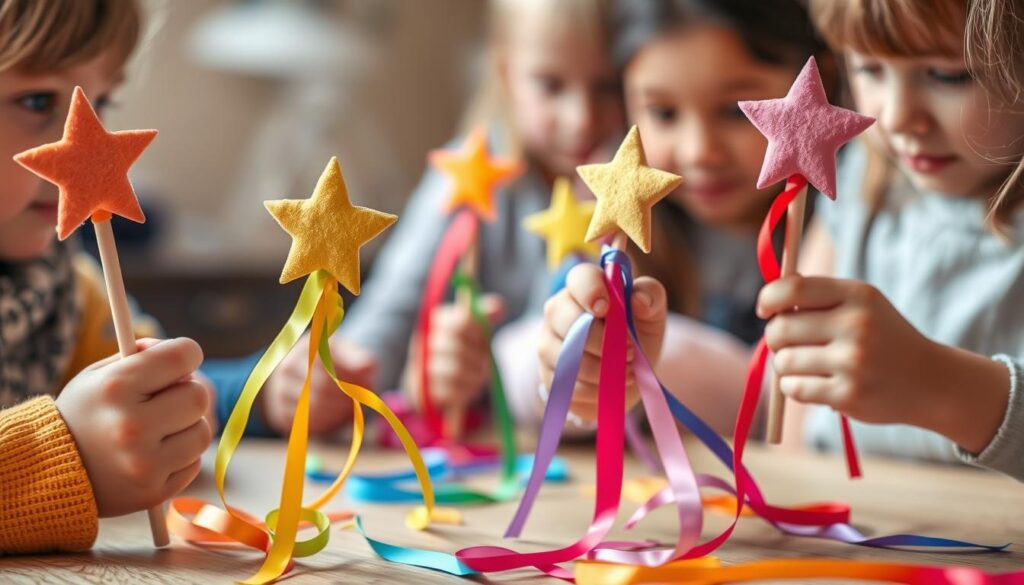
Ribbons add more than looks. They teach kids about movement. It’s a fun way to learn about science.
Choose 12-18 inch ribbons for the best flow. Satin ribbons look elegant, while curled ones add texture. Make sure they’re tied well to avoid mess.
Dowel Safety: The Non-Negotiable Foundation
Dowels need to be smooth and safe. Sand them well and keep them short. Kids’ arms are the best guide for length.
The dowel should fit small hands well. ¼ inch is good, but ⅜ inch is better for stability. Use natural wood for safety and beauty.
This kids wand craft makes wands safe and fun. It’s all about creating magic without danger. Let’s keep playtime safe and exciting.
Belts, Pouches, Amulets: Velcro closures, no‑choke designs
Crowns and wands get all the attention, but the real stars are the accessories that stay put. These pieces are key during sword fights and royal walks. They add to the look without risking safety.
Velcro closures
Velcro is a game-changer for costume accessories. It’s easy for little hands to use but strong enough for big adventures. Unlike buckles, Velcro lets kids dress themselves, making it a hit with kids.
Velcro’s charm is in its simplicity. For felt jewelry and more, it offers secure fastening without the hassle. It’s a lifesaver for kids who want to dress themselves.
Amulets should swing freely, not choke. Breakaway cords are essential for safety. They offer the look of permanence without the danger.
For belts and sashes, elastic or tie closures are better than buckles. They prevent accidents and keep the playtime magical. The goal is to keep the story alive, not the costume.
| Feature | Safe Option | Risk Factor | DIY Alternative |
|---|---|---|---|
| Necklace closures | Breakaway clasps | High choking risk | Elastic cord with felt stoppers |
| Belt fasteners | Velcro strips | Moderate entrapment risk | Fabric ties with no metal |
| Pouch closures | Magnetic snaps | Low swallowing risk | Felt flaps with button alternatives |
| Amulet designs | Lightweight materials | Heavy object risk | Felt layers with glitter paper |
The beauty of felt jewelry is its safety without sacrificing style. It’s made to be light and secure, letting kids dive into their roles. It’s like having a safe space in the world of fantasy.
Think of Sofia’s amulet from Disney. The real version is safe and looks great. You can make something similar with felt, glitter, and careful design. It’s all about looking regal but being safe.
Sensory‑Friendly Textures: soft vs sparkly, sound considerations
The debate over costume textures is more than just looks. It shows what a child likes and what they need. It’s about how textures affect their brain during play.
Soft Versus Sparkly
Texture choices are like magic for kids. Some love the softness of fleece and felt. These textures are like security blankets that make them feel safe.
Others seek out sparkly things. They love the mix of sight and touch that non-toxic glitter and sequins offer. The goal is to find non-toxic glitter that’s safe and fun.
Mixing soft and sparkly textures is the key. A felt crown with a bit of sparkle can please everyone. It’s about giving kids a variety of experiences.
Sound Considerations
Sounds in costumes are important too. Do they want the amulet to jingle? Should the wand make a sound? These are big questions for making costumes accessible.
Some kids need sounds to know they’re doing magic. Others might find certain sounds too much. The answer is to offer choices: bells that can be taken off, silent decorations, or sounds they can turn on and off.
Watching how kids react to sounds helps us understand them better. We want to spark their imagination, not overwhelm them.
Personalization Ideas: initials, emblems, color coding
In a world full of mass-produced tiaras, personalization is more than just decoration. It’s what turns a character into a legend. Adding initials to a pouch can change a child from a generic hero to a legendary champion.
This isn’t just about looks; it’s about creating a family crest or clan symbol. We’re not just adding accessories; we’re building stories with craft supplies.
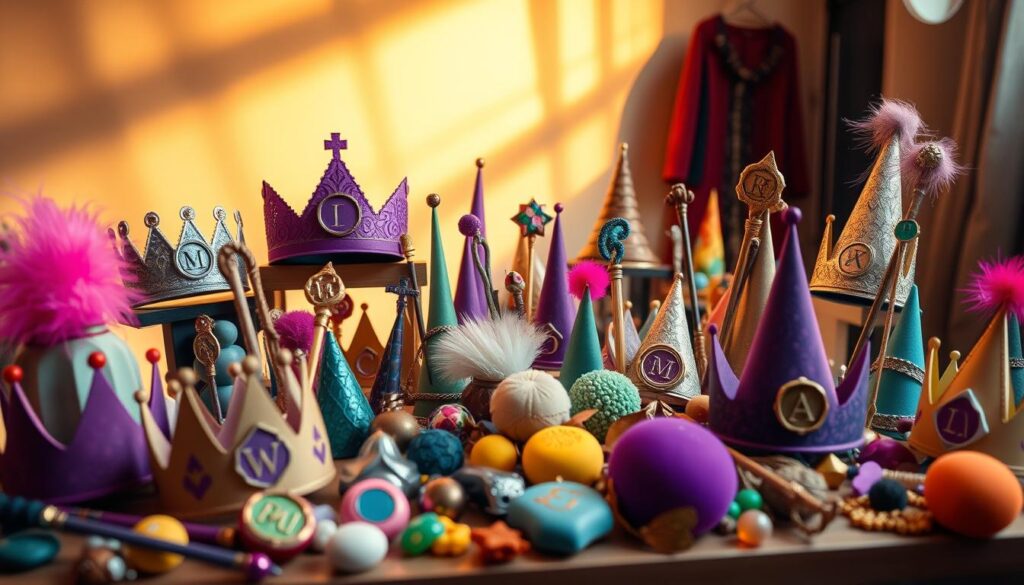
Initials are great for pouches, belts, and shield backs. You can use fabric markers or iron-on patches for quick changes. Kids often create backstories about their “royal lineage” from just one letter.
Emblems add more to the story. A dragon for fire mages, a leaf for forest guardians. These symbols tell a lot about a character’s traits. You can draw them with fabric paint or make appliqué designs.
Color coding might seem simple, but it’s powerful. Kids assign colors to elements: blue for water mages, green for earth witches. It’s like mixing Pantone with Dungeons & Dragons at the craft table.
| Personalization Method | Best Applications | Character Development | Difficulty Level |
|---|---|---|---|
| Initials | Pouches, belts, shield backs | Family lineage, royal status | Easy |
| Emblems | Capes, shields, circlets | Clan affiliation, magical specialty | Medium |
| Color Coding | Entire costume sets | Elemental alignment, team roles | Easy |
Online, we see this in action. Specific colors for characters, personalized elements in DIY crafts. Kids aren’t just dressing up; they’re building identities with these details.
Why is this important? It’s because heroes should have unique, powerful artifacts. The only thing that should be generic is the evil they face.
Math & Maker Moments: measuring heads, symmetry, counting beads
Fantasy accessories can sneak in math lessons. Kids might not know they’re learning fractions while making ribbon wands. It’s all about making learning fun.
Measuring heads for crowns is like doing geometry. Kids think they’re just making sure the crown fits right. They use a ruler without even realizing it.
When kids make symmetrical designs on amulets, they’re doing math. They balance patterns without even knowing it. This helps them understand spatial relationships.
Counting beads for wand decorations teaches arithmetic. Numbers are important for making the wand sparkly. Division becomes clear when splitting ribbon streamers.
Here’s how these DIY projects secretly teach mathematical concepts:
| Accessory | Math Concept | Learning Moment | Skill Level |
|---|---|---|---|
| Crowns & Circlets | Measurement & Geometry | Head circumference calculation | Beginner to Advanced |
| Amulets & Medallions | Symmetry & Patterns | Balanced design creation | Intermediate |
| Ribbon Wands | Counting & Division | Bead counting & ribbon splitting | Beginner |
| All Accessories | Spatial Reasoning | 3D construction understanding | All Levels |
Learning happens accidentally. Kids focus on making perfect ribbon wands, not solving math problems. They learn geometry, arithmetic, and spatial awareness through making.
Math becomes real when it’s part of creative projects. Fractions and measurements are meaningful when making something real. Magic should be the only abstract thing in playtime.
Next time you see a child making ribbon wands, watch. You’re seeing math education in disguise as play.
Care & Storage: accessory trays, travel tubes
The real test of any play system is how easy it is to clean up. Let’s face it, nothing ruins the magic like tripping over a toy sword in the kitchen.
Accessory trays with compartments turn into special places for toys. Each part is like a home for crowns, wands, or gemstones. This teaches kids to respect their toys and helps keep things tidy.
Travel tubes are great for taking toys on the go. They protect wands, magic staffs, and delicate crowns. The best part is they keep things safe and easy to find.
Here are some storage solutions that make cleaning up fun:
| Storage Type | Best For | Key Advantages | Considerations |
|---|---|---|---|
| Compartment Trays | Home storage, multiple accessories | Visual organization, easy access | Requires shelf space |
| Travel Tubes | Single items, on-the-go play | Maximum protection, portability | Limited capacity per tube |
| Wall-mounted Racks | Belts, pouches, larger items | Space-saving, display quality | Installation required |
| Drawer Dividers | Small pieces, beads, gems | Customizable spaces, hidden storage | Less visually engaging for kids |
Organizing toys isn’t just about the containers. It’s about creating systems kids can manage. Use colors for different characters and have special spots for favorite items. Even simple actions like “crowning the king” can be part of the fun.
Using clear plastic organizers is a great idea. They let kids see their toys while keeping them organized and safe.
This approach teaches kids more than just organization. It teaches them value. When they store their handmade crown, they’re not just putting away a toy. They’re caring for a character and getting ready for the next adventure. The only thing that should be chaotic is the story, not the storage.
Good care and storage solutions make toys last longer and add to the magic. Even legendary swords like Excalibur need a good home when not in use.
Party Station Setup: group crafting with cleanup plan
The real challenge of crafting isn’t the final product. It’s keeping your sanity during the process. Setting up proper stations turns chaos into fun and productivity. It’s like herding cats, but with more sparkle and success.
Having separate crafting zones keeps things flowing smoothly. A Superhero/Princess Workshop station needs its own space from the Wizarding World area. This keeps the mess contained and prevents a glitter disaster.
A good cleanup plan shows you’re a pro. Use protective coverings on tables to avoid permanent stains. Butcher paper or plastic tablecloths catch spills, letting creativity soar.
Comfortable seating is key. It lets kids reach their projects easily, avoiding frustration. This keeps their creative flow going strong.
Group crafting stations foster teamwork and imagination. The cleanup plan ensures only memories remain, not stains on your floors.