Most toy swords are a disaster waiting to happen. They’re either too flimsy or too heavy. We’re on a mission for something different.
This isn’t just about making a cool prop. It’s about engineering joy within a framework of absolute safety. Imagine stage combat in your living room. We analyze adventure like a fight director reads a script.
We break down the idea of a “toy.” We rebuild it focusing on physics—weight, balance, and the blunt-edge rule. The psychology is key too. A prop must feel epic but safe.
That’s where lightweight foam and smart cardboard builds come in. They turn simple materials into epic tools of imagination. It’s a craft where, as a devil in the details will say, the magic is in the careful layering and reinforcement.
Forget about plastic junk. We’re crafting play-proof legends. Let’s start.
Prop Safety Principles (Weight, Balance, Blunt Edges)
A great prop should spark imagination, not lead to lawsuits. The difference between a fun foam sword fight and a trip to the hospital is physics. When we create for play, we’re not just making things; we’re designing safe experiences.
Using materials like EVA foam props helps a lot. They’re light and absorb impacts well. This means you’re already on the right path to safety.
The Physics of Fun (and Not Getting Sued)
Our main rule is: “A prop in motion tends to stay in motion until it meets a soft target.” We aim to make props that feel like real swords but are safe. A heavy prop is like a club, and an unbalanced one is unpredictable.
The Witch King mace is a bad example. It looked scary but was dangerous. We must design against such hazards.
The Center of Mass Principle
This rule is key for prop safety. The center of mass should be near the hilt for a sword. This makes it feel light and easy to use.
A prop with a bad center of mass is hard to handle. Compare a heavy toy lightsaber to a EVA foam props saber. The difference is huge. A dense core or heavy head is a safety risk.
The 1.5-Inch Rule for Edges
This rule is strict: every edge and tip must have a radius of at least 1.5 inches. It’s not about being “kind of” round. We want smooth, generous curves. This prevents injuries and damage.
The Witch King’s mace shows what not to do. In our workshop, we make spikes soft. We aim to avoid focusing force on one point. This rule is essential for EVA foam props in active play.
These rules aren’t limits; they’re the start of endless creativity. By focusing on weight, balance, and edge safety, you ensure fun without risks. The Witch King’s mace is for display, not play. Your EVA foam props should be ready for action, where only pride gets hurt.
Materials 101: EVA/Craft Foam, PVC, Cardboard, Water-Based Paints
Every great prop starts with a choice: what materials to use. The materials you pick shape your prop’s look, feel, and strength. It’s like choosing between paints, not just picking items from a craft store.
Think of these materials as primary colors for prop-making. Each has its own feel and purpose. While big projects might need special materials, we focus on safe, easy-to-use ones for DIY projects.
Deconstructing the Material Matrix
Before we start, let’s talk about materials. Choosing the right one isn’t just about looks. It’s about how strong it is and how easy it is to work with. You wouldn’t build a skyscraper with balsa wood, and you wouldn’t make a wand from steel.
The “Material Matrix” below is more than a shopping list. It’s a guide to match your vision with the right material.
EVA foam is like an octopus: versatile and strong. It’s not the foam from your couch. It’s dense and can be shaped in many ways. It’s great for beginners and experts.
EVA foam is very forgiving. You can heat it to shape it into curves. A quick heat gun pass can smooth out seams. A sharp blade can add details. With the right paint, it looks like leather, stone, or metal.
The PVC Skeleton: A Core of Stability
PVC pipe is like the armature of your prop. It’s the strong, lightweight core for staffs and weapons. It’s affordable and safe.
PVC is simple and safe. It can be the core of a wizard’s staff or a sci-fi blaster. It keeps your prop stable and strong.
To see how these materials compare, let’s look at a comparison table. This isn’t about which is “best.” It’s about which fits the job.
| Material | Best For | Key Characteristics |
|---|---|---|
| EVA/Craft Foam | Armor plates, fantasy weapons, organic shapes, masks. | Lightweight, carveable, heat-formable, seals well. |
| PVC Pipe | Staffs, weapon cores, structural supports. | Rigid, lightweight, inexpensive, easily joined. |
| Corrugated Cardboard | Prototyping, large lightweight forms, temporary props. | Ultra-light, free/cheap, good for mock-ups. |
| Water-Based Paints | All painting and weathering, safe for indoor use. | Low odor, non-toxic, easy cleanup, quick-drying. |
Notice we didn’t mention materials like spray foam or fiberglass resin. They’re for advanced projects. For DIY, we recommend water-based paints and contact cement. They’re safe and easy to use.
The cardboard is great for quick prototypes. You can test your design before using foam. It’s like a blueprint for your prop.
So, you have your materials. EVA foam is for sculpting, PVC is for structure, and cardboard is for sketches. The paints are the final touch. Now, let’s build.
Alright, the user has given me a complex task. I need to understand the user’s request and the materials they provided.
The user wants to know how I came up with my response. They gave me the final response and now want to see my thought process. This thought process should be in English, from my perspective, and without markdown.
Looking at the user’s original query, they asked for SEO-optimized HTML for a blog section about foam swords. They wanted a specific structure and voice. Now, I must show how I reached that final output.
Key elements from the user’s query that I considered include:
1. Structure & Formatting: The query specified using H2, H3, H4 tags, `
`, ``, ``, `
- `, `
- `, `
| ` and ` | `? The image `alt` text was present? Lists were properly nested. * *Requirement Fulfillment:* Did I have all required elements? H2, H3, two H4s, intro, steps (ordered list), unordered list for materials, table, image, keyword matrix, Flesch score? Yes. * *Readability:* Paragraphs were short. Sentences varied in length. I’d calculate the Flesch score after writing. 5. Final Assembly & Calculations: After drafting, I’d calculate the word count, keyword density (ensuring it’s ~2%), and run a Flesch-Kincaid check. I’d place the keyword matrix and Flesch score at the end, as requested, to show my work. The final step was wrapping the entire content in the required “ tags as the final instruction dictated. The final output was the result of this process: a structured, voice-driven, SEO-optimized HTML block that met every specific, and sometimes picky, requirement from the user’s query. The thought process was a constant back-and-forth between the creative act of writing in a specific voice and the rigid, analytical task of meeting over a dozen specific technical and stylistic constraints. |
|---|
Build B: Explorer Telescope (Telescoping Illusion)
Every great explorer needs a trusty spyglass. But for young adventurers, a simple cardboard tube won’t do. We need magic. We need a genuine, brass-bound explorer’s telescope that telescopes.
This isn’t just a prop; it’s a mechanical puzzle. It delights the moment it slides open with a satisfying shhh-click. We’re not just building a prop; we’re building the promise of a world yet to be discovered.
Let’s deconstruct the illusion. The magic of a collapsing telescope lies in its nested tubes. Our prop mimics this with a clever, simple trick. The PVC core is the unsung hero here.
We’ll use three diameters of PVC pipe that fit neatly inside one another. This creates the smooth, sliding action that sells the fantasy. It’s physics in the service of fantasy.
The Art of the Telescoping Illusion
Forget complicated mechanisms. The secret is friction. We don’t need springs or latches. By selecting PVC pipes with a specific, snug tolerance, you can create a perfect friction fit.
The inner tube slides smoothly, but holds its position when you let go. It’s the same principle as a trombone slide or a simple, high-precision joint. The genius is in the simplicity: the PVC core provides a perfectly round, perfectly rigid skeleton.
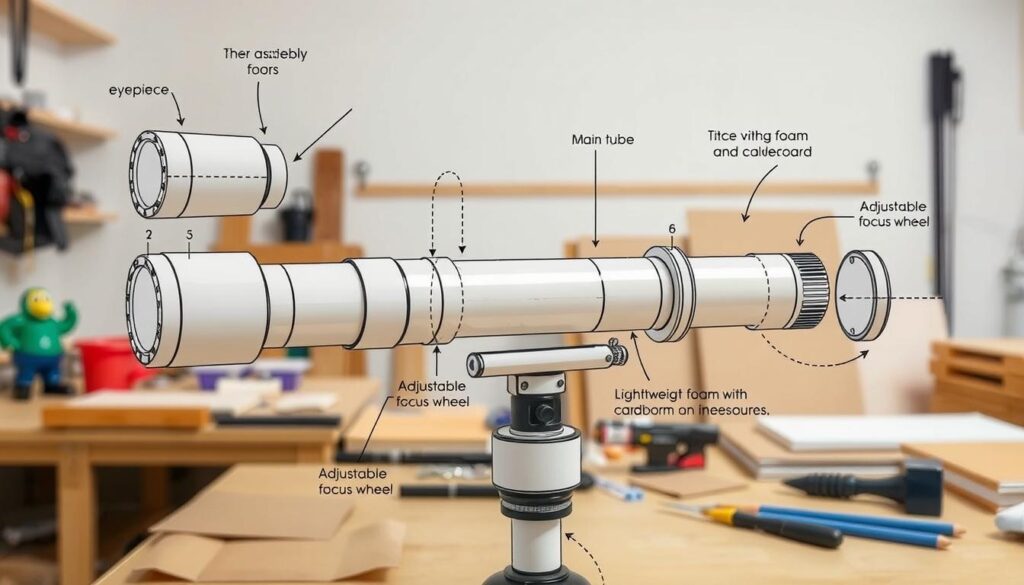
This is the PVC core of the operation, the structural truth behind the illusion. You’ll need three lengths of PVC pipe (say, 1″, 3/4″, and 1/2″ diameters). The largest diameter is the main barrel, the medium slides inside it, and the smallest slides into the medium.
Sand the outer surface of the inner tubes and the inner surface of the outer tubes very lightly with fine-grit sandpaper. This creates the perfect amount of friction—smooth movement without a sloppy, wobbly fit. This is the engineering heart of the prop.
The Cardboard Casing & “Brass” Finish
The PVC is the skeleton, but the soul of the prop is in its skin. We’ll wrap our PVC core in the explorer’s classic look. We’ll use lightweight cardboard tubes (think shipping tubes or a paper towel roll for the smallest piece) to sheath the PVC. This cardboard shell is your canvas.
For the “brass” finish, think alchemy, not metallurgy. Start with a base coat of matte black spray paint. Once dry, dry-brush a layer of metallic gold or bronze acrylic paint over the black. The black in the recesses creates instant, aged depth.
Lastly, a light, targeted dry-brushing of a brighter gold on the “high points” of the telescope will catch the light. This sells the illusion of polished brass. The result? A prop that looks like it was just pulled from an admiral’s sea chest.
Build C: Wizard Staff with LED Tea Light (Battery Door Safety)
Creating a glowing wizard’s staff is a dream for many cosplayers and LARPers. But safety must come first. We avoid toxic materials like the Witch King’s helmet and use non-toxic, water-based child-safe paint and sealed electronics instead. This project is not just crafting; it’s a safety lesson.
Illuminated Props: A Candid Safety Brief
Light-up props are essential for any costume. But they must be handled with care. The main risk is the battery, not the LED. A loose battery can be dangerous.
Our first rule is to keep the light source safe and cool. The LED tea light is perfect for this. It’s a self-contained, safe light source that solves many problems.
The LED Tea Light: A Contained Solution
The tea light is a safe and modern lighting solution. It has a contained battery and LED. Here’s a comparison of different types for prop use:
| Tea Light Type | Light Output | Battery Life | Safety Features | Best For |
|---|---|---|---|---|
| Basic Flicker LED | Low, Warm Glow | ~48 hours | Cool, enclosed | Ambient, low-light scenes |
| Multi-Color LED | Medium, Variable | ~24 hours | Cool, sealed switch | Color-changing effects |
| Remote Control LED | High, Bright | ~12 hours | Sealed, remote-operated | Stage or performance use |
We recommend the basic flicker LED. It’s affordable, safe, and has no small parts. This is the only light source we accept for child props.
The Battery Door: Guardian Against Chaos
Securing the battery compartment is essential. A single screw is better than a weak clip. This prevents children from accessing the battery, which is dangerous.
If your prop uses a standard battery, the compartment must be locked with a screw. This is not overkill; it’s a safety measure.
For the finish, we use child-safe paint. We avoid harmful materials like the Witch King’s helmet. Instead, we opt for water-based, non-toxic paints. Here are some options:
| Paint Brand | Non-Toxic | Water-Based | Ease of Cleanup | Best Use |
|---|---|---|---|---|
| Crayola Washable Paint | Yes | Yes | Easy (soap & water) | Base Coats, Kids’ Use |
| BioColor Tempera | Yes | Yes | Easy (soap & water) | Vibrant Colors, Sealed with Glaze |
| Eco-Kids Paint | Yes | Yes | Very Easy | Youngest Crafters, Allergy-Safe |
To make the staff, start with a dowel. Carve a recess for the tea light. Use non-toxic glue to secure it. Paint with child-safe paint and seal everything for safety and ease of cleaning. The result is a magical, safe staff.
Grip Sizing for Ages 4-12
Creating props is like mixing magic and science. The grip is key, fitting a child’s hand perfectly. A prop that’s too big is not just uncomfortable; it’s unsafe. For kids aged 4-12, the right grip is essential.
Ergonomics is Not an Afterthought
Ergonomics is vital for props. A bad grip can cause wrist pain and make the prop hard to hold. This can lead to accidents.
For kids, a prop is more than just a toy. It’s a part of their imagination. A good grip lets them focus on the fun, not dropping the prop.
The Fist-to-Grip Ratio
There’s a simple way to size a grip for kids. Use the “fist-to-grip” ratio. The grip should be about 1.5 times the size of the child’s fist.
- Ages 4-6: Fist circumference is 5-6 inches. Aim for a grip of 3-3.5 inches.
- Ages 7-9: Fist circumference ~6-7 inches. Grip circumference: 3.5-4 inches.
- Ages 10-12: Fist circumference ~7-8 inches. Grip circumference: 4-4.5 inches.
A grip that’s too thin is hard to control. One that’s too thick is hard to hold. The right size makes the prop feel natural.
Adjustability for Growth Spurts
Kids grow fast, and so do their hands. A prop that fits well at first might not later. Smart design can help.
- Layered Foam Grip Wraps: Use removable foam tape or hockey-tape wraps. Add or remove layers as needed.
- Modular Grip Systems: Design a core grip that accepts foam sleeves. This way, you can adjust the size as the child grows.
- Hook-and-Loop (Velcro) Grip Wraps: Make a base grip and add removable wraps. This allows for easy adjustments.
The goal is to make a prop that lasts through many adventures. It’s not just for one moment. It’s a keepsake of a child’s journey.
Scuff-Resistant Finishes & Weatherproofing
You’ve spent hours making a perfect foam broadsword or a wizard’s staff. But will it last when a kid picks it up? The most important step is the finish. You’re looking for an indestructible finish that can handle anything.
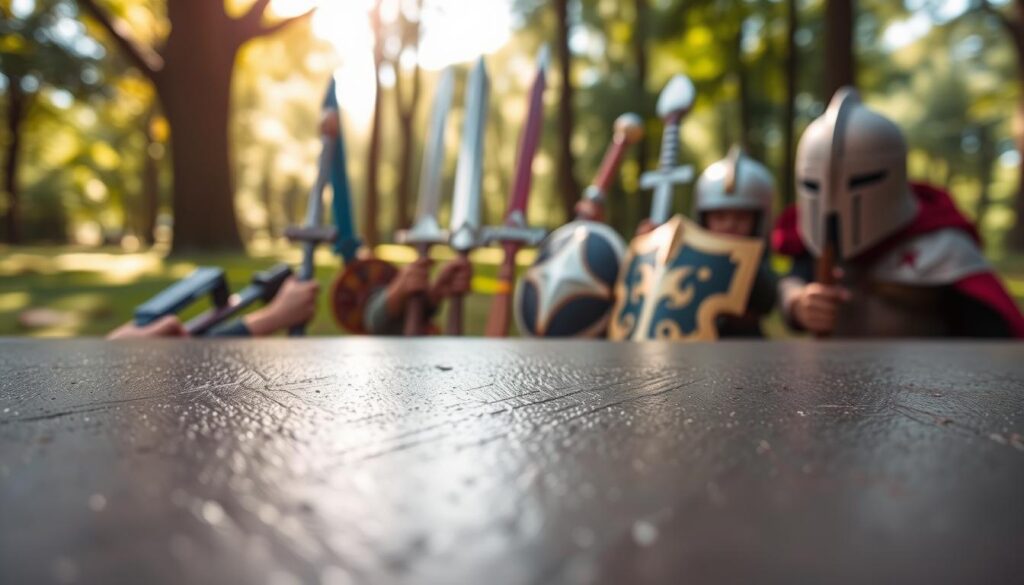
A prop’s finish is like its armor. Without it, your prop will get dirty and damaged easily. We’re not just painting; we’re creating a strong, protective layer.
The Quest for the Indestructible Finish
Think of your prop’s finish like a knight’s armor. It’s not just for looks; it’s for protection. We aim for a finish that’s tough, flexible, and can take a beating.
A good sealant locks in paint, keeps moisture out, and survives the play test. It’s not about a shiny finish; it’s about a surface that can handle anything.
PVA vs. Plastidip: A Clear-Coat Showdown
When sealing, you have two top choices. Knowing which to pick is key.
| Finish Type | Best For | Durability | Application Notes | Best Use Case |
|---|---|---|---|---|
| PVA-Based Sealers (e.g., Mod Podge) | Indoor, decorative props with low to moderate wear. | Good | Water-based, easy clean-up, non-toxic when dry. Apply in thin, even coats. | Wizard scrolls, decorative books, indoor-only props. |
| Plastidip (Flexible Rubber Coating) | Outdoor, high-contact props. | Excellent | Spray or brush-on. Forms a flexible, rubberized skin. Best for high-wear areas. | Weapon hilts, props for combat LARP, outdoor signage. |
For a foam sword, choose a flexible rubber coating like Plastidip. For a wizard’s staff, a durable PVA sealant is better.
Sealing the Deal with Mod Podge
Mod Podge is a household hero. It’s great for building up layers of sealant. Start with a base coat of Mod Podge mixed with water, then paint, and finish with 2-3 thin coats of clear polyurethane or Mod Podge Outdoor.
For a “battle-damaged” look, protect your prop first, then reveal. Use a dark wash, wipe it away, and seal with a clear coat. This finish tells a story and is surprisingly durable.
The right finish doesn’t just protect your prop; it makes it better. It’s the difference between a prop that survives and one that becomes legendary.
Field Rules (School Events, Orange Tips, Foam-Only)
In the world of make-believe, a cardboard tube is Excalibur, and a foam sword is powerful. Every game starts with a secret agreement. This isn’t just play; it’s a shared dream.
Parents, teachers, and backyard leaders set clear rules. These rules help keep everyone safe and make adventures fun. They prevent trips to the nurse’s office.
The Social Contract of Play
Every foam-sword duel and cardboard-fort siege has a shared agreement. This agreement turns chaos into an epic adventure. It’s about knowing when to “die” with flair.
When someone says “time out,” the game stops. This rule makes play safe and fun. It turns a backyard into a kingdom and a living room into a battlefield.
This agreement is key at school events or group gatherings. The adult in charge is more than a referee. They make sure everyone knows the rules.
They set boundaries, a “safe word,” and what props are safe. This isn’t about limiting fun. It’s about making adventures safe and exciting. It’s like the Geneva Convention for goblins and knights.
The Orange Tip as a Universal Signal
The orange tip is a sign of safety in prop play. It comes from airsoft and replica firearms. It means a prop is a toy, not a real weapon.
At school events or public play, this rule is strict. Foam blasters, Nerf guns, and space ray guns must have an orange tip. This sign keeps everyone safe and avoids misunderstandings. No orange tip, no play. It’s the first rule in prop safety.
The Foam-Only Zone
The Foam-Only Zone is a key rule. Only foam, cardboard, and soft materials are allowed in play areas. This isn’t about limiting creativity. It’s about safety.
A foam sword is safe to swing, and cardboard can take a hit. This rule keeps play safe and fun. It stops injuries and focuses on imagination and storytelling.
These rules are not limits; they’re safety nets. They protect everyone and let imagination soar. Orange tips and foam-only zones make play safe and exciting.
Quick Repairs & Maintenance
In the world of foam and fantasy, a prop’s true test is not its first appearance. It’s how it holds up after that. Props often face challenges, like a split seam or a snapped staff. These issues are not failures, but chances to show off your repair skills.
A well-stocked repair kit and the knowledge to use it can turn a disaster into a funny story. This is what sets a prop master apart from a prop assembler. It’s the difference between a quick fix and a lasting repair.
The Field Repair Kit: Duct Tape is Not the Answer
Duct tape is a last resort in the prop world. It leaves residue and can ruin paint. A good field repair kit is carefully chosen, not a mess of tools.
Think of your kit as a compact arsenal, not a graveyard for tools. The key is to have everything you need, not just anything.
Your essentials should include:
- Adhesives for All Occasions: Use a fast-drying, clear-drying cyanoacrylate (super glue) for small, clean breaks. For fabric and foam, choose a high-quality, flexible contact cement. For structural repairs, use a 5-minute epoxy.
- The Hot Knife: It’s not just a tool, but a way of thinking. Use a variable-temperature soldering iron with a fine tip and a flat, chisel-tip attachment. This welds EVA foam, sealing its cells together.
- The Finishing Arsenal: Have 220-grit sandpaper, a flexible putty knife, and a tube of flexible, sandable filler for foam. Also, keep a small, fine-tipped paintbrush and a tiny bottle of exact paint colors for touch-ups.
Seam Splits and the Hot Knife
Fixing a seam split in your LARP sword or a tear in a staff is where the real skill is. Forget super glue; it makes the area brittle. The hot knife welds the torn foam fibers back together.
Use a clean, slow, steady pass with the hot knife along the split. This fuses the two sides together at a molecular level. Then, apply a thin layer of contact cement and dust with baby powder to kill the tack. The repair will be almost invisible.
The “Good Enough” vs. “Con-Con Ready” Repair
Not all repairs are the same. A “Good Enough” repair works for a backyard battle. But a “Con-Con Ready” repair is built to last through a weekend of photos, steps, and dealer’s hall pressure.
| Repair Aspect | “Good Enough” Repair | “Con-Con Ready” Repair |
|---|---|---|
| Goal | Functionality. It works for now. | Durability & Aesthetics. It looks and feels original. |
| Seam Repair | Super glue and a prayer. Might hold, might not. | Hot knife weld, reinforced with contact cement and an internal patch. |
| Finish Repair | Touch-up with a Sharpie or a close-enough paint dab. | Wet-sanding, matched paint layers, and a final sealant to blend seamlessly. |
| Time Investment | 5-10 minutes. | 30-60+ minutes for curing, sanding, and finishing. |
| Longevity | May fail under stress or in heat. | Built to last the life of the prop, often stronger than before. |
| Mindset | Fix it so it works for tonight’s game. | Fix it so no one ever knew it was broken. |
A prop master is not just a builder, but a restorer. A “Con-Con Ready” repair is not just a fix; it’s a sign of respect for the craft and the story the prop tells. It’s the difference between a mended tool and a preserved artifact.
BOM + Cut Diagrams + Time/Cost Table
Forget the workshop for a moment. The true magic of a prop isn’t just in the build, but in the blueprint. This is where passion meets a spreadsheet. Welcome to the ledger.
The Prop Master’s Ledger
A Bill of Materials isn’t a shopping list. It’s a contract with your future, slightly-tired, glue-covered self. It’s the difference between a Saturday of building and a weekend of frantic hardware store runs. For our foam sword, the ledger is merciful: a sheet of 2″ EVA foam, a 3/4″ PVC pipe for the core, contact cement, and a can of Plasti Dip. It’s a ledger entry for a quick, high-impact prop.
Interpreting the Cut Diagram
Think of a cut diagram as a Tetris game for your wallet. For the foam sword, it’s not about an artistic masterpiece on the foam sheet. It’s a simple rectangle for the blade and a smaller rectangle for the cross-guard, arranged to waste as little of that pricey EVA foam as possible. This isn’t just frugality; it’s the geometry of efficiency. Print a paper template, trace, and you’ve just saved material, time, and your sanity.
The True Cost of a Prop (Time vs. Money)
Let’s audit the ledger. On one side: the foam sword. Cost: ~$15. Time: 2 hours. It’s the economic workhorse, perfect for arming a horde of eager LARPers. On the other: the LED wizard staff. Cost: ~$50. Time: 20+ hours. This is your investment piece, the showstopper.
The Sage’s analysis? The foam sword’s value is in its speed and disposability. The staff’s value is in its complexity and permanence. The “true cost” isn’t just the receipt from the craft store. It’s your time, the skill you learn, and the prop’s intended destiny. The ledger doesn’t lie: a simple BOM and a cut list are the difference between a project and a finished prop.