Watch a child put on a plastic badge and suddenly, they’re not just in a costume. They’re doing real research.
When my nephew uses a toy stethoscope, he’s not just playing doctor. He’s studying the power in a clinic. He knows who’s in charge, the one with the thermometer.
Think about an astronaut. That helmet isn’t just for fun. It’s a way for kids to learn about science. A child in a cardboard rocket is learning about physics and the unknown.
And then there’s the historical figure. A child with a cotton ball beard is learning about stories and how the world works. They’re trying on different roles to understand life.
This is what science dress-up is all about. It’s not just about pretending. It’s a serious way for kids to learn about the world. Whether it’s a vet clinic or an eye exam, it’s their first try at understanding life.
How themed dress-up boosts curiosity
Curiosity didn’t just kill the cat; it dressed it up as Cleopatra and sent it to negotiate with Mark Antony. This isn’t just fantasy. It’s cognitive scaffolding. When a child puts on a history costume, they’re not just wearing a time machine. They’re firing up an empathy engine.
Imagine wearing a Roman tunic or a pioneer bonnet. Suddenly, you must wonder: What did this person feel? What problems did they solve? Taking on a role makes it easier to ask “why” and “how.” It’s not just playing dress-up. It’s field research.
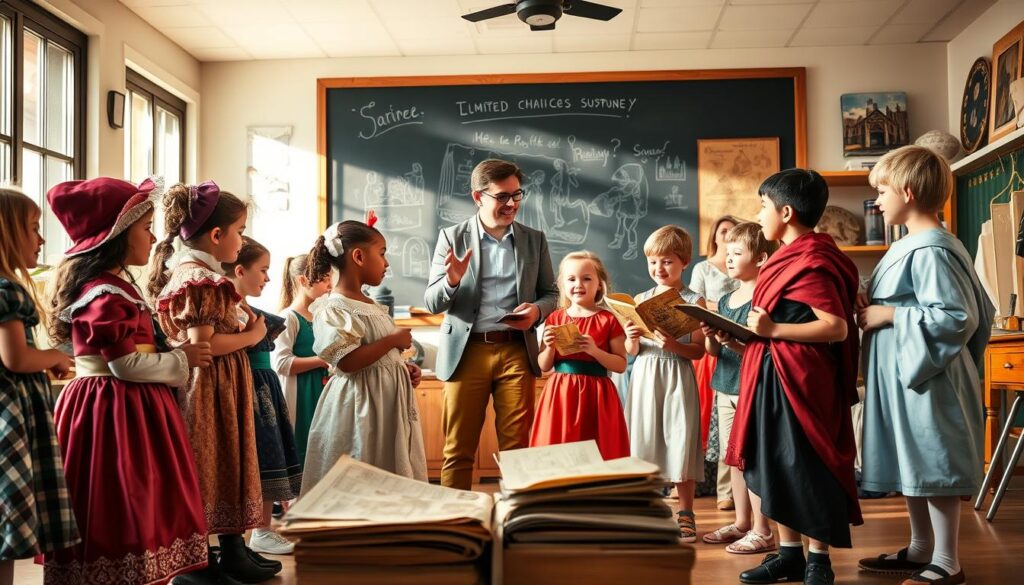
Consider a child playing a baker. They’re not just making mud pies. They’re learning about ratios, supply chains, and customer service. This is the power of dramatic play. Psychology Today says it helps kids practice social situations and deal with fears in a safe way. The costume is like a lab coat for the soul.
This matches with Waldorf education, which sees imaginative play as key to creative thinking. It builds empathy and helps process life events. By choosing a time period, a child isn’t just picking an outfit. They’re picking a worldview to explore.
So, themed dress-up is the original interdisciplinary study. It combines history, social science, and theater. Abstract concepts like trade and governance become real. Curiosity becomes the default, not an assignment. The right history costume isn’t a costume at all. It’s a question, waiting to be asked.
DIY costume instructions
Forget buying stuff at the craft store. The best tool for STEM play is in your recycling bin. A cardboard box can become a spaceship control panel with some tin foil.
A colander is perfect for a backyard geology lab. It’s a sifter. This shows that everyday items can be turned into learning tools.
Turning a side table into a taco stand teaches math and business. It’s more effective than any textbook. The goal is to encourage play, not to show off your crafting skills.
Your instructions should inspire creativity. The prop is just a starting point. The real magic is in the child’s imagination.
Creating character costumes doesn’t need a sewing machine. A simple cloak or hat can define a role. For ideas that focus on imagination, check out Heather Handmade’s DIY costume ideas. They show how to make costumes without sewing and with tools like a Cricut.
The simplest hack is often the best. It leaves room for curiosity. Making a costume from felt or an old shirt teaches resourcefulness and problem-solving. That’s the essence of STEM play.