Creating a detailed costume is like solving a complex problem, not just sewing. It involves engineering a character, making joints work, and even bringing a personality to life. It’s a family-style learning experience in foam, fabric, and physics.
We’ve made our advanced builds like a family classroom. Everyone learns the same basic idea, like a chest plate’s shape. But, beginners start with EVA foam basics, while experts explore advanced weathering techniques.
This method is key for complex costumes that need more than a pattern. How do you teach the exact wrist-pivot for a bracer or the layering of Worbla? A video shows the motion of crafting—the heat gun’s bend, the contact cement’s flex, and how light hits a paint wash.
Our video lessons break down complex costumes into skills. It’s like seeing a cathedral’s picture versus watching masons build it. You learn the why behind a pauldron’s curve, not just the how. You create a master class with your hands.
Filming Basics: Overhead Camera, Lighting, Close-Ups
Forget the red carpet. The most important action in a tutorial doesn’t happen in front of a green screen; it happens in the viewer’s hands. The difference between a frustrating, blurry mess and a masterclass in making is often just three feet of LED light and a 45-degree angle. Let’s deconstruct the “film school 101” of DIY video, where good lighting isn’t vanity—it’s visual pedagogy.
Our brains are wired for visual learning, but a poorly lit, shaky video is a cognitive roadblock. Think of it this way: if a viewer is squinting at a shadowy seam or a shaky hand-tool, you’ve lost them. The transition from, say, a festival’s main stage to a quiet workbench isn’t just a cute editing trick—it’s a visual metaphor for the learning journey. It says, “We’re moving from the spectacle to the craft.” This is where chapter markers become non-negotiable. They are the signposts on that journey, turning a monolithic video into a choose-your-own-adventure manual.
So, how do we build this invisible classroom? Three pillars hold it up:
- The Overhead God’s-Eye View: This is your primary teaching POV. A camera locked in a stable overhead rig is your audience’s eyes. It’s the ultimate “do as I do” perspective. Every cut, every measurement, every delicate heat-form of a foam piece must be seen clearly, without the camera operator’s shadow or a wobbly hand getting in the way. This shot is your foundation.
- Lighting as a Tool, Not an Effect: Harsh, single-source lighting creates deep, confusing shadows. The goal isn’t a dramatic film noir; it’s clarity. Soft, diffused light from multiple angles banishes shadows from the work area. Good lighting isn’t about looking cinematic; it’s about making the process the star. When a viewer can see the texture of a seam or the flex of a heat-formed piece, they can feel the process.
- The Close-Up is Your Close Friend: The wide shot shows the process; the close-up reveals the secret. A tight shot of a hand stitching a complex dart, or the precise application of a contact cement brush, teaches the technique, not just the step. This is where muscle memory is built visually.
This is where the “why” of chapter markers clicks. Imagine trying to find a single step in a 45-minute video. Now imagine clicking a menu and jumping instantly to “Attaching the Buckles” or “Heat-Forming the Chest Plate.” These logical breaks are the physical chapter markers for your learning. They turn a monolithic video into a reference library. You don’t re-read an entire book to find one paragraph; you shouldn’t have to scrub through an entire tutorial to find the 30 seconds you need.
So, what’s the workflow? The overhead cam captures the macro process. The close-up camera, often a secondary device, is dedicated to those micro-details. In post-production, you weave these angles together, but the magic is in the edit. You cut from the wide, establishing “here’s the problem” shot to the tight, intimate “here’s the solution” close-up. You then drop a chapter marker so the viewer can instantly replay that critical 30-second sequence. This is the rhythm that chapter markers create: a predictable, logical, and user-controlled learning tempo.
For a series like this—spanning armor, gowns, and creature hoods—clarity is your co-host. Clear, consistent visuals and a logical, navigable structure aren’t just production values; they are the foundation of trust. You’re not just showing a build; you’re architecting a learning experience. The camera isn’t just recording; it’s the most patient, precise instructor in the room.
Series Outline (5 Episodes): Your Epic Cosplay Build, Deconstructed
Think of this as a five-act fantasy epic for your living room. We’re not just making a costume; we’re building a world, one episode at a time. Forget dry, technical guides. This is a director’s cut, a showrunner’s pitch for the ultimate cosplay build series.
The goal? To build a complete, head-turning character from the ground up. Each episode is a self-contained project that builds toward a grand finale.
Why the serialized approach? Just like in series like Sadiq or Riley Reynolds, it builds skill and investment. You’re not just learning a technique; you’re following a character arc for your character.
The key to clarity? Our secret weapon: the overhead camera. This bird’s-eye view shows you the full layout of a pattern, the precise alignment of a seam, or the exact placement of a grommet. No more guessing from a wonky side-angle.
Here is the five-episode season outline for our cosplay saga:
- Episode 1: The Foundation – EVA Foam Armor
We begin with the core defense. This episode is all about transforming flat EVA foam sheets into rigid, wearable armor. We’ll cover heat-forming for curvature, beveling edges for a forged-metal look, and the art of weathering for battle-worn authenticity. The overhead camera is key, showing the exact placement of armor plates and the clean lines of your cuts before a single piece of contact cement is applied. - Episode 2: The Silhouette – Lined Twirl Dress
The regal centerpiece. This episode focuses on garment construction, from cutting fabric with a perfect drape to installing a clean, invisible zipper. We’ll tackle lining, which is the secret to a professional, non-itchy finish that looks as good on the inside as it does on the outside. - Episode 3: The Creature Hood
This is where the character truly comes to life. We’ll sculpt the creature’s personality through its headpiece. We’ll cover patterning darts for a 3D fit, constructing sturdy yet lightweight ears and horns, and techniques for attaching them securely so they survive a long con day. - Episode 4: The Articulated Wings
The showstopper. We’re building poseable, wearable wings. This is an engineering episode: creating a wire armature for structure, sewing channels for poseable wire frames, and covering it all with a taught, durable fabric skin. Safety is key, so we’ll build in secure channels and soft covers for the wire ends. - Episode 5: The Prop Staff
Every hero needs a signature prop. We’ll construct a lightweight, con-safe staff from PVC and high-density foam, using heat to shape it. The finale is all about painting and finishing, using non-toxic sealants and paints to create a staff that looks like ancient, magical wood or cold, enchanted metal.
This isn’t just a to-do list. It’s a production schedule. Each build is designed to be a self-contained project, yet they are all pieces of a grander vision. By the final episode, you won’t just have a costume; you’ll have a character, a story, and the filmmaking techniques to document your own creative journey from a bird’s-eye view.
Episode 1: EVA Foam Armor and the Alchemy of Heat
Forget the anvil and the forge. The first step in making a great costume isn’t about welding steel. It’s about working with EVA foam, using heat and pressure to transform it. This process turns a simple mat into a hero’s armor.
This isn’t a simple craft project. It’s a serious process. Our tutorial makes a key point: using a heat gun is not for kids. The captions in our video are clear and urgent, reminding everyone to stay safe.
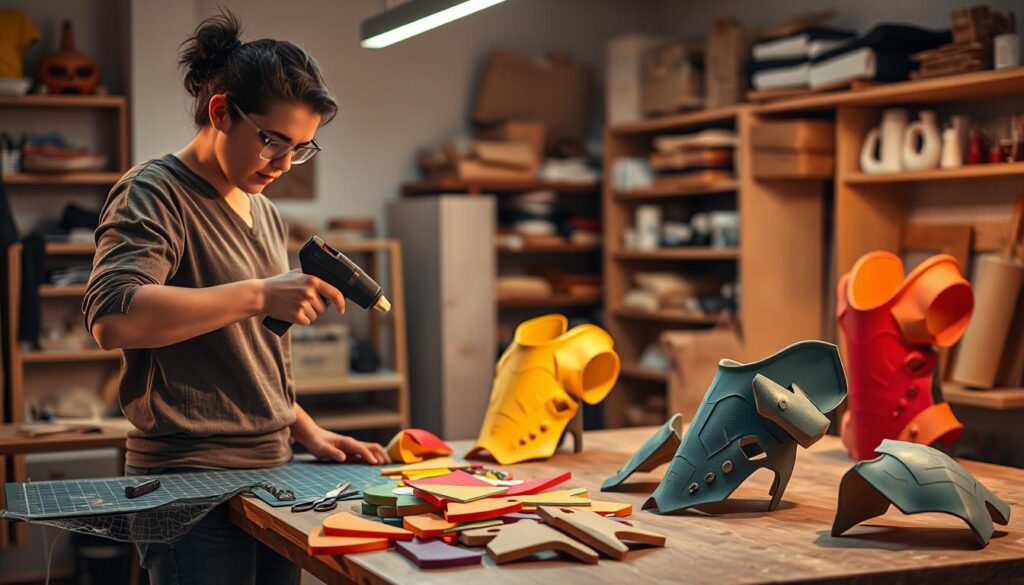
When heat is applied, the foam becomes soft and ready to shape. But our captions are more than just directions. They’re warnings, like “ADULT SUPERVISION REQUIRED: High-Temp Tool.” These captions are essential for safety.
Our advice comes from experience. We show you how to avoid mistakes, like bending the foam too much. Our captions and on-screen text guide you through each step, ensuring safety and accuracy.
This method makes our tutorial safe for families. Kids can watch and learn, while adults handle the heat. Together, they can work on the final touches, like painting and assembly.
We teach more than just making armor. We teach about understanding materials and their limits. We make sure everyone knows their role and the safety rules. The final product is not just armor, but a symbol of teamwork and safety.
Episode 2: Lined Twirl Dress with Invisible Zipper
Episode 1 was all about power armor, with its heat guns and rigid forms. Episode 2 is like its elegant, twirly cousin. We’re switching from foam to fabric and heat guns to invisible zippers. This is more than sewing; it’s a lesson in precision.
It’s all about teamwork. We’re using a “family-style learning” approach. Everyone works together, each bringing their own skill. One person handles the bodice darts, another the skirt, and a third the invisible zipper.
The invisible zipper is key in complex costumes. It makes the difference between a homemade look and a couture one. We’ll learn how to install it so it blends into the seam.
Building the skirt and bodice is like engineering. Every detail, from French seams to graded allowances, makes the dress special. It’s not just a simple dress; it’s a complex costume for the stage or screen.
So, get ready to clear your dining room table. We’re moving from warrior’s workshop to designer’s studio. The most important tool now is a perfectly placed, invisible zipper.
Episode 3: Deconstructing the Creature Hood (Darts, Ears, and Horns)
The real magic of a great monster design is in the anatomy of the build. We’re not just making a hood; we’re engineering a creature. To master this, you need control. That’s where our first, most critical tool comes in: chapter markers.
This tutorial is like a choose-your-own-adventure book. Chapter markers are your guide. Stuck on the darts? Jump to the dart chapter. Need to see how the horns are sculpted? Skip to that chapter marker. It’s an interactive workshop manual for your fandom.
Before you start, you need a blueprint. This isn’t just about sewing; it’s about turning a 2D pattern into a 3D, living form. The key is understanding the darts and gussets that give your creature its shape and character.
Anatomy of a Monster: A Materials & Method Breakdown
Building a creature is a surgical, step-by-step process. The table below breaks down the transformation from flat fabric to a fully-realized creature head. It shows you exactly where to use those chapter markers to jump to the technique you need.
| Build Phase | Key Action | Key Challenge | Why Chapter Markers Shine Here |
|---|---|---|---|
| 1. Pattern & Darts | Marking and sewing the darts that create the 3D form of the snout and brow. | Getting the darts perfectly aligned for symmetrical shaping. | Jump directly to the 5-minute segment on “Dart Placement for Snout Contouring.” |
| 2. Ear Sculpting | Attaching and shaping the EVA foam or fur for pointed, tattered, or multi-lobed ears. | Creating a sturdy, poseable ear structure that won’t flop. | Skip the fabric prep and jump to “Ear Armature & Foam Carving.” |
| 3. Horn & Ridge Construction | Building armatures for horns, spikes, or cranial ridges from wire and foam. | Creating a lightweight, durable, and safe (no sharp points!) structure. | Use the marker for “Horn Sculpting & Sealing” to bypass the fur-sewing if you’re just replacing a broken horn. |
| 4. Finishing: Fur & Features | Applying fur, hand-stitching details, and adding final paint washes. | Blending seams and making the fur or scales look organic. | Skip to “Painting & Weathering” for just the aging and dry-brushing techniques. |
Notice a pattern? Each major technique is its own, self-contained chapter. This structure respects your time and intelligence. You don’t need to watch 20 minutes of ear-sewing if you’re a pro at that and just need the horn tutorial. This is the “Capstone” approach: modular, efficient, and respectful of a maker’s time and skill level.
From Flat Fabric to Fearsome Form
The magic of a great creature hood lies in its foundation. Darts are the unsung heroes here. A poorly placed dart can give your creature a lazy eye or a lopsided sneer (unless that’s the goal, you brilliant creature designer, you). We treat each dart as a contour line on a topographical map, building the terrain of the creature’s face. The chapter markers let you isolate this precise, technical step.
Then come the ears and horns. Are they bat-like and leathery? Elf-like and pointed? The tutorial doesn’t just show you one way. We analyze the anatomy: the wire armature for structure, the foam carving for shape, and the texturing for that final, organic feel. The chapter markers let you jump straight to “Sculpting Horns from EVA Foam” if that’s your only hurdle.
In the end, you’re not following a recipe. You’re conducting an anatomical study. Each chapter marker in the video is a scalpel, allowing you to dissect the build and master the creature, one precise, well-defined piece at a time.
Episode 4: Poseable Wings (Wire Channels + Safety Covers)
Think of poseable wings like a festival’s stage transitions. Each movement tells a new story, changing the scene without changing the set. Unlike fixed costumes, these wings are all about movement.
The magic is in the physics. Wire channels in the fabric act like tendons, allowing for movement. The challenge is making it safe for everyone.
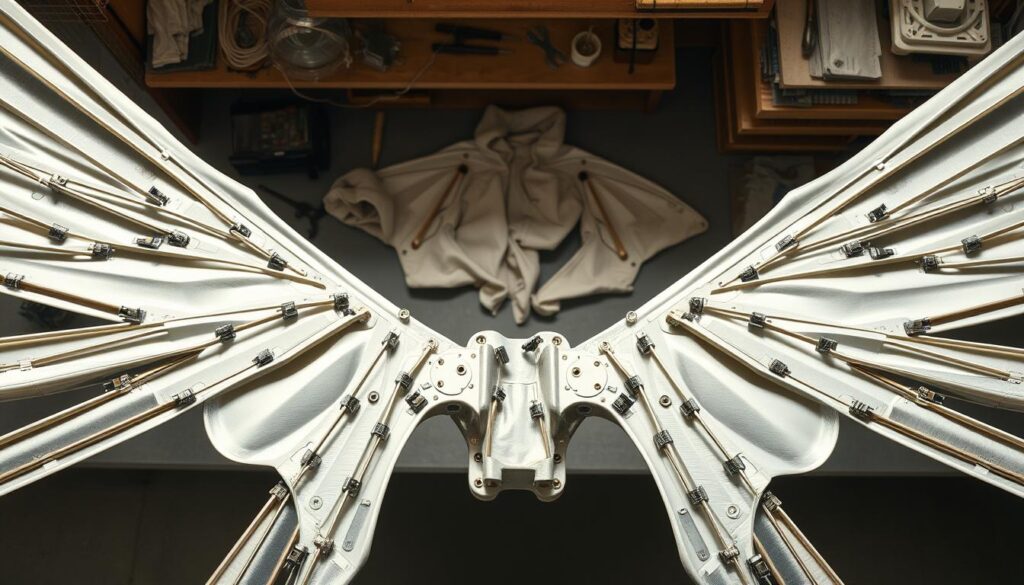
The overhead camera is key here. Explaining wire threading from the side is like describing a maze from outside. But the top-down view clears up all confusion.
The overhead camera shows the wire path clearly. It maps out where the wire goes, where to anchor it, and how to cap the ends. Safety covers are vital to avoid accidents.
Let’s break down the build:
- The Armature: We use flexible yet firm aluminum wire. It holds poses but won’t snap back. The wire’s diameter is critical—it must be just right.
- Channel Construction: The channel is more than a fabric tube. It has a lining to prevent wire snagging. It’s like a custom sheath for the wing’s skeleton.
- Anchor Psychology: Where you secure the wire ends affects the wing’s movement. Wrong placement means stiff movement. Right placement means smooth movement.
- The Safety Protocol: Every exposed wire end gets a cap and stitching. We treat sharp ends like troublemakers—identify and neutralize them.
From the overhead camera’s view, you see the transformation. The fabric becomes a three-dimensional structure. It’s a clear view of manufacturing magic.
The system’s beauty lies in its scalability. You can make wings of any size. The mechanics stay the same, but the look changes.
This episode shifts from construction to animation. The wings are not just worn; they’re performed. Understanding the engineering behind them is key to this performance.
Episode 5: The Prop Staff – Building a Spine of Safety
A wizard’s staff or a hero’s stick is only as good as its spine. You can add fancy leather and magical symbols, but a weak core ruins the illusion. This episode is about making a prop that stands strong, starting with a reliable PVC pipe.
PVC is the smart choice. It doesn’t warp, splinter, or rot like wood. It’s also light and safe, perfect for cosplay with special effects. Start with PVC for a solid base.
The paint brings a prop to life, and we choose carefully. We use non-toxic paints for safety, making sure our props are safe for all fans. This choice shows we care about the details.
| Core Material | Pros | Cons | Best For |
|---|---|---|---|
| PVC Pipe | Lightweight, strong, inexpensive, easy to cut and shape. | May require sealing for a perfect paint finish. | Durable, long-lasting props for frequent use. |
| Wooden Dowel | Classic, natural look and feel. | Can warp, splinter, and is heavier. | One-off, rustic, or period-accurate pieces. |
| Metal Conduit | Extremely strong and rigid. | Very heavy, conductive, difficult to cut and shape safely. | Industrial or sci-fi props where weight is not an issue. |
The build process is a three-act play: Plan, Build, and Finish.
- Planning & The Core: This is the blueprint phase. Measure and cut your PVC to the desired staff length. This is your prop’s skeleton—get it straight and true.
- Building the Form: Here’s where we move from structure to form. Use EVA foam, insulation foam, or even high-density upholstery foam to sculpt the staff’s details around the PVC core. Heat guns and a sharp blade are your best friends here.
- Priming & Painting: This is where the non-toxic promise is kept. Use a high-quality primer, then apply your chosen colors. The final, non-negotiable step is a non-toxic, water-based sealant to protect your art from the wear and tear of a hero’s journey.
Now, a word on captions. In our video tutorial for this episode, every safety tip, every measurement, and every caution about ventilation is clearly called out in the captions. This isn’t just for accessibility—it’s a critical safety feature. A viewer can watch, listen, and read along, ensuring they don’t miss a critical step about ventilation while using a sealant, even a non-toxic one. It’s a layer of safety and clarity, just like the primer on our PVC core.
So, what’s the final analysis? A great prop isn’t just a visual effect; it’s a safe, durable object born from a strong, stable core and a conscientious build process. The PVC is the silent, reliable truth inside the fantasy. And the captions in our video? They’re the unsung hero, ensuring the knowledge—like the prop itself—is built on a solid, accessible, and safe foundation.
Accessibility: Captions, Pattern Overlays, Downloads
Most tutorials ignore accessibility, treating it as an afterthought. True design, whether for books or complex costumes, starts with inclusivity. It’s not something added later.
Capstone’s mission is to include diverse voices. Great stories are for everyone. A tutorial that excludes is a failure.
Captions are key. They’re not just for the deaf or hard of hearing. They help everyone, even when there’s background noise.
For complex costumes, captions are essential. They ensure safety messages are clear, no matter how you listen.
Pattern overlays are another important feature. They make complex patterns easy to understand. A transparent layer with arrows and notes helps a lot.
It breaks down each step clearly. What seemed hard becomes simple. It’s like having a teacher show you exactly where to go.
Downloadable patterns are the third pillar. They make things accessible to everyone. You can print them out or enlarge them on a tablet.
They remove barriers. Now, anyone can make complex costumes, not just those with fancy studios. The tools are right there with you.
These features show that accessibility is smart design. It’s about recognizing that everyone has different abilities and needs.
By including captions, overlays, and downloads, we make things possible for more people. Our goal is to open up the most ambitious projects to everyone. They’re not exclusive clubs. They’re open workshops, ready for anyone to join.
Safety Cards & Age Recommendations
The most important chapter markers in this series are safety guidelines and age recommendations. They are not just disclaimers. They are the essential start to every project.
Our method is like a family homeschool model. Age and skill suggestions are not limits but creative freedoms. A project for a teen can be a solo effort. But with adult guidance, it becomes a lesson in tool safety and technique.
As you progress from Episode 1 to Episode 4, remember these safety tips. Building a legendary costume is about making smart choices. The smartest choice is knowing which chapters to read and which to write for yourself. The final chapter marker is when you finish, having created something amazing and staying safe for the next project.