Welcome to the world of a family makerspace, where creativity is everywhere. It’s not just a crafting area; it’s a place for the next makers. But, it can easily turn into a danger zone.
Creating this space is not just about looks. It’s a careful plan. Imagine it like a city, with areas for painting, building, and careful work. The right tools for each age are key. A five-year-old with safety scissors is great, but a hot glue gun is a no-go.
True safety is more than just a first-aid kit. It’s a way of life. It’s about teaching why we wear goggles and why we don’t point hot tools at each other. It’s about making a space where only art can cause a meltdown.
We’ll talk about safe glue, the debate over scissor storage, and hidden dangers like 3D printer fumes. This guide will help you create a safe space that inspires creativity and innovation.
Key Takeaways:
- Zone Your Space: Set up areas for messy, wet, or loud activities.
- Tools by Age: Choose tools that match the child’s skill and maturity.
- Safety is Culture: It’s about understanding the reasons behind the rules.
- Plan for the Unseen: Be aware of hidden dangers like 3D printer fumes.
Zoning: Adult Tools vs. Kid Stations
Zoning is key in a home with both safety scissors and soldering irons. Think of your makerspace as a tiny city. You wouldn’t put a foundry next to a playground. This rule keeps creativity flowing and fingers safe.
The “SawStop” Zone vs. The Creative Quarantine
Your makerspace needs clear zones. This isn’t just about organization. It’s about keeping high-risk and no-risk activities separate. One zone is for forging, the other for free play.
This zoning is your first defense against accidents. It lets both adult projects and child-led exploration thrive safely together.
Establishing a Clear “Hot Shop” Area
This is the industrial district. The “Hot Shop” is for tools like soldering irons and 3D printers. Access is restricted for younger family members. Ventilation is non-negotiable here.
This zone needs a dedicated workbench, a fire extinguisher, and strict use rules. It’s where you work with tools that demand respect and generate heat or fumes.
This is the Creative Quarantine: a space for age-appropriate, non-toxic supplies. Think safety scissors and hand-crank drills. It’s about autonomy and skill-building with zero-volt tools.
The physical separation from the “Hot Shop” is key. It creates a psychological barrier. Here, the focus is on kid-powered tools and projects that encourage experimentation without risks.
This clear zoning isn’t about limiting access; it’s about enabling the right kind of access. It teaches a fundamental lesson in kid tool safety and respect for tools by context. When a child sees the “Hot Shop” as a place for experts and their own “Maker-Lite” station as a place of unbounded creation, you’ve done more than organize a room—you’ve established a culture of mindful making.
Tool Safety: Scissors, Rotary Cutters, Glue Guns, Irons
Working in a family makerspace means knowing the difference between a rotary cutter and a pizza cutter. It’s where creativity meets safety. Every tool, from scissors to hot glue guns, has its own level of danger. It’s not about being scared, but about showing respect for each tool.
The Hierarchy of Sharp and Hot
Tools in the makerspace aren’t just “dangerous” or “safe.” They need different levels of respect. At the top are tools that cut, burn, or pierce. These tools are not just risky; they can cause serious harm.
The next level includes tools like hot glue guns and irons. They might not be as immediate a danger, but they can cause burns. It’s not about banning tools, but about being careful. You wouldn’t give a chainsaw to a beginner, and you wouldn’t give a hot glue gun to a child without teaching them about heat.
Scissors & Rotary Cutters: The Edged Weapons
A rotary cutter is like a samurai sword in the craft room. Its sharp blade is meant for precision, but can be dangerous if not used right. The main rule for sharp tools is to keep them closed and covered.
- For Scissors: Always keep them closed when not in use. Store them in a case or container, not loose with other tools. This is not just about being tidy; it’s a reminder they’re not toys.
- For Rotary Cutters: These are not for cutting pizza. They need a special container and must have a safety guard on at all times. The rule is simple: if the blade is out, you’re cutting. Put it away as soon as you’re done.
This isn’t just about avoiding accidents. It’s a way to show respect for the tools. Sheathing the blade or closing scissors is a sign that you’re done using it. It teaches a maker’s discipline.
The Glue Gun & Iron: Not Toys, But Tools
A hot glue gun is not a toy. It can burn skin and stick it together. The same goes for the craft iron. Safety rules for these tools are based on physics and common sense.
First, have a cooling station. This is a must-have area: a ceramic tile, silicone mat, or trivet. Never put a hot tool on the table or any other surface. It goes on the cooling station until it’s cool enough to touch.
The main rule for hot tools is the Two-Minute Rule. When you’re done, put it on the cooling station and wait two minutes. Don’t leave it unattended. Those two minutes are for cooling and starting the clean-up process. The tool is not “put away” until it’s cool and stored properly.
This hierarchy is not about fear. It’s about building a maker’s mindset. It’s the difference between doing crafts and being a true maker: one who respects their tools and their projects.
Non-Toxic Standards: Paints, Sealers, Adhesives (Reading the Labels)
The “non-toxic” label on craft supplies can be misleading. It promises safety but often hides unpronounceable chemicals. In a family makerspace, knowing what’s in your supplies is key. It’s not just about avoiding a tummy ache; it’s about protecting young bodies from harmful chemicals.
Your job is to become a label detective. This means understanding what’s in your paints, glues, and sealers. It’s about keeping your home safe from toxins.
Decoding the MSDS in Your Craft Paint
Forget the front of the bottle. The truth is in the fine print. The Material Safety Data Sheet (MSDS) is your guide. It lists the hazardous components.
Look for VOCs, formaldehyde, and heavy metals like lead and mercury. A true non-toxic supplies search starts here. The ACMI AP seal is your gold standard, showing the product is safe.
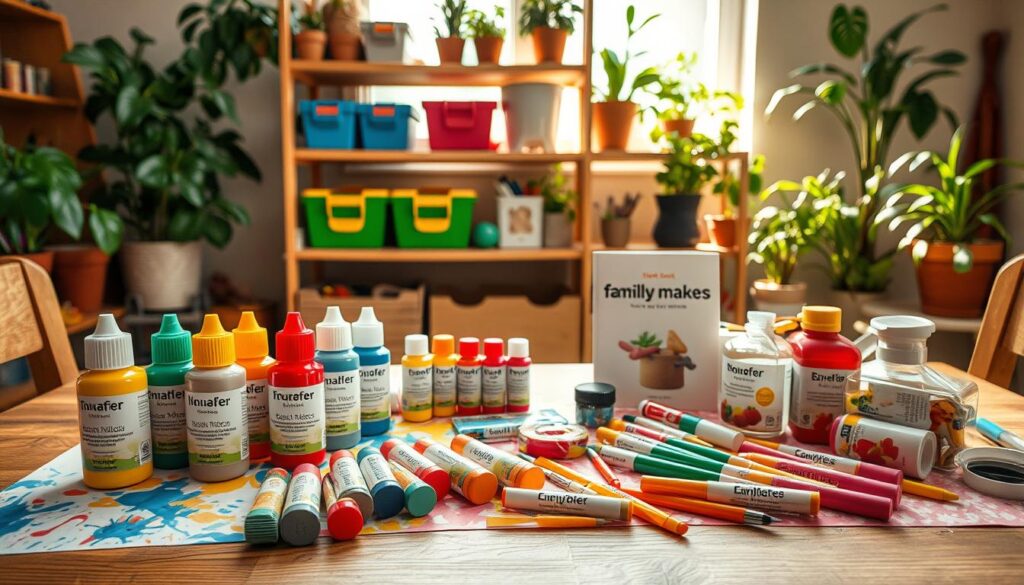
Water-based is your baseline. If it smells of chemicals, it’s off-gassing something bad. Opt for water-based, low-VOC, and solvent-free supplies.
Never burn Styrofoam or PVC in crafting projects. The fumes are toxic and can cause cancer.
The “Kid-Safe” Label and What It Actually Means
“Kid-Safe” is an advertising term, not a safety standard. It means the product won’t cause immediate harm if a child eats it. But it doesn’t talk about long-term effects.
A non-toxic adhesive is a PVA glue, not a solvent-based one. For paints, look for “water-based” and “washable.” The AP seal is your true guide.
Be careful with old supplies. Vintage model airplane glue and old paints can be toxic. When in doubt, throw it out. Your makerspace should be safe, not a chemical hazard.
| Plastic Type (#) | Common Craft Uses | Safety for Kids | Safer Alternatives |
|---|---|---|---|
| #3 PVC / #6 PS (Polystyrene) | Foam sheets, disposable containers, some glues | Avoid (Releases toxins when cut, sanded, or burned) | #2 (HDPE), #4 (LDPE), #5 (PP) |
| #2 HDPE | Durable bottles, some storage bins | Generally Safe | Widely recyclable, stable |
| #4 LDPE | Squeeze bottles, tubing | Generally Safe | Flexible, good for molds |
| #5 PP | Containers, tool handles | Generally Safe | Heat-resistant, durable |
Build your makerspace with water-based, AP-certified paints and PVA glues. Use known-safe plastics like #2, #4, and #5. Ventilate your space, label everything clearly, and teach your young makers about safe projects.
Ventilation, Fire Safety, and Heat Mats
Your makerspace should spark creativity, not actual sparks. It’s important to manage fumes and fire risks. This isn’t just about following rules; it’s about safety.
Clearing the Air: Fumes, Fires, and Filtration
When you’re soldering or using solvents, you’re running a mini lab. A simple box fan in a window isn’t enough. It’s like using a butterfly net to stop a bull.
For serious work, you need active ventilation. You wouldn’t spray-paint in a closet. A basic window fan is a start, but for dedicated spaces, consider these options:
| Ventilation Method | Best For | Effort Level | Ideal For |
|---|---|---|---|
| Box Fan in Window | Light soldering, low-fume gluing | Low | Beginners, occasional use |
| Bathroom Exhaust Fan | Moderate fume projects | Medium | Regular crafters, small spaces |
| Dedicated Fume Extractor | Soldering, resin work, 3D printing | High | Serious makers, small businesses |
| Window Fan with Filter | Dust and fume control | Medium | Allergy sufferers, messy projects |
Fire safety isn’t just about having an extinguisher. You should have one rated for electrical and chemical fires. It’s about creating a zone where heat and sparks are contained.
The Unsexy, Non-Negotiable Heat Mat
The heat mat is the most unglamorous but essential tool. It’s as mandatory as a hard hat on a construction site. A silicone or ceramic-fiber heat mat keeps your 400°F glue gun in check.
Pair that heat mat with a small, accessible fire extinguisher rated for electrical and chemical fires. This isn’t paranoia—it’s the makerspace equivalent of wearing a seatbelt. You don’t plan to crash, but you’d be an idiot not to buckle up.
Your ventilation and fire safety setup shouldn’t be an afterthought. It’s the difference between a creative space and a cautionary tale. A simple box fan in the window is a start, but for anything more than glitter and glue, think like a chemist: contain, ventilate, and always have a plan for when things get hot.
Small Parts Policy by Age (Buttons, Beads, Magnets)
The small parts bin is a big temptation for kids under five. It turns harmless craft supplies into dangers. This isn’t just about choking. It’s about how kids explore with their mouths and hands.
Your small parts policy must grow with your child. What’s safe for an eight-year-old might be too risky for a three-year-old. It’s not about stopping creativity. It’s about making sure it’s safe.
The Choking Hazard Scale: From Chonky Beads to Perilous Magnets
Not all small parts are the same. Their size, shape, and material decide how risky they are. The “toilet paper tube test” is a good rule of thumb: if it fits, it’s not safe for kids under three.
Big, wooden beads are one thing. Tiny, smooth buttons are another. The former might choke a child but is easy to spot. The latter can hide and be found months later by a toddler.
Now, we move from general worry to specific steps. Your age guidelines should match your child’s physical and mental abilities. A four-year-old might handle a bead but might not know not to put it in their mouth.
| Age Range | Allowed Small Parts | Supervision Level | Special Notes & Restrictions |
|---|---|---|---|
| Under 3 years | None. Use large, chunky alternatives (pom-poms >1.5″, mega beads) | Constant, direct supervision if in shared space | If it fits in a toilet paper tube, it’s banned. Period. |
| 3-5 years | Large beads (>1″ diameter), big buttons, jumbo sequins | Direct, within-arm’s-reach supervision | Implement “count-in, count-out” for all pieces. No magnets of any kind. |
| 6-8 years | Standard beads, buttons, small sequins with blunt edges | Active supervision in same room, frequent check-ins | Can use low-powered craft magnets under direct guidance. No rare-earth magnets. |
| 9+ years | Most small parts including beads, buttons, detailed pieces | Periodic supervision, established clean-up protocols | May use high-powered magnets with strict safety training and storage rules. |
The progression isn’t just about size. It’s about responsibility, understanding consequences, and following rules. An eight-year-old who follows rules might get bead privileges sooner. But a six-year-old who puts things in their mouth might not.
The Magnet Menace: More Than a Stomach Ache
High-powered magnets are a big concern. They’re the supervillains of the craft room. These magnets are shiny and can hold a lot of weight for their size.
When swallowed, these magnets are not just a choking hazard. They can attract each other inside the body. This can cause serious problems like perforation and tissue damage. It might even need emergency surgery.
A study on pediatric magnet ingestions shows how dangerous these magnets are. They need special safety rules that are different from other small objects. These magnets are not toys for young children.
So, what’s the policy? For kids under six, it’s strict: no loose, small, high-powered magnets. For kids aged 6-8, use large, low-powered magnets in toys or tools. Teach them about magnets when they’re older and can understand it better.
For older kids and teens, magnets can be a great teaching tool. But they must be treated with respect. Store them safely, use a sign-out system, and treat any missing magnet as a serious issue.
Your small parts policy shows that knowing your child’s stage is more important than their age. A curious three-year-old might handle big beads safely. But a distractible eight-year-old might need constant reminders. Watch, assess, and adjust. Because in the makerspace, as in life, one size never fits all.
Sharps & Needles: Count-In/Count-Out for Pins, Needles, X-Acto Blades
In a family makerspace, a stray needle or misplaced X-Acto blade is a big risk. It’s not just a problem; it’s a danger waiting to happen. The key is to be very careful with these tools. This isn’t about stopping creativity; it’s about being super careful.
Before you can use a tool, you must know where it is. This rule is very important. It makes sure everyone is safe and focused.
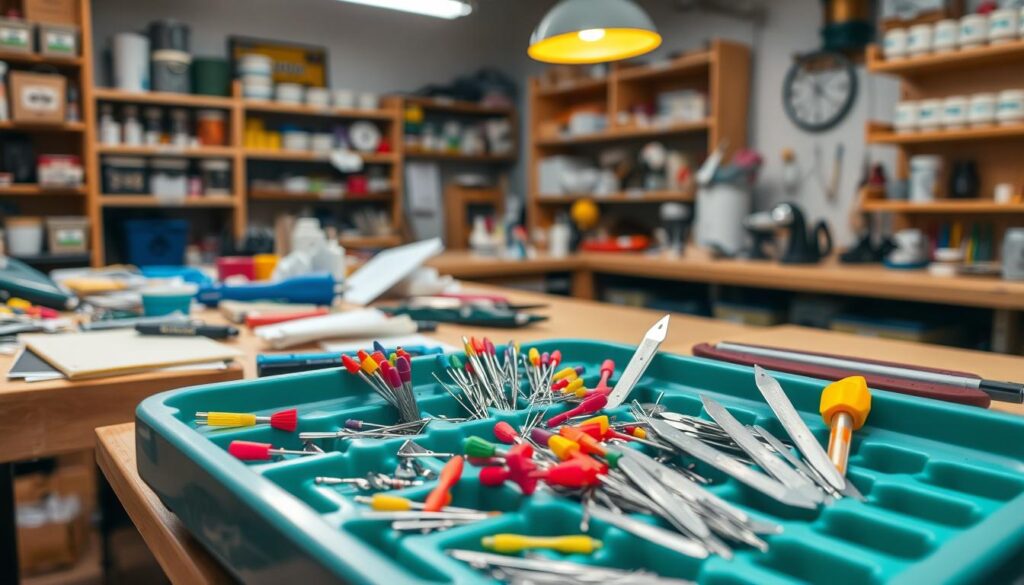
This isn’t about being suspicious. It’s about making a system that works well. If a tool is missing, everyone stops and looks for it. This makes a big difference between a craft table and a real workshop.
The “Surgical Tray” Mentality for Sharps
Forget the messy craft drawer. Start using a surgical tray mentality. In a real operating room, every tool is counted carefully. Your craft room should be the same.
Have a special, safe place for all sharp tools. Each tool, from a sewing needle to an X-Acto blade, has its own spot. You must check out and check in every tool. This isn’t just for safety; it’s about being disciplined.
It makes every sharp tool precise and safe. You always know where it is.
The “Needle in a Haystack” Protocol
This plan is for when things get tricky. The “Needle in a Haystack” protocol kicks in if a tool is missing. The rule is simple: All activity stops.
This isn’t too much. A single pin on the floor is dangerous. A lost X-Acto blade could hurt someone. The plan is clear but must be followed exactly:
- Freeze. Everyone stops working right away. No one moves.
- Contain. Close off the area where work was happening. Nothing is moved.
- Search. Look carefully, using a pattern. A magnet helps find metal tools; a flashlight can spot a blade.
- Account. The missing item is not lost. It’s just unaccounted for until it’s found.
This drill does more than find lost items. It teaches a lesson. It shows that losing a sharp is a big problem. If a sharp is lost, all work stops until it’s found.
This is the count-in, count-out system at its best. It’s not about trust; it’s about being responsible.
Electrical & Battery Safety for Light-Up Projects
Adding electricity to a makerspace is like adding a new spice to a recipe. It can make things amazing, but too much can ruin it. Moving from simple tools to circuits and LEDs is a big step. It turns your craft table into a mini lab, where electricity brings things to life.
But, this power comes with rules. A 9V battery can turn into a firestarter fast if not handled right. We aim to respect electricity, not fear it. This means learning to handle everything safely, from small batteries to complex circuits.
Before diving into the details, remember: electricity is a powerful tool, not a toy. This is a key change for both you and your kids.
From Coin Cells to Breadboards: Powering Up Safely
Let’s talk about power sources. For kids, start with the lowest voltage. A 3V coin cell battery is a safe way to begin with a single LED. But, be careful of the swallowing hazard.
As projects grow, so does the power. You might use 9V or AA batteries. But, teach the danger of short circuits. A 9V battery and a paperclip can quickly get too hot.
For more complex projects, like breadboards, the rules get stricter. Teach about polarity first. A battery in the wrong way can damage your project. Use secure battery holders and keep the battery cover tight.
The Hidden Danger of Button Batteries
Button batteries are a big risk. If swallowed, they can cause serious burns in just two hours. This is why they need a “Sharps Protocol” for batteries.
- Treat them like sharps: Store them in a locked or high, child-proofed cabinet, just like you would with exacto blades or needles.
- Count them in, count them out: Have a designated, magnetic parts tray for a project. Every battery that goes into the project must be accounted for when the project is done or taken apart.
- Secure the source: When a device (like a greeting card, watch, or tiny toy) is broken or discarded, immediately remove the battery and dispose of it properly. Don’t just toss the whole thing.
The key to circuit safety is respect for components. A 9V battery might seem harmless, but misuse can be dangerous. Start with low-voltage, supervised projects, lock down your button cells, and treat your power sources with respect. This way, you can use electricity safely and creatively.
Clean-Up Systems Kids Can Own (Bins & Labels)
Chaos can be dangerous. A glue bottle without a lid can hide under a box of glitter. A stray pin might be hidden in a piece of felt. A forgotten rotary cutter could be hiding under a sheet of felt.
The solution isn’t just yelling at kids. It’s creating a system that’s easy for anyone to follow. This system helps keep the room tidy and safe.
The “Homes for Everything” Organizational Doctrine
Don’t use a general “art supplies” bin. It only leads to frustration. The “Homes for Everything” rule means every item has its own spot.
This rule makes clean-up easier. It turns it into a simple game of matching. For example, there’s a bin for pompoms and a jar for glass beads.
This system teaches kids about order without needing to explain it. It’s like having a silent teacher that shows them how to keep things organized.
Labeling: The Key to Independent Clean-Up
Labels are key to teaching kids to clean up on their own. For young kids, use pictures. For early readers, add the word next to the picture. Color-coding helps too, like using red for hot tools and green for safe tools.
This makes clean-up faster and safer. It helps kids find what they need quickly. No more searching for small parts or tools.
This isn’t just about keeping things tidy. It’s about teaching kids to be responsible and independent. When kids know where everything goes, they’re learning important skills.
They learn that every tool has its place. This respect for space and craft starts with putting things back where they belong. Clean-up becomes a ritual, not a fight. The makerspace becomes a place of order and possibility.
Emergency Kit & Contact Card
After setting up your tools and organizing your beads, the last step is preparing for emergencies. When things go wrong, you need a quick plan. This plan should be easy to follow.
Beyond Band-Aids: The “Oh Crap” Kit
A makerspace first-aid kit is more than just basic supplies. It’s about being ready for anything. You’ll need more than just bandages.
For example, a chemical cold pack is great for accidents with hot glue. Saline solution is good for cleaning eyes after a spill. Trauma shears can help cut away tangled threads or fabrics.
While a basic classroom first aid kit from Discount School Supply is good for school, your home studio needs more.
The “In Case of Everything” Contact Card
The most important thing isn’t in a box. It’s on the wall. Make a card with important numbers like 911 and your pediatrician. Also, include the address of the nearest ER.
But the real key is the action checklists. “Fire: 1. Evacuate. 2. Grab this card. 3. Use extinguisher IF safe. 4. Call.” These checklists help you act fast when you can’t think clearly.
They are your emergency plan. They help you handle any situation, so you’re always prepared.