Ever feel like building a story world is hard? It’s like trying to put together IKEA furniture without instructions. We’ve all been there, staring at a blank page, with a great idea but no clear path.
Imagine having a ready-made toolkit for your next project. That’s what our Story-World Bundles offer. We’re not just talking about ideas. We’re talking about three coordinated, interlocking patterns for every theme.
Think of it as a creative spark. Instead of a single template, you get a system. Each theme has three patterns—narrative, aesthetic, and character—that work together. No more hitting creative roadblocks.
We don’t just give you a map; we give you tools to explore. Every bundle comes with a beautifully designed PDF and learning prompts. These prompts are narrative keys that unlock your theme’s full power.
So, are you ready to stop building from scratch and start with purpose? Let’s move beyond the blank page.
Why Bundles Save Time & Spark Learning
Imagine the night before a school play, and your child needs a “Galactic Space Ranger” costume. We had the helmet, boots, and a utility belt made of duct tape. But, the final look was more like a thrift store find than a space ranger.
This experience shows the challenge of making costumes from scratch. It’s like trying to solve a puzzle blindfolded. A themed bundle offers a solution, making it easier to create a cohesive look.
The Curated Solution to Creative Chaos
A themed bundle is like a team working together. Each piece has its role, like a vest, utility belt, and helmet. They work together seamlessly.
This approach makes creating costumes much easier. You don’t have to worry about whether different pieces match. It’s like having a pre-made plan for your costume.
Programs like Daily Wonder use this idea for learning. They combine different subjects to make learning fun and connected. A themed bundle does the same for costumes, making imagination and creativity flow.
| Ad-Hoc, Piecemeal Approach | Themed Bundle Approach | |
|---|---|---|
| Planning Time | Hours of searching, coordinating, and second-guessing. | Virtually none. The creative direction is pre-vetted. |
| Creative Spark | Often lost in the logistics of “making it work.” | Built-in. The coordinated theme sparks immediate imaginative play. |
| Educational Payoff | Inconsistent; depends entirely on the assembler’s skill. | Integrated learning prompts are baked into the theme (e.g., a “Space Patrol” bundle includes prompts about planets, navigation, and teamwork). |
| Final Result | Often a mismatched, less-inspired final product. | A cohesive, immersive character that sparks deeper, more focused play and learning. |
The real magic is in the time and mental space saved. When you have a clear costume idea, you can focus on the story and characters. This is where learning truly happens.
A well-designed themed bundle is more than patterns. It’s a complete learning experience. It turns a group of musicians into a symphony orchestra. With a themed bundle, you and your child can create an amazing adventure together.
Theme 1: Space Patrol (Vest, Utility Belt, Helmet Cover)
Let’s explore the Space Patrol theme like a cultural treasure. Each part of the costume tells a story of a child’s journey. It’s not just dressing up; it’s a coordinated set designed for storytelling.
Like a movie series, the vest, belt, and helmet cover tell a story of adventure. They work together to create a world of exploration. This way, each item becomes part of a bigger universe.
The Vest: The Core Module
The vest is like the heart of the spacesuit. It’s the first layer of who the hero is. In the Space Patrol coordinated set, the vest is the hero’s “skin.” It shows their mission and beliefs.
It’s not just a costume piece; it’s the hero’s second skin. In Daily Wonder, it’s the central theme that holds everything together.
Utility Belt: The Problem-Solver’s Toolkit
The utility belt is like the control center of the suit. It’s not just a strap with pockets; it’s full of possibilities. Each pouch and loop is a challenge to be solved.
Will the child use it to store “rocket fuel” or a “data pad”? It teaches organization and resourcefulness. It’s a wearable lesson in how to solve problems.
Helmet Cover: The Crowning Identity
The helmet cover is the final sign of the mission. It declares, “I am here, and I am on a mission.” It’s more than just headgear; it’s the ultimate sign of role.
When a child puts it on, they don’t just wear a costume; they become a character. This moment of putting on the helmet is key to forming their identity.
| Component | Function | Narrative Role | Learning Outcome |
|---|---|---|---|
| Vest | Base layer of the “spacesuit,” provides identity and mission. | The Hero’s Foundation | Role-Play & Identity Formation |
| Utility Belt | Organizes “tools,” holds mission-critical items. | The Problem-Solver’s Toolkit | Executive Function & Problem-Solving |
| Helmet Cover | Completes the uniform, defines the character. | The Crowning Identity | Confidence & Role Assumption |
Together, these pieces create a perfect loop of play. The vest sets the role, the belt adds interactive props, and the helmet completes the identity. It’s not just random dress-up; it’s a coordinated set designed for deep storytelling.
Like a great film trilogy, each piece is a success on its own. But together, they create a universe. This is the power of a truly thematic, coordinated set: it changes how a child sees the world.
Theme 2: Woodland Realms (Tunic, Leaf Cape, Critter Mask)
If our Space Patrol is about exploring the final frontier, the Woodland Realms bundle is about rediscovering the one we’ve always had under our feet. This isn’t just a costume; it’s an anthropologist’s kit for exploring the floor of the forest. Forget the screen—this is about becoming a guardian of the green, a steward of the soil. It’s less about playing a character and more about inhabiting an ecosystem.
The lesson tie-ins here aren’t just added value; they are the very fabric of the experience. They weave ecology, empathy, and imaginative play into a single, leafy tapestry.
Tunic of the Forest Guardian
Forget the drab browns of a medieval serf. This tunic is a canvas for a child’s burgeoning environmental consciousness. It’s not a costume for a king, but the practical, sturdy garment of a forest guardian.
The deep, earthy greens and browns aren’t just colors; they’re a camouflage and a creed. When a child dons this tunic, they’re not just wearing a shirt—they’re assuming a role. They are a ranger, a keeper of the woods.
The simple act of putting it on triggers a mental shift. The playroom floor becomes a mossy forest floor, the sofa a moss-covered log. This is the first, most critical lesson in immersive play: the environment you create in your mind is the most powerful prop of all. The tunic is the uniform of a new responsibility.
Leaf Cape: The Canopy Connection
This is where the magic of the woodland truly unfurls. The leaf cape isn’t a superhero’s cape; it’s a tactile connection to the forest’s own architecture. Each felt or fabric leaf is a discussion starter about photosynthesis, canopy layers, or why leaves change color.
It’s a lesson in biomimicry and botany disguised as a fashion accessory. As the child runs, the cape of leaves “rustles” behind them, a constant reminder of the character they embody. It’s a kinetic, sensory prompt that ties the wearer’s movement to the imagined world, making the lesson tie-ins about the life cycle of a forest tangible and personal.
Critter Mask: Empathy in a Snout or Beak
This is where the “realms” in Woodland Realms comes to life. The critter mask—be it a fox, an owl, or a badger—is the ultimate empathy engine. A child doesn’t just wear a fox mask; they must think like a fox.
Where does it live? What does it eat? How does it move? This isn’t just dress-up; it’s a masterclass in ethology and ecological roles. It transforms a game of tag into a lesson on predator and prey, food chains, and habitat. The mask is a powerful tool for embodying another consciousness, teaching biology and compassion not through a textbook, but through inhabitation.
| Costume Piece | Educational Focus | Sample “Lesson Tie-In” Activity | Learning Domain |
|---|---|---|---|
| Tunic (Guardian’s Garb) | Systems Thinking, Stewardship | Map-making: Children draw a map of their “realm,” identifying key landmarks (the big oak = the castle, the stream = the moat). Teaches spatial reasoning and narrative sequencing. | Environmental Science, Geography |
| Leaf Cape | Botany & Ecology | Leaf Identification & Rubbings: Collect real leaves, compare to cape design, discuss why leaves have different shapes. Explores adaptation and plant biology. | Biology, Art & Science |
| Critter Mask | Biology & Empathy | “A Day in the Life”: Child must narrate a day from their animal’s POV—what it eats, its predators, its shelter. Teaches animal behavior and habitat. | Biology, Language Arts, Social-Emotional Learning |
The Woodland Realms bundle moves beyond simple role-play. The tunic grounds the character in a role of responsibility. The leaf cape connects the child to the physical and scientific wonder of a forest.
The critter mask dissolves the barrier between child and creature. Each piece is a conversation with the natural world, a lesson in ecology, storytelling, and self. It’s not about escaping to a fantasy world, but about discovering the profound magic and complexity of the real, living world just outside the door.
The final, most powerful lesson tie-in is this: to protect something, you must first learn to see the world from its perspective.
Theme 3: Ocean Quest (Scale Pants, Fin Hood, Trident Prop)
Our third theme, Ocean Quest, takes you on an underwater journey. It turns your living room into Captain Nemo’s library. Your child becomes a deep-sea explorer. This isn’t just dressing up; it’s an underwater adventure.
Like the BiblioPlan model, this theme weaves together history and literature. It uses costumes to teach about marine biology, mythology, and the wonders of the deep.
Forget the usual sea creature costumes. Our Ocean Quest dives into the story-world of the deep. Each piece of the themed costume tells a part of a bigger story. It’s like having the Nautilus, a diving bell, and a coral reef research station all in one.
Scale Pants
The Scale Pants are more than just pants. They teach about biomimicry and adaptation. The shimmering scales mimic those of deep-sea fish, showing how they protect themselves.
When a child wears these pants, they’re not just getting dressed. They’re learning about survival in the deep sea. It’s a hands-on science lesson. The pants spark conversations about ocean habitats and how life adapts to the deep.
Fin Hood
The Fin Hood takes us from biology to myth and physiology. It’s not just a hood with a fin. It’s a piece of speculative evolution, asking us to imagine what if we were of the sea.
This piece connects to deep human stories and mythology. It’s a gateway to learning about fish and marine mammals. It’s a way to explore global mythology and our connection to the sea.
Trident Prop
The Trident Prop is where Poseidon, ocean conservation, and fine motor skills meet. It’s the mighty weapon of a sea god, connecting us to Poseidon’s myth. In a child’s hand, it’s a tool for storytelling and learning.
In a modern context, the trident is a tool for studying the ocean. It’s a symbol of authority for young Ocean Guardians. It makes us think about power, stewardship, and our changing oceans.
This Ocean Quest bundle is a themed costume set that integrates science, mythology, and ecology. The scale pants, fin hood, and trident aren’t separate items. They’re a curated syllabus for learning.
They turn play into a voyage, echoing Jules Verne’s 20,000 Leagues Under the Sea. The goal is to think like an ocean creature and learn about our planet’s blue heart.
Mix-and-Match Matrix Across Themes
Forget the old, single-use costumes. The magic lies in the coordinated sets and the endless characters you can create. It’s like a game for your imagination, where a Space Patrol vest can turn into a druid’s jerkin with a cape swap. It’s not just dressing up; it’s solving problems creatively, just like BiblioPlan’s curriculum does.
Think of this as your command center. You’re not just picking clothes; you’re creating a masterpiece. A Space Patrol vest under a Woodland Realm cape makes a “Steampunk Druid.” The Ocean Quest trident becomes a scepter for a Sea King. This creativity is key, just like BiblioPlan’s curriculum connects different subjects.
Here’s a simple guide to get you started. It’s like a DJ’s set for storytelling, blending themes together:
| Core Garment (Theme A) | Layering Piece (Theme B) | Accessory (Theme C) | Resulting Character Concept |
|---|---|---|---|
| Space Patrol Vest (Space) | Woodland Realm Cape (Woodland) | Ocean Quest Trident (Ocean) | Steampunk Druid of the Abyss |
| Woodland Tunic (Woodland) | Ocean Quest Scale Pants (Ocean) | Space Patrol Helmet (Space) | Deep-Wood Stellar Ranger |
| Ocean Quest Fin Hood (Ocean) | Space Patrol Utility Belt (Space) | Woodland Critter Mask (Woodland) | Aquatic Sky-Pirate |
This isn’t just random play. It’s strategic thinking. Mixing these coordinated sets teaches resourcefulness and systems thinking. A child sees a cape as a variable, not just a piece of fabric.
The real win is the educational parallel. BiblioPlan’s curriculum connects subjects like history and literature. Our mix-and-match matrix does the same. A child in a “Steampunk Druid” outfit is not just playing; they’re learning creatively.
These coordinated sets are a starting point, not a limit. The mix-and-match matrix guides you, turning costumes into a storytelling tool. It shows that learning can happen at the intersection of ideas.
Fabric Lists by Budget Tier (Stash vs. New)
Let’s talk about getting fabric. It’s a mix of dreams and reality, mixing what you have with what you want. You can be thrifty, strategic, or fancy. Your budget is just a starting point. Choosing the right fabric teaches you about managing resources, a key lesson tie-in for young creators.
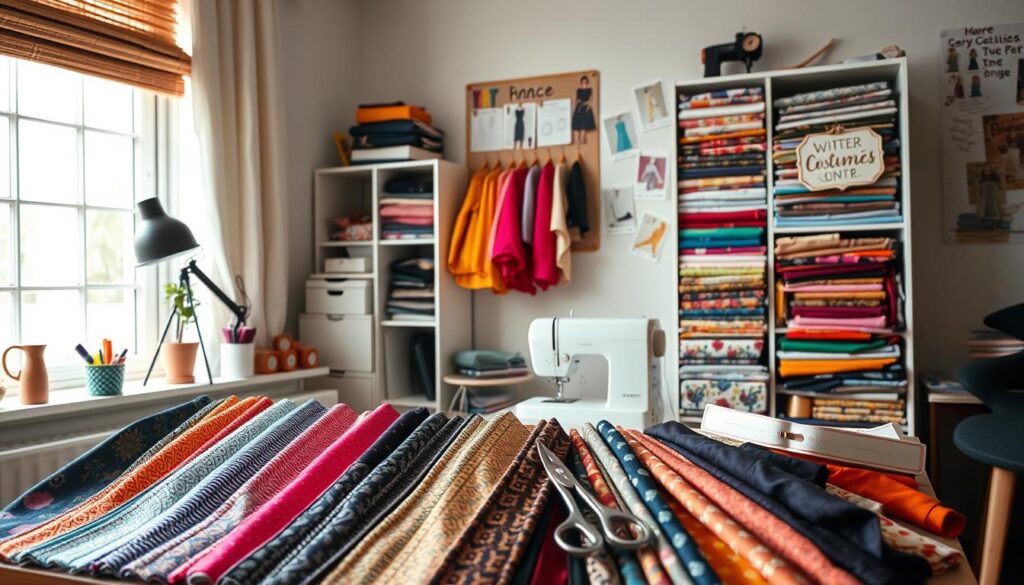
Your fabric plan is more about thinking than buying. It’s a lesson in economics and being green, hidden in a trip to the craft store or digging through scraps. Let’s look at how you approach it.
The Thrifty Alchemist (Stash-Busting)
This tier is for the clever ones. Your fabric list is like a treasure hunt in your supplies.
- Materials: Look to your scraps, old sheets, thrift finds, and past project leftovers.
- Sourcing Strategy: Aim for zero waste. Turn a fleece blanket into a Space Patrol vest lining. Old jeans become utility belt pouches. This teaches you to turn old into new, showing creativity and problem-solving.
- Lesson Tie-In: This teaches sustainability and cleverness. It’s about making do and mending, like our ancestors did.
The Savvy Sourcing Strategist (Mid-Tier Budget)
You find the perfect balance between cost and quality. You’re not just buying fabric; you’re making smart choices.
- Materials: Use felt, fleece, broadcloth, and cotton from big stores. You’re always on the lookout for remnant sales.
- Sourcing Strategy: Wait for sales, grab “ugly” colors at discounts, and watch for online deals. It’s like running a supply chain.
- Lesson Tie-In: This teaches you math and economics. It’s about comparing prices, calculating taxes, and planning your budget. It’s a lesson in planning and budgeting.
The Couture Connoisseur (Luxury Tier)
For projects that need to wow. This is for when you want a high-quality, show-stopping finish.
- Materials: Use imported linen, heavy cotton, boiled wool, or silk for a royal touch. Look for specialty stores and online boutiques.
- Sourcing Strategy: Focus on the experience and the final product. Find unique materials like Italian wool or jacquard for special touches.
- Lesson Tie-In: This teaches you to value quality over quantity. It’s about understanding materials and their properties, connecting craft to science.
Your fabric choice is more about your creativity than your budget. The Thrifty Alchemist finds innovation in scarcity. The Savvy Strategist masters logistics. The Couture Connoisseur studies materials. Each way offers a unique lesson tie-in on value, whether it’s materials, time, or vision. The real magic is in the creative mind you build while choosing.
Step Levels: Beginner, Confident Beginner, Intermediate
Starting a new adventure can be scary. But, making your own themed costumes is like a hero’s journey. It’s not just sewing; it’s a journey with a needle and thread.
Don’t be afraid of the end result. We’ve divided the process into three Step Levels. These levels are like the hero’s journey: the Call to Adventure (Beginner), the Trials (Confident Beginner), and the Return with the Elixir (Intermediate).
Each level gets easier, showing off your growing skills. Whether you’re new to sewing or already skilled, there’s a clear path ahead.
The Hero’s Journey in Three Acts
Your crafting journey has its own story. Each level is a new chapter in your crafting saga.
| Level | The Hero’s Stage | Core Focus | Example Quest | Your “Level Up” Reward |
|---|---|---|---|---|
| Beginner | The Call to Adventure | You’re Luke on Tatooine. Focus on basic, straight-line construction. Think simple tunic panels, elastic-waist pants, and straight seams. The goal is to master the basics: pinning, cutting, and sewing a straight line that doesn’t look like a drunken worm. | Construct the simple tunic from the Woodland Realms bundle. | Confidence with a sewing machine and the triumphant completion of a wearable, simple garment. |
| Confident Beginner | The Trials | This is your Dagobah training. You’re past the basics, but Yoda isn’t done with you. Here, you face the trials of zippers, buttonholes, and basic set-in sleeves. It’s where the magic of more complex construction happens, and your themed costumes start to look less “homemade” and more “handcrafted.” | Add a functional zipper to a vest or create a lined, simple mask. | Mastery of functional closures and the ability to follow a multi-step pattern. |
| Intermediate | The Return with the Elixir | You’ve returned to the village with the prize. Now you’re handling linings, facings, and perhaps a simple hood or structured accessory like the Space Patrol helmet cover. This level is about refinement and adding professional touches that make a costume look cohesive and intentional. | Construct the Space Patrol vest with a lined interior and a functional utility belt. | A complete, polished costume piece that looks cohesive and stands up to play. You’ve not just made a costume; you’ve crafted a character. |
Choosing Your Path: It’s a Game, Not a Grind
This isn’t a race. You can be a Beginner on one project and an Intermediate on another. The “Confident Beginner” level is where you’ll grow the fastest, learning one new technique at a time. The goal is to enjoy the journey, learn from mistakes, and level up with every seam.
So, choose your starting point. Grab your pattern, pick your themed costume bundle, and let’s craft. The only wrong choice is not starting at all.
Photo Guides: Step Thumbnails & Captions
Forget the complex instruction manual. The most powerful teaching tools are often wordless. Think of Chaplin’s Modern Times: a masterclass in visual storytelling. Every pratfall and gesture is a clear instruction.
Our photo guides are your silent film, your visual curriculum. They turn complex coordinated sets of fabric and thread into a storyboard for success.
Each thumbnail is a storyboard cell, and every caption is its director’s commentary. We show you the exact moment the seam is pressed. We show you the precise way to align a patch or the exact drape of a leaf-shaped cape.
It’s the difference between reading a map and following a breadcrumb trail of images.
Anatomy of a Visual Guide
To build your coordinated sets with confidence, each step is broken down into a single, potent image. It’s paired with a concise, actionable caption. Here’s how to read the guide:
| Step | Thumbnail Focus | Caption Content | Pro-Tip (The Director’s Note) |
|---|---|---|---|
| 1. The Foundation | Fabric pieces laid out, with key notches and marks highlighted. | “Pin the notches at the shoulder and hip. This is your anchor.” | This is your “spine” shot. If the pieces are aligned here, the whole project stays on track. |
| 2. The Critical Seam | Close-up of the right sides of fabric being pinned, with a pin visibly marking the 5/8″ seam allowance. | “Right sides together, raw edges aligned. This seam is the backbone of the piece.” | This is the moment of commitment. The thumbnail should show the fabric layers, not just the finished seam. |
| 3. The Reveal | The piece turned right-side-out, with a finger or tool pushing out a corner for a crisp point. | “Gently coax the corners out. Use a blunt tool, not the scissors!” | The “Aha!” moment. The caption should convey the tactile satisfaction of the reveal. |
| 4. The Finishing Touch | Close-up of a topstitch or a perfectly mitered corner. | “Topstitch 1/8″ from the edge. This is where the piece goes from homemade to handmade.” | This is the detail that signals quality. The photo must show the precision of the stitching. |
This visual language ensures that whether you’re assembling a Space Patrol vest or a Woodland Tunic, you’re not just following steps—you’re reading a visual story. The thumbnails eliminate the “wait, which side is right?” panic. They are the silent, efficient director of your project, cueing your next move without a word.
Ultimately, these guides transform the coordinated sets from a pile of fabric into a cinematic experience. You’re not just building a costume; you’re directing a production, with each photo caption as your script. The result? You’re not just making a costume. You’re directing a silent, stylish masterpiece, one frame at a time.
Play Prompts & Mini-Lessons: Where Costumes Spark Curiosity
Think of the costume as the key that unlocks the story. But what if that story could also unlock physics, engineering, or narrative theory? This is where play transcends dress-up and becomes a miniature classroom. The real magic isn’t just in wearing a utility belt; it’s in the “why” and “how” that a simple prompt can unleash a Socratic dialogue with a five-year-old about torque, leverage, and the history of human tool use.
This is the Sage archetype in action: we don’t just give kids capes, we give them conceptual grappling hooks. We’re not just sewing a vest; we’re embedding lesson tie-ins that transform a game of pretend into a conspiratorial whisper about how the world works.

Consider the prompt: “Why does the Space Patrol Officer need a utility belt? Is it for style, or is it a lesson in ergonomics and resource management?” This isn’t a yes-or-no question. It’s a Socratic launchpad. The child, now an Officer, must defend their gear choices. “The multi-tool is for hull breaches,” they might say. “The grappling hook is for low-gravity asteroid hops.” Suddenly, they’re not playing—they’re engineering. They’re solving problems with limited resources. The belt isn’t just a prop; it’s a case study in the physics of necessity.
We can push further. The utility belt is a mini-lesson in physics. Why is the heaviest tool placed closest to the hip? “It’s about center of gravity, kid. A lopsided astronaut is a spinning astronaut.” This isn’t a lecture; it’s a conspiratorial tip shared between co-conspirators against boredom. We’re not teaching them facts; we’re teaching them how to think like an engineer.
This is the “Easter egg” model of learning, inspired by the integrated models of Daily Wonder and BiblioPlan. The costume is the game, but the mini-lessons are the hidden levels. For the Woodland Realm’s leaf cape, the prompt isn’t just “be a forest spirit.” It’s: “Your leaf cape is a solar panel. How would you design it to catch the most morning light, and what does that mean for the angle of the leaves?” A simple green cape becomes a lesson in photosynthesis and biomimicry.
Here’s how to think about these prompts and mini-lessons:
- The Socratic Gadgeteer: “Your trident (prop) is a lever. Where do you place your hands to lift the heaviest sunken treasure chest? (Hello, fulcrums!).”
- The Narrative Architect: “Your character’s tunic is torn. Is it a battle scar from a bramble, or a gift from a grateful griffin? The story’s logic is your physics.”
- The Systems Analyst: “Your critter mask isn’t just a disguise. How would a real fox’s hearing (ears on the side of the head) differ from your own? That’s a lesson in predator-prey biology.”
The goal is to move beyond “I am a space ranger” to “As a Space Ranger, I need to calculate the trajectory of this grapple hook, and it’s given me a whole new respect for Newton.” The costume is the key, but the lesson tie-ins are the doors it unlocks. It’s intellectual play, where every snap, button, and fabric choice is a mini-lesson waiting to be discovered, turning playtime into a dialogue with the universe’s operating manual.
Pack Index, Printing Tips & Classroom License Note
This is your guide, the secret note at the end of the story. Every adventure needs a map. The pack index is your guide, like the Dewey Decimal system for your imagination.
Printing your themed costumes should be easy. Think of the tips as helpful spells. They help your scale pants and leaf capes print perfectly, without using too much toner. For easy digital crafting, check out the Cactus Classroom Decor bundle for more tips.
The classroom license is your key to endless adventures. It lets you use these themed costumes year after year. But, sharing the files with another teacher needs their own license. We keep the magic alive, one classroom at a time.
So, you have everything you need. The map, the spellbook, and the rules. Now, gather your heroes. The story is ready to begin.