I scrolled through Lemon8 and found a user named Niky. After watching Inside Out 2, she didn’t just feel a little blue. She decided to become Sadness.
Her outfit was a sartorial thesis on melancholy. Blue tones and soft textures acted as a non-verbal language. This is where dress-up emotions begin—not on a playground, but in the closet.
It’s emotional alchemy. You transform a chaotic, internal feeling into an external, curated identity. When a child puts on a cape, they’re externalizing courage. What Niky and legions on #movieinspiredoutfits challenges do is the adult, more sophisticated version.
They use fashion’s lexicon to articulate nuances that words fail to capture. This act is foundational. It’s saying, “This complex thing inside me? I see it. I name it. I give it a form.”
This process mirrors how play provides a safe way for children to express big. It’s the first step in a deeper literacy.
It’s emotional couture. And it’s far more profound than just looking cute for the movies. It’s about the magical intersection of identity and artifact, much like the mission at Fairytale Fashion to blend technology with and bring enchanting clothing to life.
Processing big emotions
Naming and dressing up a feeling is like art. But processing it is like science. You’ve found the feeling, like “Spiky Anxiety” or “Glum Disappointment.” Now, the real emotional lab work starts.
For this, we use tools that look like toys. The “Printable Emotions Sorting Game” is a great example. It seems simple, but it’s actually a way to understand feelings better. By matching scenarios to emotions, we learn to recognize our feelings.

“Discovery Bottles” are another clever tool. Fill a bottle with red glitter and oil, and label it “Anger.” Shake it up and watch the storm calm down. It’s a way to see our emotions in a real way.
Observing our emotions is key. We’re not trying to get rid of them. We’re learning to understand them better. Using storytelling prompts helps us do this in a safe way.
Adults can learn from this too. On platforms like Lemon8, people share “Anxiety” outfits. Curating these looks helps them process their feelings. It’s a way to understand and deal with emotions.
The main point is that Emotional intelligence is about understanding, not avoiding. It’s about seeing our emotions clearly, like glitter in a bottle. These activities help us do that. They turn big emotions into something we can study and learn from.
Embracing the Power of Imaginative Play
Imaginative play is a powerful tool for emotional growth in children. It allows them to explore their feelings and develop empathy. By engaging in imaginative play, children can express their emotions in a safe and controlled environment.
Imaginative play also helps children develop problem-solving skills. Through role-playing, they can practice different scenarios and learn how to navigate challenges. This type of play encourages children to think creatively and find innovative solutions to problems.
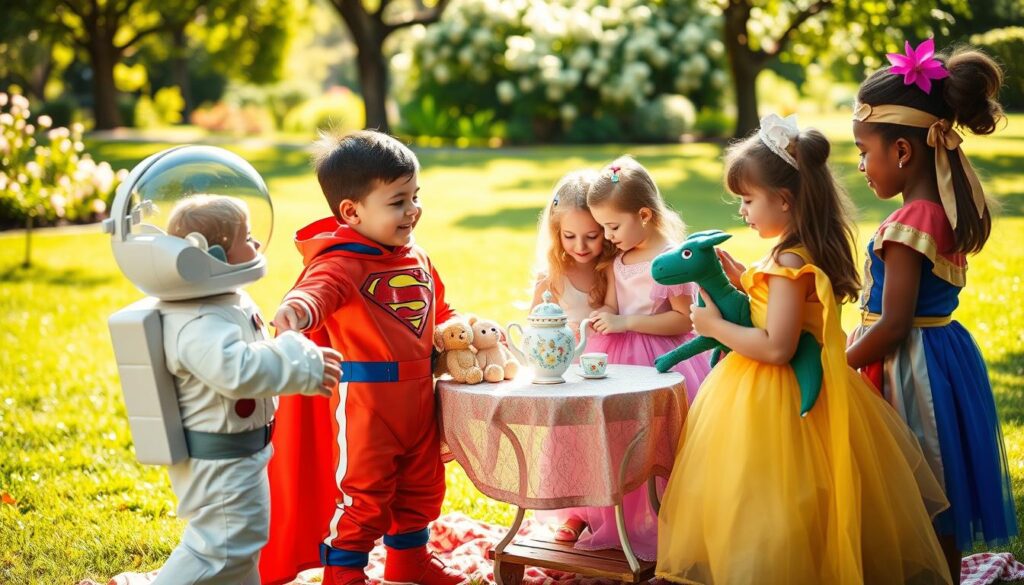
One way to foster imaginative play is by providing children with dress-up clothes and props. These items can spark their imagination and help them create their own stories and characters. Dress-up emotions, such as costumes that evoke specific emotions, can further enhance the imaginative play experience.
By embracing the power of imaginative play, parents and caregivers can support children’s emotional growth and development. Encouraging children to engage in imaginative play can have a positive impact on their emotional well-being and overall development.
Benefits of Imaginative Play
Imaginative play offers numerous benefits for children’s emotional growth and development. Some of the key benefits include:
- Emotional Expression: Imaginative play allows children to express their emotions in a healthy and constructive way.
- Empathy Development: Through role-playing, children can develop empathy and understand different perspectives.
- Problem-Solving Skills: Imaginative play helps children develop problem-solving skills as they navigate different scenarios.
- Self-Confidence: Engaging in imaginative play can boost children’s self-confidence as they explore their creativity and imagination.
By embracing the power of imaginative play, parents and caregivers can support children’s emotional growth and development, fostering a strong foundation for their overall well-being.
Activities for home/school
So you’ve learned the theory. Now it’s time to get creative with glue and glitter.
Turn your living room into a place for exploring feelings. After watching Pixar’s Inside Out, use the “Printable Activity Sheets.” They’re not just for fun. They help start important talks your kid might shy away from.
The “DIY Inside Out Craft” shows what’s inside. It’s a way to express feelings in a real way.
Imagative play emotional growth becomes real through these activities. Making Anger’s shape with Perler beads is like a meditation. Creating a “Memory Ornament” for Joy connects emotions to something physical. These actions help us learn new words for our feelings.
In school, things get even more interesting. “Inside Out Bingo” is more than a game. It’s a way to learn about complex emotions. The craft about sadness and colors is like a mix of recycling and deep thinking.
These projects make emotional intelligence easier to understand. They turn a big goal into smaller, doable steps. You’re not just making a craft. You’re building a more aware mind, one bead, one memory at a time. The journey never ends, but you have the tools to keep going.