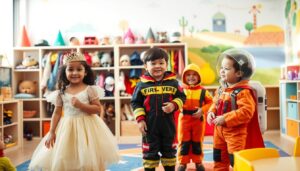
Let’s be honest. To the untrained eye, a kid in a Batman cape threatening a stuffed penguin seems like just messing about.
But what if I told you that cape is a cognitive tool, that penguin a narrative foil, and the whole scene a masterclass in developmental psychology? Welcome to the unassuming genius of dress-up play.
Far from mere costume chaos, this is where your child’s brain goes to the gym. Synthesized research confirms that pretend play is a critical learning tool, fundamental to a child’s growth.
It shapes cognitive, social, emotional, and language skills in profound ways. This isn’t just fun and games. It’s the foundational work of a tiny philosopher-king.
In this analysis, we’re moving past the glitter and into the gray matter. We’ll unpack six unexpected, research-backed advantages of this imaginative exercise.
Prepare to see that cape-wearing thespian in a whole new light.
Boosts creativity
A simple piece of fabric can turn into a superhero’s cloak. It’s not just fun. It’s a powerful tool for cognitive development.
Pretend play is open-ended, with no script or wrong answers. It lets kids build worlds from scratch. This boosts their creativity and sharpens skills like memory and critical thinking.
Think of a cardboard box. To an adult, it’s for recycling. But to a child, it becomes a spaceship, a dragon’s cave, or a throne. This fast-paced world-building is a sign of peak cognitive performance.
Dress-up play is like a sandbox for divergent thinking. It challenges the mind to think creatively and adapt quickly. Every costume change is a chance to rewrite reality.
This mental agility is impressive. It’s the foundation of innovation, built through pretend play. The benefits of dress-up and pretend play are vast because they foster creativity.
| Dress-Up Scenario | Cognitive Skill Exercised | Real-World Parallel |
|---|---|---|
| Doctor with a toy stethoscope | Empathetic reasoning & sequence planning | Diagnostic logic and procedural thinking |
| Chef in a play kitchen | Short-term memory (recipes) & measurement concepts | Project management and resource allocation |
| Astronaut in a “rocket” (cardboard box) | Spatial reasoning & hypothetical problem-solving | Engineering design and systems thinking |
| Superhero with a cape | Moral reasoning & conflict resolution | Ethical decision-making and leadership |
Look at the table. Each scenario is a training module for adult skills. The child is not just playing; they’re running complex cognitive software. Their creativity is the operating system.
So, when you see a kid in a role, remember. You’re watching a brain under construction. The Dress-Up Play Benefits are clear: it builds the flexible, innovative thinkers tomorrow’s world needs.
Social skills
Dress-up play is like a mini United Nations summit. It’s where kids build connections through stories and roles. It’s not just fun; it’s a place where they learn to interact with others.
When a child puts on a firefighter’s helmet, they’re not just dressing up. They’re assigning a role and learning about expectations. They figure out who’s in charge and who needs help. This is how they learn about different thoughts and desires.

In pretend play, kids always negotiate. Who gets to be the astronaut? They learn to share and take turns. These skills are important for getting along with others.
Cooperation is key in dress-up play. Kids must work together to build forts or have a royal banquet. They learn to communicate and listen to each other.
Empathy is also practiced in dress-up play. Kids learn to see things from another’s point of view. They understand that everyone has their own feelings and needs.
Let’s look at what kids learn in the dress-up corner:
- Perspective-Taking: Trying on a costume means trying on a new perspective.
- Conflict Resolution: Debating roles teaches negotiation and fairness.
- Collaboration: Shared pretend scenarios require teamwork and shared goals.
- Verbal & Non-Verbal Communication: Kids articulate roles, direct action, and read social cues.
Dress-up play is linked to cognitive development. It strengthens brain connections related to social skills and planning. For more on this, check out these developmental benefits to dress-up play.
So, the next time you see a pile of costumes, remember it’s more than just play. It’s a place where kids learn to be leaders and work together. The benefits of dress-up help them become better humans.
Problem-solving
Forget pre-scripted endings. The real magic of dress-up lies in solving unexpected problems with creativity. It’s not about the costume; it’s about the thinking.
Every story hits a snag. The castle’s drawbridge is missing. The superhero’s powers are gone. In regular toys, this is a problem. But in dress-up, it’s the adventure.
It’s like real-life problem-solving. Kids create scenarios like playing house or saving the world. They assign roles and then face obstacles.
They find creative solutions with what they have. A couch cushion becomes a drawbridge. A juice box can restore powers. They learn that problems are just challenges waiting to be solved.
Children become their own directors, solving puzzles in real-time. Obstacles lead to new chapters, teaching them to think on their feet. This kind of play is more valuable than any puzzle.
Let’s look at how common dress-up problems build serious skills.
| Problem Scenario | Improvised Solution | Skill Honed |
|---|---|---|
| The Castle Has No Drawbridge | Using a couch cushion or blanket as a ramp; declaring a “magic password” instead. | Resourcefulness and spatial reasoning. |
| The Superhero’s Power is Drained | Inventing a “power juice” (a drink); finding a “charging crystal” (a shiny rock). | Creative hypothesis and sequential thinking. |
| The ‘School’ Has No Books | Using food boxes as “textbooks”; telling stories from memory. | Adaptive communication and symbolic representation. |
This is the secret genius of costume play. While they’re being knights or doctors, their brains are solving problems fast. “If this, then what?” They negotiate, test ideas, and learn from failure.
The true Dress-Up Play Benefits aren’t just about being someone else. They’re about becoming better at solving problems. You learn to find solutions with what you already have. That’s a lesson no textbook can match.
Language development
Listen to a preschooler’s dress-up session, and you hear more than play. You see grammar and imagination come together. This is the benefits of dress-up for a strong verbal skill set.
That “doctor” isn’t just saying you’re sick. They’re diagnosing “a severe case of dragon flu” and prescribing “three drops of unicorn horn powder.” Kids use new words with confidence, as if they lived them.
They become tiny narrators and scriptwriters, spinning complex plots on the fly. One moment they’re a knight, the next a diplomat brokering a treaty with the sofa dragon. This dramatic play forces them to use language in wildly diverse ways.
They learn turn-taking, listening, and the art of the persuasive argument. “But Queen, we MUST attack the pillow fortress before naptime!” That’s rhetoric, my friend. They’re also labeling emotions—”the princess is furious!”—expanding their emotional intelligence alongside their word bank.
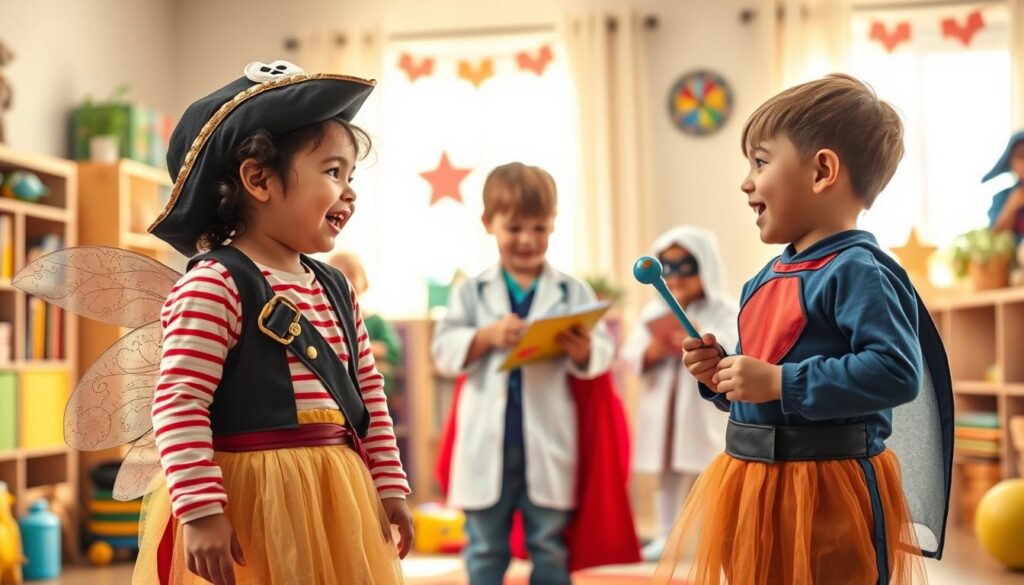
Compare this to rote memorization with flashcards. The motivation there is external. In dress-up, the drive is intrinsic and powerful. They need the right words to save the kingdom or cure the patient. This intrinsic link is a powerhouse for cognitive development. It makes the language stick.
Let’s break down the contrast. The table below shows why the costume box might be a better language tutor than the textbook.
| Aspect of Language | Traditional Learning Method | Dress-Up Play Method |
|---|---|---|
| Vocabulary Acquisition | Memorization from lists or apps. Often decontextualized. | Organic, context-driven. Words are learned through immediate, imaginative need. |
| Sentence Structure | Practiced through repetition and grammar exercises. | Experienced through creating dialogue and issuing commands within a scenario. |
| Narrative Skills | Learned by reading or listening to stories. | Built by actively creating and acting out original plots from beginning to end. |
| Motivation | Often external (praise, grades, completion). | Intrinsic and fierce (solving the story’s problem, staying in character). |
| Social Context | Often solitary or one-on-one with an adult. | Inherently social, requiring negotiation, explanation, and collaboration with peers. |
So, while you might worry about their future test scores, their cognitive development is getting a serious workout in the playroom. They are coding complex linguistic software while pretending to be pirates. The benefits of dress-up for language are profound, turning every play session into a masterclass in communication. It’s learning disguised as an epic adventure.
Self-confidence
That superhero cape isn’t just fabric; it’s a symbol of bravery. It shows how Dress-Up Play Benefits helps kids feel brave. A shy kid might wear an explorer’s hat and become loud and curious.
The costume lets kids try out different roles without fear. They can be a pirate captain or a caring vet. This is how they build confidence.
Every time a child hosts a tea party for stuffed animals, they feel a sense of pride. They learn to solve problems and feel accomplished. This builds their self-esteem.
This isn’t just play; it’s rehearsal for reality. The confidence kids build in dress-up helps them face real challenges. They feel ready for new situations because they’ve practiced being brave and clever.
The confidence comes from knowing they can be brave. It’s not just about the cape or crown. It’s about the child who knows they can wear it.
Safe play tips
You’ve set up a royal court in your living room. The benefits of dress-up are clear, but safety is key. Think of safety as the foundation for all the fun.
First, clear the floor of anything that could trip you up. Offer a box of props like fabrics, hats, and old clothes. These props suggest stories without telling them. Your role changes to supporting the play, not directing it.
When you join in, follow their lead. This makes them feel heard and strengthens your bond.
Good costume design helps keep everyone safe. Look for non-slip soles and adjustable straps to prevent falls. Choose breathable fabrics and soft seams to avoid discomfort.
This setup isn’t about wrapping everything in bubble wrap. It’s about removing obstacles so kids can learn and grow. When safety is part of the play, kids can solve problems and build confidence. Now, let’s open the curtain.