Let’s face it: a scratchy costume can ruin a day of fun. We’ve all seen it—the fairy with sandpaper wings, the superhero with a Brillo pad emblem. The real problem is the scratchy backing and stiff trims inside.
We’re not just adding glitter for fun. We’re on a mission to stop the itch. The key is in the hidden layers. The right fusible backing, breathable lining, or HTV can make a costume last forever.
This isn’t just about quilting texture or fabric paint. It’s a way of thinking. It’s about making costumes comfortable from the start. We’ll show you how to make every detail, from trims to transfers, safe and comfy for all day.
Appliqué Basics (fusible web + secure stitches)
Appliqué is all about making one fabric stick to another without any trouble. It’s like turning a small piece of fabric into something special, like Captain Cosmos’s emblem. This is done with a bit of force and a lot of skill.
At its heart, appliqué mixes fabric and story. It’s not just about sticking cloth together. It’s about making a story that can last through many adventures.
Fusible web is a key player in appliqué. It helps fabrics work together, even if they don’t want to. It’s like a temporary handshake before they commit for good.
Some people think fusible web is cheating. They say it’s a quick fix that skips the real work. But others see it as a smart move. After all, who has time to waste when there’s so much to do?
The truth is, fusible web is just the beginning. It helps hold things in place while you do the real work. This real work is the secure stitch.
This stitch is your shield against the rough stuff of childhood. It’s about making stitches that are strong and reliable:
- Satin stitch: The overachiever, laying down dense, smooth coverage
- Zig-zag stitch: The reliable workhorse, creating a flexible barrier
- Three-step zig-zag: The strategic thinker, distributing tension across multiple points
Each stitch has its own way of keeping things secure. The satin stitch promises to cover everything perfectly. The zig-zag stitch offers flexibility. And the three-step zig-zag is all about outsmarting friction.
For beginners, knowing about these stitches is key. Your choice of stitch isn’t just about technique. It’s about how your creation will look and last.
| Stitch Type | Best For | Durability | Skill Level | Machine Setting |
|---|---|---|---|---|
| Straight Stitch | Simple outlines, lightweight fabrics | Medium | Beginner | 2.0-2.5 length |
| Zig-Zag Stitch | Most fabrics, curved edges | High | Intermediate | Width 3.0, Length 2.0 |
| Satin Stitch | Decorative coverage, no raw edges | Very High | Advanced | Width 4.0-5.0, Length 0.5 |
| Three-Step Zig-Zag | Stretchy fabrics, high-stress areas | Highest | Intermediate | Width 4.0, Length 3.0 |
| Blanket Stitch | Traditional look, felted fabrics | Medium-High | Intermediate | Special foot required |
As stitches get stronger, so does the skill needed to make them. This isn’t just a coincidence. It’s because the toughest stitches require the most from the person making them.
The main lesson is to use fusible web to start. Then, add strong stitches to keep it in place. Your appliqué is more than decoration. It’s a promise between your imagination and the real world. Make sure both sides keep their word.
Remember, fusible web gets your appliqué to the party. But it’s the secure stitch that keeps it there all night. Even when the party gets wild, like sliding down banisters or saving the world from sofa-cushion fort invaders.
Fabric Paint & Stencils: The Art of the Crisp, Colorful, and Washable
Welcome to the world of kid-friendly embellishment. Here, we turn simple fabric into a canvas for imagination. It’s not just about slapping paint on a t-shirt. It’s a precise dance between pigment, polymer, and fabric.
Think of it like selecting a vintage fabric paint and a superhero cape as your canvas. The goal is to create designs that are both durable and dazzling.
The Fabric Paint Sommelier: Choosing Your Medium
Not all fabric paints are equal. Your choice is the most important decision. It’s not just about slapping color on cloth. It’s about engineering a bond that survives washing.
Choosing the right paint is like choosing the right tool for a job. You wouldn’t use a sledgehammer to hang a picture frame.
Fabric Paint: A Comparative Guide
| Paint Type | Best For | Heat-Setting | Washability | Kid-Friendliness |
|---|---|---|---|---|
| Acrylic Fabric Paint | General use, bold colors, stenciling | Essential (Iron or dryer) | Excellent after heat-setting | Easy to use, but can be stiff |
| Textile Medium + Acrylic | Mixing custom colors | Essential | Excellent | Requires mixing; for advanced crafters |
| Puff/3D Paint | Textured designs, sensory play | Air dry or heat-set (check label) | Good, but texture may flatten | Very high; kids love the 3D effect |
| Fabric Markers | Fine detail, drawing | Usually heat-set | Good to Excellent | Excellent; low-mess |
The Heat is On: The Non-Negotiable of Setting Paint
Heat-setting is the only thing between your child’s masterpiece and disaster. This is where you channel your inner lab scientist. The Sage advises: Follow the instructions on the paint bottle like it’s a sacred text.
Too little heat, and the paint will wash out. Too much heat, and it will fuse into a plasticine pancake. The sweet spot? Usually 3-5 minutes with a dry iron on the appropriate fabric setting, with a pressing cloth as a protective barrier.
The Washfastness Gauntlet: Your Quality Control
Never skip the washfastness test. This is your pre-flight check. Apply your paint to a scrap of the same fabric, heat-set it, and then wash and dry it. Does it bleed? Does it fade? Does it turn your white load of laundry into a tie-dye experiment? This is your final exam before the main event.
Stencils: The Secret to Crisp, Professional Lines
Freehand is for the brave and the brilliant. For the rest of us, stencils are the cheat code to crisp, professional-looking designs. The key to avoiding the dreaded “bleed” is to use a stencil adhesive spray to secure it to the fabric, creating a perfect seal.
Your Foolproof Stencil Guide:
- Prep the Surface: Tape your fabric taut on a flat, protected surface. Iron it flat. Wrinkles are the enemy of crisp lines.
- Stick the Stencil: Use a light spray of repositionable adhesive on the back of your stencil. Press it down firmly, ensuring all edges are sealed.
- Load the Brush (or Sponge): Less is more. Use a stencil brush or a dense foam pouncer. Dab, don’t brush. Load your tool, then dab off the excess on a paper towel. This is the single most important step to prevent bleed.
- Pounce, Don’t Paint: Use a straight up-and-down pouncing motion to stipple the paint into the fabric. Never use a sweeping brush stroke.
- Slow and Steady: Build up color in thin, light layers. Let each layer dry slightly before adding the next for opacity without bleed.
- The Big Reveal: Gently lift the stencil straight up. Do not slide it. Admire your crisp, perfect lines.
Remember, the goal isn’t just to decorate a shirt. It’s to win the war against the washing machine, to create something that survives the exuberant, messy, wonderful chaos of childhood. So test, heat-set, and stencil with the confidence of a chemist and the eye of an artist.
Heat-Transfer Vinyl: The Iron-Clad Truth About HTV
The world of Heat-Transfer Vinyl is a delicate dance between your iron, patience, and dreams. It’s a debate where the home iron fights against the heat press. This isn’t just about sticking vinyl to fabric; it’s a high-stakes negotiation of heat, pressure, and the sacred “cool-peel.”
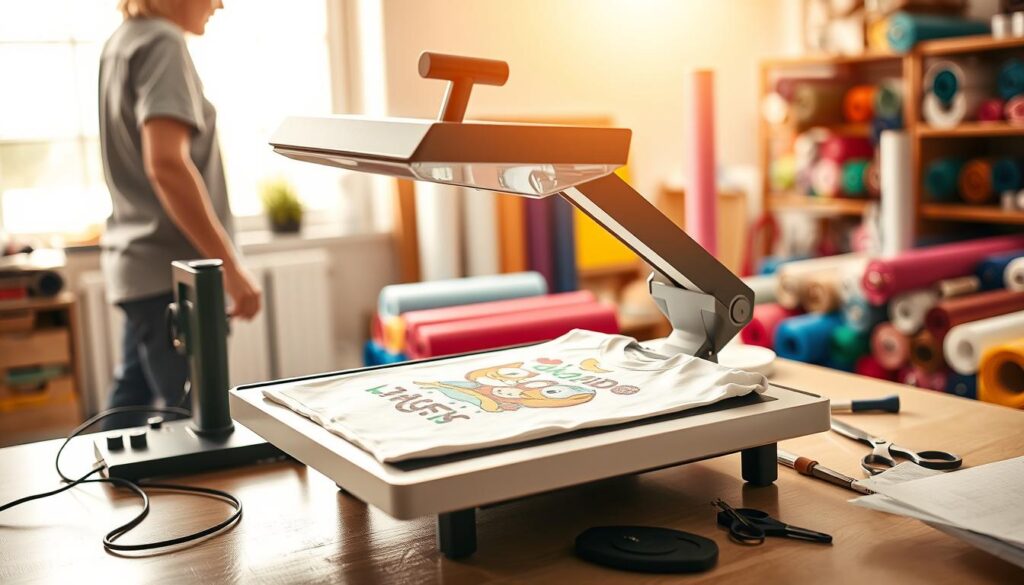
The debate is between the Home Iron vs. Heat Press. The home iron is the plucky, moody underdog. It’s the tool you have, perfect for small projects. But, it’s inconsistent and can get distracted.
The heat press, on the other hand, is the stoic professional. It applies even heat and pressure perfectly. The press doesn’t get distracted and does the job well.
The real challenge is the peel. This is the law of the vinyl jungle. You have two choices, and only one is correct:
- The Hot Peel (The Rookie Mistake): Peeling the carrier sheet while the vinyl is warm. This can lift the design, leaving a sticky mess. It’s the vinyl’s way of saying, “Not yet, amateur.”
- The Cool Peel (The Only Way): Wait until the vinyl cools completely. Then peel. This allows a permanent, washable bond. This isn’t a suggestion; it’s the law.
So, which tool should you choose? The answer, as with most things, is: it depends on your needs.
| Home Iron | Heat Press | |
|---|---|---|
| Cost | Low (you probably own one) | High (significant investment) |
| Even Heat | Uneven, requires constant motion | Perfectly even across the platen |
| Pressure | Manual, inconsistent | Consistent, adjustable pressure |
| Best For | One-off projects, small designs, beginners | High-volume, professional results, intricately weeded |
The Sage’s Verdict? The home iron is your test kitchen. Use it for prototypes and small projects. The heat press is for perfection, volume, and no excuses. But remember, the most expensive press in the world is useless if you don’t respect the cool-peel. In the kingdom of HTV, patience isn’t just a virtue; it’s the law.
Trims & Ribbons: The Art of Safe Adornment
In the world of costumes, fabric is like the main story. Trims and ribbons add the finishing touches. They must be safe for kids, yet look great. It’s a delicate balance between beauty and safety.
Trims can fray, which is a big problem. To stop this, use a liquid anti-fray solution. For ribbons, fold the edges twice before sewing. This makes the trim strong and neat.
But the most important rule is: no neck loops. Ribbons can be dangerous if they get caught. Use breakaway closures like Velcro instead. This keeps the costume safe and stylish.
Think about how the trim looks and feels. A heavy trim can weigh down a light fabric. Choose trims that match the fabric and are comfortable. Every detail matters for a safe and beautiful costume.
3D Texture: Foam Scales, Stuffed Motifs, Quilted Panels
We’ve mastered the flat plane. Now, let’s conquer the Z-axis. Paint and vinyl offer a 2D design. But, true costume magic happens when you add a third dimension.
This is where your costume becomes an environment you can feel. Think of a dragon’s hide, a knight’s gambeson, or the chitinous plates of a spacefaring alien. This is the realm of 3D texture, where your costume goes beyond fabric and enters the realm of tactile architecture.
Moving beyond appliqué and vinyl, 3D embellishment builds character and story through form. It’s the difference between looking at a lizard and petting a dragon. We’re not just adding decoration; we’re engineering a tactile narrative. The goal isn’t just to be seen, but to be experienced. Let’s deconstruct the three pillars of this third dimension.
The Armorer’s Secret: Layered Foam Scales
Forget flat, lifeless scales. The secret to realistic dragon hide or dragonfish scales lies in layered construction. Think like a master armorer, not a costumer. Start with a flexible foam base.
Cut individual “scales” from craft foam, but here’s the sage’s trick: don’t just glue them on flat. Layer them. Overlap them like shingles on a roof or the actual scales of a reptile. The magic happens when you use two tones of paint—a darker base and a dry-brushed metallic highlight on the raised edges.
This creates an iridescent shimmer and a convincing, multi-layered quilting texture that catches the light from every angle. It’s not a costume piece; it’s a wearable, flexible piece of armor.
Stuffed Motifs: From Flat to Puffy
If foam scales are for armor, stuffed motifs are for charm and whimsy. The key here is strategic under-stuffing. The Sage advises: a plush motif should have a gentle give, like a firm pillow, not a overstuffed couch cushion.
The goal is dimension, not a beanbag. For a puffy cloud, a puffy heart, or a cartoonish emblem, use a lightweight, non-bulky stuffing and secure the motif with a tight, invisible ladder stitch. The result is a dimension you can’t get from any flat appliqué—a 3D emblem you can squish.
Quilted Panels: The Textural Power of Stitchcraft
Quilting isn’t just for grandmothers and country aesthetics. In the world of costume texture, a quilted panel is tactical, futuristic, or enchanted armor. By stitching a raised pattern into a padded fabric, you create a quilting texture that suggests high-tech padding, arcane circuitry, or the bark of an ancient tree.
It’s not just for warmth; it’s for world-building. The lines of stitching create light and shadow, adding a layer of visual and tactile complexity that flat fabric can’t achieve. It’s the difference between wearing a jacket and wearing a power core.
Building Your 3D Texture: A Quick-Start Guide
Each technique serves a different purpose. Choose your texture based on the character you’re building:
- Foam Scales & Plates: Best for armor, dragonkin, reptilian creatures, and sci-fi armor plating. Creates a hard, defensive, and imposing silhouette.
- Stuffed Motifs: Perfect for whimsical, cute, or magical designs. Ideal for mascot heads, puffy appliqués, or creating soft, 3D logos.
- Quilted Panels: Ideal for adding “tech” texture to sci-fi uniforms, creating “enchanted” armor with glowing stitch lines (using EL wire or LED lights in the channels), or adding geometric, padded sections to a garment.
The architecture of fluff matters. Too little stuffing looks deflated; too much becomes a misshapen pillow. The Sage’s advice? Build your texture with purpose.
A dragon’s scale, a knight’s gambeson, and a starfleet officer’s uniform all have their own internal logic. Your material choices—craft foam, quilt batting, strategic stuffing—are the tools to build that logic, transforming a flat idea into a world you can feel.
Older-Kid Projects: Hand-Sewn Sequins & Beads (Knot Security)
Leaving glue guns and iron-ons behind, we dive into the world of needle and thread. This isn’t just a craft session; it’s a lesson in patience and precision. It’s about securing tiny, sparkly things so they stay put.
This is for kids (or adults) who can focus like a cat on a laser pointer. They’re ready to move up to hand-sewn sequins and beads.
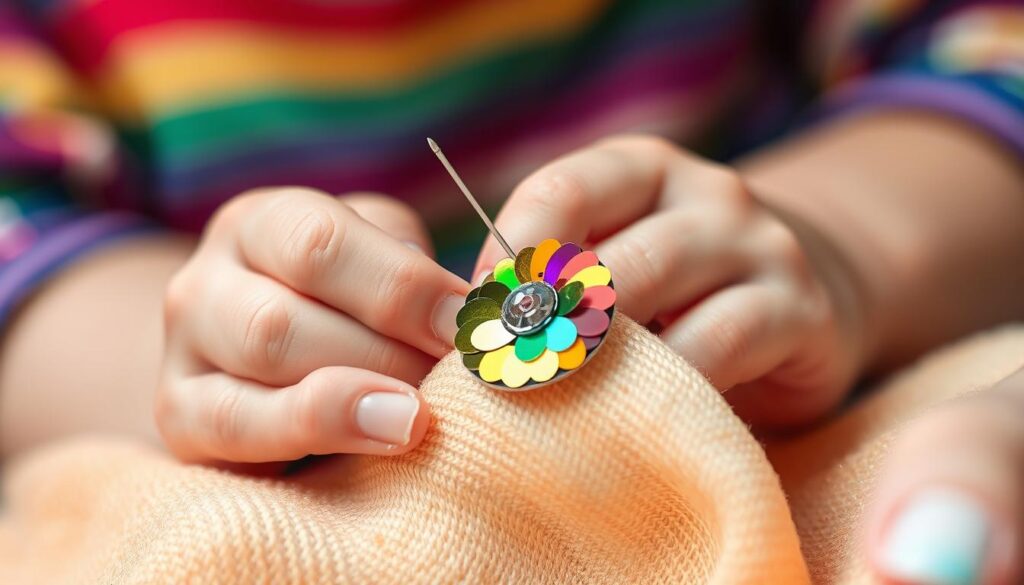
Forget about weak glue and temporary adhesives. We’re aiming for the thwick of a needle through felt and the *click* of a bead in place. The key is a double-secured knot. This isn’t just decoration; it’s a meditation with a pointy end.
The goal is to create something beautiful that lasts. It won’t fall apart after its first use.
The Sacred Art of the Unbreakable Knot
A single, poorly tied knot can ruin any beaded or sequined masterpiece. A weak link can turn your child’s beaded dragon scale into a storm of glass and plastic. We’re not just tying knots; we’re building a fortress of thread.
The secret to Knot security is the right materials. Use strong, bonded nylon or beading thread for beads. For sequins and heavier embellishments, choose a strong, waxed cotton or fine, strong embroidery floss. The wax gives grip, and the strength keeps your secure knots in place.
The Double-Knot Protocol
Here’s the unbreakable law: One knot is a prayer. Two knots are a promise. The process is a ritual:
- Anchor it: After threading your needle and anchoring the thread at the back of your fabric, take your first stitch. Before pulling it taut, loop the thread through the bead or sequin and then back through the fabric.
- The First Knot: On the backside, tie a standard overhand knot. This is your foundation.
- The Locking Knot: This is the key step. Before tightening the first knot completely, create a second overhand knot on top of the first, pulling it tight against the initial knot. This creates a “double-lock” system. Think of it as a deadbolt over a doorknob lock.
- The Burn Test (For Synthetic Threads): For synthetic threads, a careful and brief touch with a lighter’s flame to the knot’s tiny tail can melt the ends into a tiny, hard seal. (Adult supervision is non-negotiable here).
Common Knotting Fails & Fixes
- The Slippery Slope: Using the wrong thread (too smooth or too thick) for your beads. Sequins with small holes need beading needles and specialized thread.
- The Phantom Loop: Not leaving a long enough tail when you start. You need at least 3 inches to tie a proper finishing knot.
- The Chokehold: Pulling the knot too tight before it’s seated can stress and break the thread. Snug, not strangling, is the mantra.
| Knot Type | Best For | Security Level | Difficulty |
|---|---|---|---|
| Double Overhand (Surgeon’s Knot) | General beadwork, securing sequins | High | Beginner |
| Square Knot with a Half Hitch | Heavy beads, focal points | Very High | Intermediate |
| Backstitch Anchor | Starting/ending thread, no-knot starts | Maximum | Intermediate |
The table above isn’t just a chart; it’s your cheat sheet for bead knot security. Notice we don’t even list a “Single Knot” option. In this dojo, we don’t speak of such things.
Remember the messy, joyful chaos of dyeing wooden beads in a rainbow of colors? That’s the spirit we bring here. It’s not just about the final, sparkling product. It’s about the process: the focus required to thread the needle, the rhythm of the stitch, and the profound satisfaction of a knot that will not fail. It’s a lesson in patience, precision, and the quiet confidence that comes from creating something beautiful and durable with your own two hands.
Theme Boards: Space, Forest, Ocean, Mythic
The true test of a costume isn’t in its stitches, but in its story. Does it whisper ‘astronaut’ or scream ‘interstellar pioneer’? We’ve navigated the technical manuals. Now, let’s play museum curator. This is where fabric becomes folklore, and a child’s play transforms into immersive theater.
Think of each theme board as a creative brief for a tiny epic. We’re analyzing color psychology, texture semiotics, and the narrative power of a single, well-chosen prop. The Sage doesn’t just make a mermaid costume; we deconstruct the lore. What texture says “I am of the sea”?
Below is your comparative field guide. It’s less about rules and more about resonant combinations—the visual grammar that makes a theme feel cohesive and alive.
| Theme | Color Palette | Key Textures | Signature Embellishment | Prop/Narrative Hook |
|---|---|---|---|---|
| Deep Space Explorer | Black, midnight blue, silver, iridescent purple | Velvet (space), slick HTV (planets), puffy paint (stars) | Iridescent heat-transfer vinyl planets & constellations | DIY cardboard control panel with LED lights; “mission patch” appliqué |
| Enchanted Forest | Moss green, bark brown, mushroom cream, berry red | Faux fur (moss), quilted “bark,” felt leaves | Layered appliqué leaves with varying green shades | Twig “wand” with ribbon vines; acorn pouch belt |
| Mystic Ocean | Teal, seafoam, pearlescent white, deep aqua | Shiny scales (HTV), netting, draped blue chiffon | Sequined scales in a gradient pattern | Shell necklace; “treasure map” bandana. For more aquatic ideas, see our beach-theme resource. |
| Mythic Realm | Gold, crimson, deep purple, marble white | Brocade trim, faux leather, chainmail HTV | Embroidered or HTV heraldic symbols | Foam-core shield; “spellbook” with fabric cover |
Let’s dissect these worlds, starting with the final frontier. The Deep Space Explorer theme thrives on contrast. Matte black velvet bodysuits become the void. Iridescent HTV planets seem to float. The genius touch? Puffy-paint star constellations you can feel. It’s tactile astronomy.
Add a helmet from a repurposed bubble bowl and a vest with a “mission control” patch. Suddenly, you’re not at a birthday party—you’re conducting a flyby of Jupiter. The narrative hook is exploration, not just decoration.
Next, the Enchanted Forest. This isn’t about generic green. It’s about the ecosystem. Mossy trims (faux fur) at the hem suggest the forest floor. Upward, quilted panels mimic tree bark. Appliquéd leaves in satin, felt, and burlap create depth.
The color palette should tell a story from forest floor to canopy. Add a belt with a little pouch for “foraged” acorns. The texture combination sells the fantasy.
The Mystic Ocean theme is a study in fluidity and light. The goal is capturing shimmer, not just blue. Use heat-transfer vinyl scales in a gradient—teal at the top fading to aqua. Overlap them like real fish.
Drape sheer blue chiffon over sleeves for a wave-like effect. The prop is everything: a net bag for “sea treasure” or a crown woven from rope and shells. It’s about creating the illusion of movement on dry land.
Lastly, the Mythic Realm. This is where costume edges into cosplay. Think legends, knights, and sorcerers. The materials must look aged and heroic. Faux leather for vests. Brocade trim for royal gowns. Chainmail patterns cut from silver HTV.
The embellishment is heraldic: a family crest in appliqué on a tunic. A foam-core shield wrapped in metallic vinyl completes the transformation. The palette is regal—golds and deep reds speak of power and ancient magic.
The through-line? Cohesion. Each element—color, texture, prop—must converse with the others. A theme board ensures they’re all speaking the same visual language. It turns a decorated outfit into a portal to another world. And isn’t that the best kind of play?
Care & Repairs: Keep It Looking New
The real test of a Sage’s work is how it holds up over time. A costume that falls apart after one use is a disappointment. It’s not just about keeping it looking good; it’s about showing respect for the craft and the child’s imagination.
Here’s how to make sure your costumes last. They should sparkle and endure for many wearings.
The Gentle Art of Washing (Without Unraveling Your Masterpiece)
Forget the agitator. The washing machine can ruin HTV, foam scales, and beading. A Sage’s method is gentle.
Turn the garment inside out. Use cold water and a mild detergent. The dryer is too hot and can ruin your work.
Remember, cold water, mild detergent, and air-drying flat are key. The dryer is not your friend.
Storage: A Place for Everything
You wouldn’t stuff a crown into a shoebox. Storage is important for your work. Lay 3D elements like foam scales flat or hang them in a garment bag.
This prevents damage and keeps beading from snagging. A simple garment bag protects against dust and moths.
The table below is your quick-reference field guide to post-creation care, the emergency procedures for your embellished creations.
| Issue | Immediate Action | Long-Term Repair |
|---|---|---|
| Loose Bead or Sequins | Secure with a tiny dot of fabric glue to back of item to prevent further unravelling. | Re-stitch using the original thread holes with a doubled, knotted thread. |
| Peeling HTV or Appliqué | Do not pull! Place a thin cloth over the area and apply a warm (not hot) iron with firm pressure for 10-15 seconds to reactivate adhesive. | If fusible web fails, use a fabric glue designed for the specific materials (vinyl to fabric). |
| Fraying Ribbon or Trim | Apply a thin line of clear-drying, flexible fabric glue (e.g., Fray Check) to the raw edge. | For a permanent fix, stitch a new, clean edge just inside the frayed area. |
| Loose 3D Embellishment | If foam or stuffed, check for popped seam. Use a ladder stitch for invisible mends. | Reinforce the original seam with a new, longer running stitch for durability. |
The Invisible Mend and the Philosophy of “Wabi-Sabi”
Perfection is boring and unattainable. A Sage sees beauty in the kintsugi of costuming: the artful repair. A lost sequin is a chance to add something new.
A popped seam is a chance to make the whole seam stronger. The goal is to honor the garment’s history, not hide it. A small, nearly invisible whipstitch on the inside of a seam shows wisdom, not failure.
The final, most important care instruction is to trust your initial technique. The fusible web, triple-secured knots, and cool-peel of your HTV are your primary repair tools. A well-built costume tells a story of adventures survived, lasting through time and play.
Download: Stencil Pages & Motif Patterns
You’ve learned the techniques and mastered the methods. Now, it’s time to get the tools. Theory is for planning, but creation needs a toolkit.
This is your formal invitation to the practical. Below, you’ll find the Sage-approved toolkit. It’s not just any clip-art. It’s a curated collection of patterns, including the definitive dragon-scale and perfect elven leaf templates.
Your download includes stencil pages and scalable vector files (SVG/PDF). Print them, trace them, and scale them for your mythic quilt or space-adventurer’s cape. These patterns and templates will help you turn the techniques into tangible, wearable art.
This is the final step from theory to your next masterpiece. Your toolkit awaits. The only thing left to add is your spark.