Forget the boardroom. The most intense negotiations I’ve ever witnessed happened in a playroom. A child in a cape and another wearing a colander helmet were at it. We often dismiss costume play as mere fun.
But strip away the glitter, and you’ll find a premier laboratory for human interaction. Developmental psychology data shows that pretend play builds real-world confidence, communication, and cooperation. It’s where kids first practice the delicate art of reading a room.
Consider the “Newspaper Costume Show.” This isn’t just arts and crafts. It’s a crash course in resource allocation and collective narrative. Who gets to be the robot’s head? How do we explain our cardboard kingdom? These questions force collaborative storytelling and expressive vocabulary.
So, the next time you see a pile of fairy wings and firefighter hats, look closer. You’re not seeing a mess. You’re seeing a training ground for future diplomats, convened around the original, analog social network.
Role-switching
I’ve seen my niece change from a bossy tea party host to a humble guest in just thirty seconds. This quick change is where learning happens. It’s not just about taking turns. It’s about stepping into someone else’s shoes and seeing things from their point of view.
Think of it like a mental Airbnb. A child has to leave their own thoughts and feelings behind. They become someone else, like a pirate captain or a cashier. This is key for handling tough social situations.
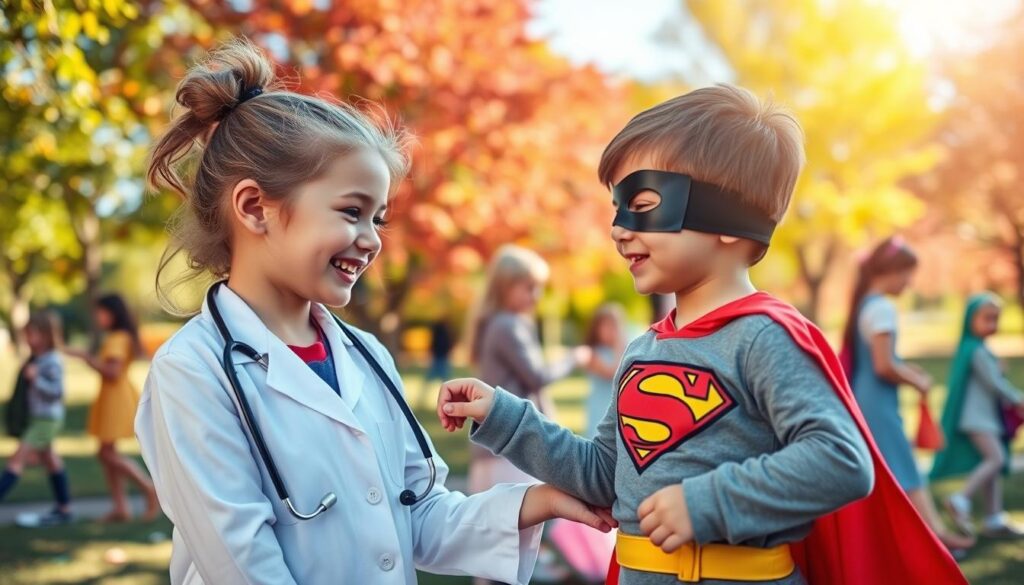
That plastic grocery store is more than a toy. It’s a place for kids to practice being a service provider. When they switch roles, they face new challenges. This back-and-forth helps them learn to adapt quickly.
The table below shows how role-switching helps kids learn important social skills.
| Child’s Assumed Role | Primary Social Skill Practiced | The Underlying Mechanism |
|---|---|---|
| Restaurant Server | Anticipating needs, polite requests | Forces focus away from self and onto the “customer’s” experience. |
| School Teacher | Instruction, patience, authority | Requires organizing thoughts for others and managing a “classroom.” |
| Pirate Captain / Crewmate | Sharing leadership, following orders | Demands rapid identity shift between command and cooperation. |
| Doctor with a Patient | Empathetic care, problem-solving | Creates a power dynamic focused on helping and being helped. |
Next time you see kids arguing over a toy, think about it. It’s like a mini-diplomacy. Each time they say, “You be the dragon, I’ll be the knight,” they’re making a deal. This is how they learn that the world is bigger than their own story. It’s a key lesson for growing up.
Empathy building
Forget empathy workshops for executives; the real training ground is a playground game of ‘Weasel in the Middle.’ This is where the abstract concept of caring for others gets its stress test. Group play isn’t just fun and games. It’s a natural laboratory for social interaction, a boot camp for the heart.
Think of it this way. Empathy isn’t bestowed. It’s built, brick by social brick. The key pragmatic skill here is perspective taking. It’s the mental gymnastics of asking, “How would I feel in your shoes?” Or, more critically, “What are you thinking right now?”
Structured activities force this issue. Take the simple task of sorting “funny vs. not funny” jokes. The debate isn’t about comedy. It’s a masterclass in reading a room. Kids must vocalize why a joke might land for them but fall flat for a friend. They’re decoding invisible social cues in real-time.
Dress-up scenarios are empathy simulators on overdrive. When the child in the princess costume kneels to console the “slain” dragon, they’re not just following a story. They’re interpreting slumped shoulders and a pout as signals of distress. They’re practicing an emotional response. This is social software debugging at its most fundamental level.
Researchers call this space a “natural laboratory” for a reason. Games like collaborative challenges, where a team must build a tower with limited resources, have no villain. The conflict is the problem itself. Success demands understanding your teammate’s frustration, their idea, their silent plea for help. You learn to read the field.
Let’s be brutally honest. Many adults could use a refresher course in the “Cold Wind Blows” game to remember what common humanity feels like. The chaotic, beautiful mess of group play is where theory of mind moves from a textbook concept to muscle memory. It’s emotional cross-training.
This isn’t touchy-feely stuff. It’s the bedrock of social cohesion. The ability to accurately gauge another’s perspective is the anti-dote to tribalism. In a world often lacking nuance, these childhood games teach a critical lesson. Your truth is not the only truth in the room.
So, the next time you watch a seemingly chaotic group game, look closer. You’re witnessing the forging of social intelligence. Brick by brick. Play by play. It’s where children learn the most complex algorithm of all: how to be human, together.
Conflict resolution
The throne room of a pillow-fort castle is where kids practice diplomacy. One might claim the glittery crown by right; the other might suggest a vote. It’s not just play. It’s a lesson in negotiation, focusing on dress-up social skills.
These pretend battles are smart. They let kids try out big people skills in a safe place. The drama feels real, but the consequences are just playroom stuff. This lets them try out different ways to solve problems, like figuring out if a problem is big or small.
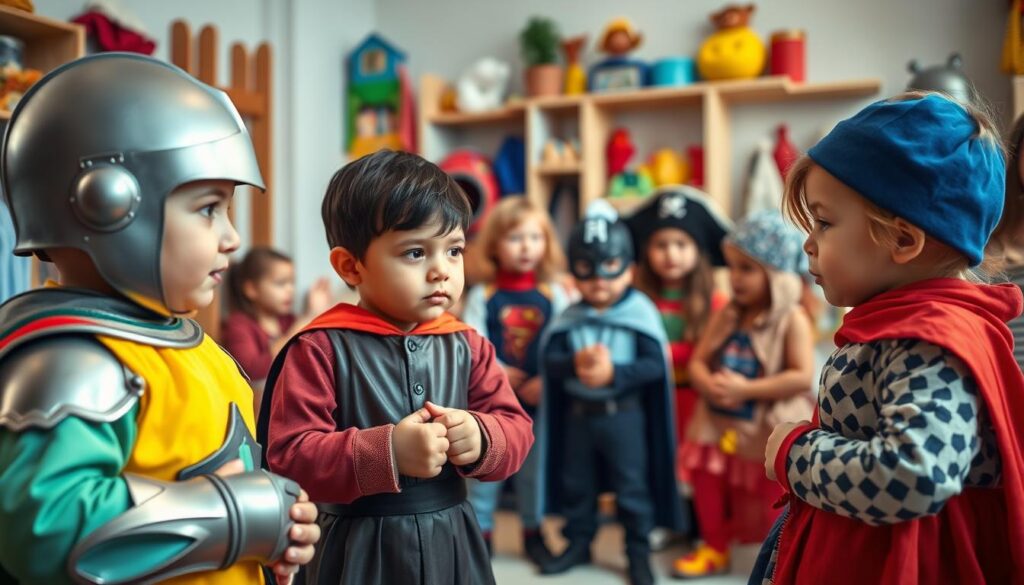
Children learn complex strategies in these play scenarios. It’s like a mini guide to peacekeeping:
- I-messages: Changing “You’re a cape hog!” to “I feel frustrated when you take my cape because I’m flying a rescue mission.” This way, they focus on their feelings, not blaming.
- Genuine Apologies: Saying “I’m sorry I knocked over your block tower. I’ll help you rebuild it.” This teaches them to take responsibility and make things right.
- Compromising: Learning to share. “You can be king until the timer goes off, then I get a turn.” It’s about finding a fair deal.
- Walking Away: Knowing when to step back to cool down. This skill is useful beyond playtime.
These activities help kids develop emotional smarts, just like linking dress-up to literacy and empathy does. They learn to communicate and share, which are key to emotional intelligence.
They also tackle group challenges. Tasks like building a spaghetti tower or solving a pipeline problem require teamwork. Disagreements are part of the process. They learn to share ideas and work together, combining creativity with problem-solving.
So, learning to settle a dispute over a plastic crown is important. It’s basic training for handling bigger issues later on. The skills they develop—like patience, communication, and compromise—are essential for working well with others. In the end, the most valuable thing they take away is the skill of dress-up social skills.
Parental encouragement
See your living room as a place for kids to learn social skills, not just play. You’re the stage manager, not the boss. The kids write their own stories.
Experts from Zero to Three and the CDC say it’s best to let kids lead. Don’t control the story. Ask open-ended questions like “What does the dragon do next?”
Give kids the tools they need, like dress-up clothes. But also give them time to play freely. Be part of their play, but let them set the pace.
This way, kids can learn to work together naturally. You’re creating a space for them to grow and learn. You give them the tools and the space to explore.
Your support is what makes it all happen. It turns simple play into a lesson in how to interact with others.