Have you ever really understood someone just by reading about them? It’s like trying to learn salsa from a book—it’s hard, awkward, and misses the beat.
Storyboard costumes make literacy play more than just reading. It’s like acting for kids in school.
Teachers are using My Storybook to turn classrooms into theaters. Students don’t just read about Matilda’s struggles—they become her. It’s not just play; it’s learning to feel what others feel.
By acting out stories, kids connect what they read to how they feel. It makes understanding real, not just a theory. And they feel more confident too.
Choosing a Character: traits, signature colors, symbols
Ever notice how some book week outfits feel like cheap Halloween costumes while others capture literary magic? The difference lies in visual semiotics – the art of reading character design like a language. Great characters don’t just wear clothes; they wear their personalities.
Think of it as visual storytelling. Round shapes suggest friendliness (Winnie-the-Pooh’s belly), triangles imply mischief (Cheshire Cat’s grin), and squares communicate stability (Aslan’s majestic frame). These aren’t arbitrary choices – they’re character traits made visible.
Proportion tells its own story. Oversized heads signal childlike wonder (think Calvin from Calvin and Hobbes), while elongated limbs suggest elegance or otherworldliness (the BFG’s towering presence). It’s why generic princess costumes fail where specific character designs succeed.
Signature colors become psychological shorthand. Mary Poppins’ crimson coat signals magic and authority. Where’s Waldo’s stripes create seek-and-find fun. Charlotte’s web glistens with dew-drop silver. These palettes aren’t decorative – they’re narrative devices.
Building authentic book week outfits means decoding these visual cues:
- Shape language: Circular elements for friendly characters, angular features for antagonists
- Color psychology: Warm hues for approachability, cool tones for mystery
- Proportion play: Exaggerated features that define personality
- Symbolic accessories: Mad Hatter’s hat, Pippi’s mismatched socks, Harry’s glasses
The best character traits manifest physically. Sherlock Holmes’ deerstalker cap signals observation. Matilda’s books represent intelligence. Corduroy’s missing button embodies longing. Each element serves the story.
When planning book week outfits, ask: What shapes define this character? Which colors tell their story? What proportions make them recognizable? The answers transform fabric into literature.
This isn’t costuming – it’s character analysis through wardrobe. And honestly, it’s more fun than analyzing political rhetoric. At least here, the stripes are actual stripes.
Research Together: illustrations, time periods, themes
Turn your living room into a literary detective agency. The best storybook costumes are about understanding the character’s world. You and your mini-research assistant will decode visual clues like art historians and cultural anthropologists.
Begin with the illustrations. Each stroke tells a story beyond the text. Maurice Sendak’s Wild Things are both scary and cuddly, showing intentional design. The evolution of children’s book illustrations makes our costume research richer.
Time periods are key. Is your character from Victorian England or 1960s America? The difference in clothing is huge. Even fantasy worlds, like Narnia and Harry Potter, have historical touches.
Here’s how to research:
- Gather different book editions to see how illustrations change
- Look at color palettes and visual motifs
- Learn about the story’s historical setting
- Find symbols that define the character
Themes are the heart of your costume. A Where the Wild Things Are costume is about wild energy. Corduroy’s overalls symbolize longing and belonging.
Different books need different approaches:
| Book Type | Research Focus | Costume Complexity |
|---|---|---|
| Board Books | Simple shapes, bold colors | Low (1-2 elements) |
| Picture Books | Detailed illustrations, color symbolism | Medium (3-4 elements) |
| Chapter Books | Text descriptions, historical context | High (5+ elements) |
The goal is understanding, not perfection. Your seven-year-old might not know semiotic theory, but they’ll get why Madeline’s yellow hat is important. They’ll understand how visuals support the story.
This research turns costume making into a literary analysis. You’re not just sewing clothes – you’re creating a story interpretation. The storybook costumes become a way to share character and context insights.
It’s also educational, but keep it a secret. Shhh – don’t tell the kids they’re learning about history and visual literacy while planning their Halloween costume. Some secrets are best kept between enlightened parents.
Mood Boards & Sketching: kid‑friendly planning steps
Forget about perfect Pinterest boards – the best mood boards are made with crayons and a bit of chaos. While pros focus on details, we’re building something more important: creative confidence. This comes from embracing a little mess.
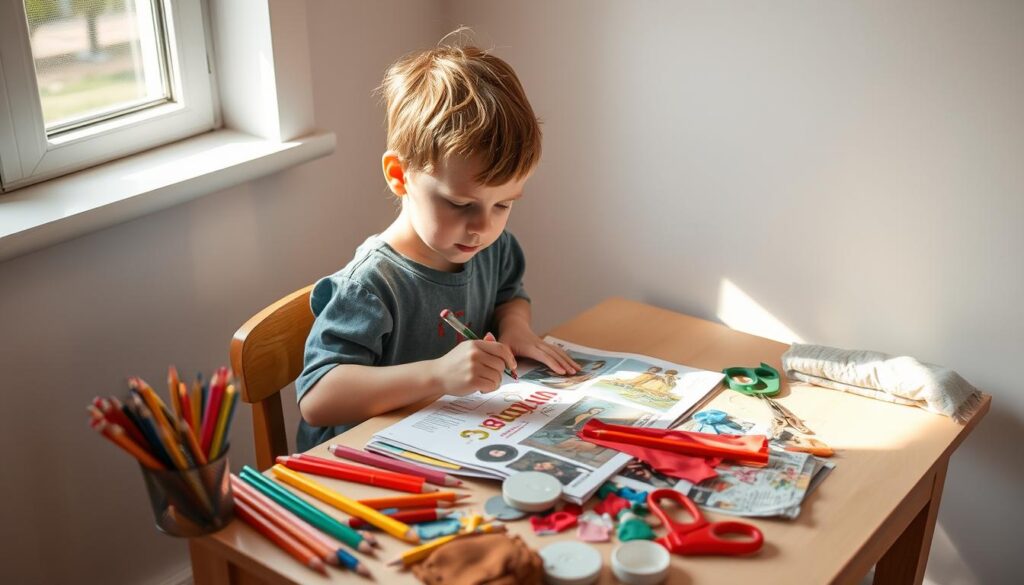
Begin with “visual brainstorming” – a fancy way of saying cut out anything that catches your child’s eye. Use magazine snippets, fabric swatches, or even leaves from the backyard. The goal is to find new things, not to make everything match.
Children naturally create contrast in their own way, unlike professional designers who plan it out. This is where the magic happens.
Here’s how to keep things fun without losing their focus:
- Set a 15-minute timer (because attention spans are shorter than most TikTok videos)
- Use a pizza box instead of fancy boards – it doubles as storage
- Sort images into “love” and “maybe” piles instead of formal categories
When sketching, think of wobbly lines as style choices. An uneven crown or mismatched boots can be part of a character’s charm. Unlike pros who aim for perfection, kids show us that sometimes the best things come from mistakes.
Constraints can spark creativity. Limited markers? That’s a color scheme. No purple paper? Silver becomes the standout feature. It’s like jazz with construction paper – the limits make it beautiful.
This isn’t about making art for a portfolio. It’s about making memories through fun, intentional mess. The crooked sketch today might become tomorrow’s treasured memory of creative bravery.
Building the Look: closet shopping list and DIY elements
Your closet is full of hidden character possibilities. It’s all about seeing what you already have in a new way. Think of it like turning everyday items into something magical.
Imagine you’re a costume expert, like MacGyver. That gray sweatshirt can become an owl costume with a few tweaks. And those red curtains? They’re perfect for Little Red Riding Hood’s cape or a royal robe.
It’s all about seeing the narrative in objects. Every item should tell a part of the story, like pages in a children’s book. This makes your costumes unforgettable.
Let’s look at how common items can become something special:
| Household Item | Character Look | Transformation Method | Storybook Example |
|---|---|---|---|
| Colored bedsheets | Royal robes, capes, dresses | Draping, safety pin construction | Queen from Snow White |
| Cardboard boxes | Armor, animal shells, buildings | Cutting, painting, straps | Tortoise from Hare & Tortoise |
| Winter scarves | Animal tails, hair, accessories | Braiding, attaching to clothing | Fox from Fantastic Mr. Fox |
| Pool noodles | Magic wands, swords, antennae | Cutting, foam covering | Fairy godmother wand |
| Old t-shirts | Animal bodies, tunics, base layers | Cutting, stitching, adding elements | Mouse from Lion and Mouse |
This table is more than a shopping list. It’s a guide to creating characters. Each transformation adds to the story, not just looks.
DIY elements are like special effects. Fabric paint can change clothes into patterns. Hot glue guns add details like scales or feathers. The goal is to show the character in a way that sparks imagination.
Creating amazing storybook costumes means seeing your home as a source of inspiration. Every towel can be a superhero cape. Each cardboard box can be a miniature world. It’s all about reading your home like a book.
Safe Props: cardboard engineering, foam details, rounded edges
Forget NASA – the real engineering marvels happen when you’re crafting cardboard swords that won’t send anyone to urgent care. We’re talking industrial design thinking applied to children’s play, because nothing kills literary magic faster than a safety incident.
Let’s break down the physics of play-safe prop design. This isn’t just arts and crafts – it’s structural engineering with imagination as the primary building material.
Cardboard engineering principles would make any aerospace engineer proud. The secret? Understanding grain direction and stress points. Corrugated cardboard has natural strength along its flutes – position these for maximum structural integrity.
Think of it as origami meets architecture. Single-thickness for lightweight elements, double or triple-layer for structural components. Reinforce stress points with strategic folding, not just more tape.
Now for the magic trick: foam details that add authenticity without adding danger. Craft foam sheets become everything from medieval armor detailing to sci-fi control panels. They cut easily, shape beautifully, and have the impact resistance of a political promise.
Here’s my pro tip: use different foam densities strategically. Firmer foam for structural elements, softer foam for decorative details. It’s like casting the right actor for each role in your miniature production.
Rounded edges matter more than aesthetic perfection. Sharp corners transform props from imaginative tools into hazards. Every edge gets the softening treatment – because in prop design, safety is the ultimate sophistication.
Three construction commandments I live by:
- Watch for tangents – those protruding elements that might catch on clothing or skin
- Work the gaze – design from a child’s eye level, not adult aesthetic preferences
- Mind the sizes – props should be proportionate to the child, not the character
The best prop design balances visual appeal with physical safety. It’s the design equivalent of writing that’s both sophisticated and age-appropriate. Your creations should withstand enthusiastic play while maintaining their storybook authenticity.
Remember: we’re building imagination tools, not museum pieces. If a prop survives Act III of an eight-year-old’s dramatic interpretation of Charlotte’s Web, you’ve achieved engineering excellence.
This approach to prop design ensures that the only thing getting pierced is the dramatic tension – not anyone’s skin. The goal? Props that look like they stepped out of the storybook but feel like they were designed by safety experts.
Cultural Sensitivity: respectful portrayals and learning moments
Let’s talk about something important. Cultural representation in kids’ books isn’t just about looks. It’s about doing the right thing. Choosing costumes wisely is more than picking a random outfit.

Costumes that look like they’re from different cultures can be hurtful. They make fun of real cultures. Instead, learn about the meaning behind the designs. Think about when and where people wear these clothes.
Every time we make a mistake, we can learn something. That Native American headdress? Look into its true meaning. That “geisha” costume? Learn about real Japanese dresses. It’s like doing homework on your costume.
Is what we’re doing respectful or not? Real understanding turns dressing up into a way to honor, not mock. It’s like deep thinking about a book.
Children can understand this if we teach them. They know that dressing up as Moana means learning about her world. It’s not just about the clothes.
In the end, being respectful is key. It’s not about avoiding other cultures but about learning from them. Remember, the wrong costume can ruin the fun.
Performance Time: read‑alouds, mini‑plays, puppet scenes
Forget awkward school plays – this is where your costume becomes a passport to performance. We’re not recreating those cringe-worthy parental audiences, but building something far more authentic. This transformation turns reading into living literature, where text jumps off the page and becomes embodied experience.
Read-alouds undergo magical metamorphosis when delivered in character. Suddenly that timid voice finds new resonance, stumbling over words becomes character-appropriate hesitation. The costume does half the acting work before you’ve even opened your mouth. It’s like method acting for the elementary school set, minus the pretentiousness.
Mini-plays become glorious improvisational theater where scripts are mere suggestions. Kids naturally expand dialogues, add gestures, invent subplots – all while staying true to character essence. This organic storytelling builds confidence far beyond memorized lines. You’re witnessing creative problem-solving disguised as play.
Puppet scenes offer brilliant psychological distance for shy performers. Behind that cardboard stage, even the most reserved child channels character voices with surprising bravado. The puppet becomes both shield and amplifier, allowing emotional expression without personal exposure. It’s literacy play at its most strategically brilliant.
This approach mirrors what My Storybook achieves in classrooms, but with home-field advantage. We’re trading institutional constraints for creative freedom, standardized assessments for genuine engagement. The goal remains the same: transforming students into confident storytellers, just through more authentic channels.
The result isn’t performance for audience approval, but literacy play as its own reward. Children internalize narrative structure through embodiment, develop empathy through character immersion, and build communication skills through improvisation. The costume becomes not just clothing, but conduit for comprehension.
Reflection & Documentation: photo journals, story summaries
Let’s be honest – the costume’s just the opening act. The real magic happens when we turn our creative play into lasting documentation that would make anthropologists nod in approval.
Photo journals become time capsules of imagination. Snap pictures during dress-up sessions, then have your child arrange them like a graphic novel. Add speech bubbles or captions that capture their character’s voice. Suddenly you’re not just documenting – you’re creating parallel narratives.
Story summaries transform play into literary analysis. Ask questions that dig deeper than “Did you have fun?” Try “What would your character think about this ending?” or “How would they solve problems differently?” You’re building critical thinking skills disguised as play discussion.
Reflection practices turn one-time activities into ongoing learning. Create a simple template:
- Character traits I discovered
- Story moments that surprised me
- What I’d change next time
These archives become growth markers. Comparing September’s Dracula reflections to December’s Hermione observations shows evolving comprehension skills. You’re building a portfolio of creative development – with better costumes than most art schools.
The meta-cognitive payoff? Children learn to analyze their own creative choices. They see patterns in their character selections. They recognize how different stories spark different imaginative responses. It’s literacy development wearing a very clever disguise.
So take the pictures. Write the summaries. Keep the journals. Because sometimes the most valuable part of dressing up isn’t the performance – it’s understanding what it all meant afterward.
Storage & Rotation: home costume library
So you’ve built an arsenal of book week outfits. Now what? Let’s talk logistics without turning your home into a backstage disaster zone.
Think of your costumes as a library. Each piece gets a cataloged home—clear bins for visibility, labeled shelves for series like Harry Potter or Percy Jackson. Rotate seasonal themes to keep excitement high.
Prop design matters here too. Cardboard crowns fold flat. Foam swords stack neatly. A little planning prevents a clutter avalanche.
This system isn’t just tidy—it’s a renewable resource for storytelling. Revisit old favorites with new depth. Because the best stories deserve encores.