Imagine a shop called “Costumes for Time Travelers.” The warning sign isn’t about price, but paradox. It reads: “Beware ripples in the fabric of time.” That’s our starting point.
Selecting an era isn’t about picking a date from a textbook. It’s about choosing a narrative portal. We’re engineering a temporal bridge. The materials? Bedsheets, safety pins, and a massive dose of imagination.
Think less ‘Bill & Ted’s Excellent Adventure,’ more ‘A Wrinkle in Time’ meets a local thrift store. This is where timeline learning transforms from a chore into a chase. History becomes the main character.
The goal is alignment. What period matches your child’s grade? What connects to their current reading? Most importantly, what has the “cool factor”? Get this right, and you’re not just assembling an outfit. You’re fashioning a new idea of what their education can become.
Let’s start building that bridge. The first step is the most important one.
Fast selector by grade & curriculum
You’ve picked the era. Now, let’s talk logistics. A great plan for a Tudor court gown can fail with a wiggly kindergarten historian. Our job is to teach history in a way kids can live it. Think of this as your quick guide.
We match the project’s ambition to the kid’s developmental stage. It’s the difference between a simple pioneer apron and a complex Roman toga. We aim for maximum learning with minimal stress.
This matrix is your first stop. It cuts through the noise and links your curriculum goal to a feasible, safe project.
| Grade Level Band | Historical Focus Suggestion | Project Complexity | Key Material Consideration |
|---|---|---|---|
| K-2 | Pioneer Life, Community Helpers | Very Low. Single-piece items (aprons, vests, simple caps). | Pre-cut fabrics. No small fasteners. Focus on large, safe embellishments. |
| 3-4 | Ancient Civilizations (Egypt, Rome), Colonial America | Low to Moderate. 1-2 piece costumes (tunics, tabards) with basic draping. | Introduce simple closures (Velcro). Breathability is critical for active wear. |
| 5-6 | Medieval Times, Renaissance, American Revolution | Moderate. Layered looks, more detailed accessories. | Durability and authenticity balance. Can handle buttons but offer alternatives. |
Age‑Safe Materials
Authenticity has its limits. Scratchy burlap might be perfect for a colonial costume kids project, but it’s also itchy. Our goal is to respect history but keep kids comfortable. We choose materials that are safe for kids’ skin and active play.
Younger students have sensitive skin. They also get hot, tangled, and frustrated easily. The right materials prevent problems before they start. We’re doing textile forensics—not for a crime scene, but for a successful classroom.
Breathable Fabrics, Closures, Footwear
Let’s get specific. The devil, and the comfort, is in the details.
Breathable Fabrics: Cotton muslin, broadcloth, and felt are your allies. They’re lightweight, washable, and non-irritating. Avoid heavy wool or synthetic costume satins that trap heat. A child pretending to be a colonial blacksmith shouldn’t actually feel like they’re forging metal in a sauna.
Closures: This is where we embrace modern miracles. Hook-and-loop tape (Velcro) is the undisputed champion. It empowers kids to dress independently and eliminates the finger-pinching nightmare of authentic tiny buttons or laces. For older grades, large toggles or fabric ties can offer a more period look without the fine-motor skill struggle.
Footwear: Never underestimate the power of happy feet. The goal is suggestion, not replica. Clean sneakers or simple ballet flats in a neutral color work far better than attempting uncomfortable period shoes. If you must, make simple “boot tops” from felt that slip over their own shoes. The day is long, and recess waits for no historian.
By prioritizing these elements, you’re not cutting corners. You’re building a bridge between the historical concept and a child’s lived reality. The result? A engaged student, not just a dressed-up one.
Age‑Safe Materials
Let’s talk about the elephant in the room. We’re all about authenticity in our adventures, but what does that really mean?
For a peasant, historical accuracy meant burlap that was rough and wool full of bugs. I suggest we aim for intelligent inauthenticity instead.
Our goal isn’t to make museum pieces. It’s to create portals. The right materials are key to making these portals—comfortable, safe, and changeable.
Modern fleece is like a tech wonder compared to old wool. Cardboard armor is light, easy to paint, and perfect for a day of battling dragons. This is what age-safe construction is all about.
Why is this important? A scratchy tunic can ruin the fun. Comfortable explorers can focus on their adventures, not their aches. The materials we pick can make or break the fantasy.
We’re not taking shortcuts. We’re picking the best options.
Breathable fabrics, closures, footwear
If you’re dressing up for history, think about the fabric, closures, and shoes. Each part must pass the test. Forget about looks for now. We’re talking about science and design. Your costume should last all day, from running to sitting quietly.
Start with breathable fabrics. It’s not just about feeling good; it’s about fighting the school’s air. In a gym, cotton is best. It’s like a small air conditioner for kids. Think of Tracy Beaker’s famous top. Its success is in the breathable cotton that keeps up with drama.
For November events, layering is key. A wool tunic over linen is wise. Here’s a guide to your fabric choices.
| Fabric | Best For | Historical Vibe | Playground Test |
|---|---|---|---|
| Cotton | Indoor events, warmer months | Pioneers, 20th Century | High. Washes well, breathes easily. |
| Linen | Under-layers, ancient & medieval eras | Roman, Egyptian | Medium. Wrinkles famously, but cool. |
| Wool Blends | Colder weather, outer layers | Viking, Medieval | Low (itchy). Use over another fabric. |
| Broadcloth (Poly-Cotton) | Budget-friendly, durable base | Versatile for many eras | Very High. The workhorse of the costume bin. |
Now, let’s talk about closures. The zipper is a 20th-century wonder, but for school, adjustable closures are best. Velcro is quick, but it can ruin the illusion.
Laces and ties are better. Think of the Beast Quest tunic hack. It’s not just smart; it’s genius. It fits every child perfectly with a simple adjustment. Buttons are okay, but they can be tricky. Snaps are quiet heroes. Choose wisely, like a general plans a battle.
Next, we have practical footwear. The wrong shoes can ruin a great costume. Ballet flats are pretty but not good for running. Choose shoes that are inspired by history, not exact replicas.
Learn from Percy the Park Keeper. His wellington boots are perfect for practical costuming. For a pioneer look, simple boots or dark sneakers are better than fake leather. The key is safety and durability over exactness. A confident child is more convincing than one worried about slipping.
Design these three parts—breathable fabrics, adjustable closures, and practical footwear—with care. You’re not just making a costume. You’re creating a safe, comfy space for imagination. It must handle history, homework, and more.
DIY Tutorials by Era
Let’s get our hands dirty. This isn’t about buying a pre-packaged identity. It’s about the craft of making, turning the ordinary into something extraordinary.
Think of a plain white bedsheet. Most see linen. I see the chance to create something amazing. With the right mindset, it can be a Roman toga, a knight’s surcoat, or a ghost from another time. The material stays the same, but your vision changes.
I’m inspired by Calisto, the artisan who saw fabric’s soul. We’re creating more than clothes. To make it easy, I follow the “five-piece rule.” If a project needs more than five parts, it’s too hard to do alone.
This way, we make style accessible to all. With a pair of scissors, some fabric paint, and smart thinking, we can dress a whole group of time-travelers. We’re not dealing with complicated patterns. We focus on simple, smart changes.
Remember, fashion is not just fancy clothes. It’s a verb. Let’s start doing.
Roman tunic, medieval tabard, pioneer apron, newsie cap
Welcome to the practical laboratory, where history comes alive. We’re not just reading about it; we’re making it. Below, we explore four iconic styles from different times and places.
Each project is more than a costume. It’s a way to talk about daily life, social status, and culture. We mix archaeological inspiration with lunchroom survivability. It’s your guide to time travel through making.
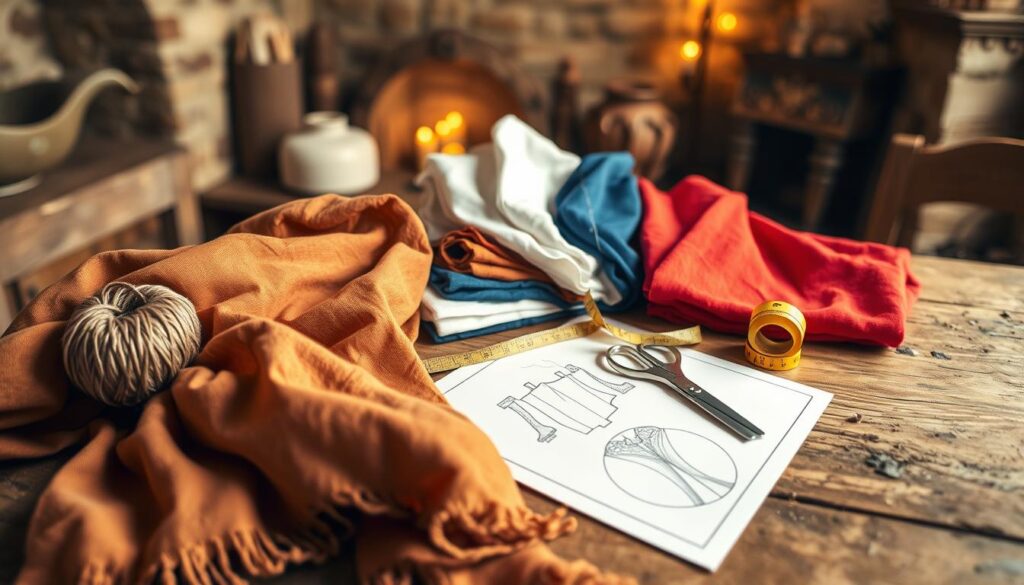
Roman Tunic: The Art of the Drape
The ancient Rome tunic shows the beauty of simplicity. It’s the everyday version of the toga. You don’t need complex sewing; just clever draping and knots.
Cultural Significance & A Modern Hack
In Rome, the tunic’s color stripe, or clavus, showed your social rank. Senators had wide stripes, while equestrians had narrow ones. We use red duct tape for a modern twist. It’s durable, easy to see, and sparks interesting conversations.
Materials & Difficulty
- Base: A large, light-colored t-shirt or a rectangular piece of linen/bed sheet.
- Clavus: Strips of red duct tape or fabric ribbon.
- Belt: A length of rope or a fabric sash.
- Difficulty: Easy. No sewing required.
Just put the t-shirt on, tie the belt around your waist, and add your ‘clavus’ stripes. For a ‘Horrible Histories’ or ‘Percy Jackson’ look, use an orange tee.
Medieval Tabard: Your Heraldry Canvas
Making a medieval child costume is easy with a tabard. This sleeveless tunic was a walking billboard for family crests. Today, it’s a canvas for your child’s creativity.
From Crests to Dragons
The symbols are simple: lions for bravery, fleurs-de-lis for purity. Or, let’s say, a dragon your kid drew last week. It’s about communicating through images. Cut a simple T-shape from felt, leave an opening for the head, and decorate.
Materials & Difficulty
- Fabric: 1 yard of felt or sturdy fabric (no hemming needed).
- Decoration: Fabric paints, markers, or pre-cut felt shapes.
- Closure: Fabric glue or safety pins for the sides.
- Difficulty: Moderate. Involves cutting and decorating.
This project teaches basic heraldry and celebrates creativity. It’s like wearing art.
Pioneer Apron: The Pocket of History
The heart of a true pioneer outfit is the apron. It wasn’t just for baking; it was a mobile workstation. Pockets held everything from sewing kits to foraged berries.
Practicality in Stitch
We’re inspired by Laura Ingalls Wilder here. We use durable fabrics like calico or muslin. Our tutorial shows how to make a waist-apron with deep pockets—perfect for storing “found artifacts” in class.
Materials & Difficulty
- Fabric: ½ yard of calico, muslin, or homespun-style cloth.
- Waistband: Long strip of fabric or ribbon.
- Notions: Scissors, needle & thread (or sewing machine).
- Difficulty: Moderate to Challenging. Involves straight sewing for pockets and waistband.
Wearing an apron changes how you move and what you do. It’s a costume that lets you act.
Newsie Cap: Urban Flair, Simplified
Jump to the early 20th century with the newsboy cap. It’s a lesson in urban style and the gig economy of the past. This iconic piece adds instant character with minimal materials.
Structure from Softness
This cap is about making structure from soft fabric. Traditionally made from tweed, we use felt for its ease. The button crown and small brim are surprisingly simple to make.
Materials & Difficulty
- Fabric: ¼ yard of stiff felt.
- Notions: A button, needle & thread, fabric glue.
- Pattern: A simple 6-panel cap pattern (easily found online).
- Difficulty: Challenging. Requires precise cutting and stitching.
When a child wears this cap, they’re not just a student—they’re a entrepreneur hawking the latest headline. It’s a powerful transformation from a single accessory.
Each of these projects is a gateway. They turn abstract dates into real textures. Remember, our goal isn’t to make museum-quality items. It’s historical empathy, built by hand.
Character Cards
So, you’ve picked the perfect outfit. The tunic fits right, and the apron looks just like it should. But, a costume is only as good as the person wearing it. We’re stepping into the world of storytelling.
It’s like mixing psychology with digging through old clothes. A toga isn’t just a fancy bed sheet. It’s the outfit of a brave Roman slave from “The Thieves of Ostia,” with a story of defiance and a secret scroll.
That pioneer apron isn’t just for churning butter. It’s a symbol of Laura Ingalls Wilder’s strong spirit. It’s where her optimism shines through.
The character card is like a cheat sheet for young actors. It answers key questions: What’s their special item? Their most famous line? What’s their secret goal?
It turns someone wearing clothes into someone living a story. That quiet kid in the wizard’s robe isn’t just a costume. They’re Harry Potter, ready to face the next challenge. The clothes are just the beginning of their adventure.
Book Pairings: Where Literature Meets Costume
This section is like your own literary costume department. It pairs historical fiction with your classroom’s outfits. A costume without a story is just fabric. But add a book, and you’re not just wearing clothes—you’re stepping into a character’s world.
Our DIY tutorials get a new soul here. We’re not just making clothes. We’re becoming characters. Each book series gives a unique view of history through fashion.
Little House on the Prairie: Prairie Practicality
Laura Ingalls Wilder’s stories are about simple, useful clothes. It’s not about fancy dresses. It’s about survival wear. The apron we made is more than a piece of fabric. It’s Laura’s work uniform, covered in berry juice and flour.
Here, we talk about purpose. Why wear a sunbonnet instead of a prairie bonnet? The book explains. Clothes were for sun protection, modesty, and survival. Students wearing these costumes learn about a real lifestyle.
Character Connection Points
Focus on Ma’s careful mending or Laura’s old calico. These details turn simple clothes into family stories. Ask students: “What chore would your apron witness today?”
I Survived…: Disaster Dressing
Scholastic’s I Survived series puts characters in the middle of big disasters. The costume here is about crisis attire. A newsie cap isn’t just cute. It’s what a kid wore while selling papers about the Titanic.
The 1906 San Francisco earthquake needs suspenders and rolled-up sleeves. Pompeii demands a simple Roman tunic, now covered in ash. The story’s urgency makes the costume feel more intense.
Narrative Tension in Fabric
These costumes should look lived-in and frantic. A slightly askew newsie cap tells a story of running through crowds. A tunic with a fictional “tear” suggests a narrow escape. The book’s panic is in the costume’s disarray.
The Royal Diaries: Regal Requirements
This series shows the opposite side. Clothes here mean power, family, and politics. A medieval tabard for Eleanor of Aquitaine isn’t just wool. It’s a symbol of her lands and marriages.
Cleopatra’s simple gown (but not simple) shows her elegance. The fabric becomes diplomacy. Students learn that royal clothes sent messages to others.
Symbolism Over Simplicity
Challenge students to pick colors with meaning. Why did royalty wear purple? What would a rebellious princess add to her dress? The book sets the scene; the costume is the message.
| Book Series | Historical Era Focus | Recommended DIY Costume | Key Character Insight |
|---|---|---|---|
| Little House on the Prairie | American Pioneer Life (1870s-1880s) | Pioneer Apron & Sunbonnet | Clothing as survival tool and family legacy |
| I Survived… | Various Historical Disasters | Newsie Cap, Roman Tunic, Pioneer Attire | Garments as witnesses to chaos and resilience |
| The Royal Diaries | Global Royal Histories | Medieval Tabard, Simple Ancient Gowns | Dress as political language and power symbol |
The table is more than a reference. It’s a matching game between stories and clothes. Notice how each series needs a different costume attitude? That’s the magic we’re after.
It’s easy to use. Read a chapter while students look at their costumes. Ask: “How would this fabric feel during that scene?” The answers will surprise you. A wool tabard feels heavy with responsibility. A newsie cap feels light with hope.
This method does more than teach history. It builds literary analysis muscles. Students learn to find clues in text and turn them into designs. They’re not just readers or costume-makers. They’re historical interpreters.
Cultural Respect & Accuracy
Time travel novels give us a lesson: “At some point, we become responsible for the trouble we bring in our wake.” It’s not just about avoiding paradoxes. It’s about being culturally responsible.
Wearing clothes from another era or culture is tricky. Is it a sign of respect or a form of taking something that’s not yours? The line is thin. Stereotypes are easy but wrong. Think of “Indian headdresses” or “geishas” in cartoons.
True respect means doing your homework. It’s about going beyond simple stereotypes to a nuanced understanding. We need to ask: Does this honor the culture it’s representing, or does it just entertain at their expense?
The key is to be humble. Do your research. Aim for authentic accuracy. Your goal is to represent respectfully, telling a real story, not a caricature.
Research tips, avoid stereotypes, resource links
Before dressing students as Vikings, consider this: you might be teaching a myth. This section guides you beyond costume clichés. We aim to respect history, not just mimic old pictures.
Think of yourself as a historical detective. Your case is the authentic lives of people from another time. Your tools include a sharp eye, skepticism, and digital archives.
Research Like a Historical Detective
Good historical costume research starts with knowing where to look. The internet is both a blessing and a curse. Your job is to find scholarly sources amidst pop-culture noise.
Primary Source Pit Stops
First, head straight to the source. Reputable museum websites are gold mines. Institutions like the Metropolitan Museum of Art or the Smithsonian digitize their collections. You can zoom in on embroidery stitches from 14th-century France.
Period art is another witness. Paintings, tapestries, and illuminated manuscripts show how clothes were actually worn. Not how a Hollywood costume designer imagined them. Look for details like how sleeves are attached or where belts sit on the waist.
Archaeological reports sound dry. But they tell you what fabric fragments survived. What dyes were available. These are the forensic facts of fashion history.
The Children’s Book Advantage
Don’t underestimate a well-vetted children’s non-fiction book. Authors like David Macaulay or Russell Freedman work with historians. Their illustrations are researched, not invented. These books distill complex topics into accessible visuals.
They’re perfect for showing students “this is what a Roman legionary really wore.” The text is simple. The pictures are accurate. It’s a win-win. Just apply critical thinking, like the methods outlined in this guide for analyzing children’s books for bias.
Stereotype Deconstruction 101
Now for the fun part. Let’s dismantle some pervasive myths. Avoiding stereotypes isn’t about political correctness. It’s about historical accuracy. And respecting cultures that aren’t your own.
The Horned Helmet Fallacy
Vikings. Those horned helmets are everywhere from cartoons to football logos. Here’s the truth: there’s zero archaeological evidence for them. The myth was born in 19th-century opera costumes. It looked dramatic on stage.
Real Viking helmets were simple, functional iron caps. Sometimes with a nose guard. Teaching the horned version perpetuates a cartoonish view of a complex society. It reduces traders, explorers, and farmers to a single, violent image.
Beyond the “Noble Savage” Trope
Indigenous costumes are often the worst offenders. The “feather headdress and loincloth” for all Native American tribes is a gross oversimplification. It erases hundreds of distinct cultures with unique clothing traditions.
Similar to dressing “Asian” in a generic kimono ignores vast differences between Japanese, Chinese, Korean, and Vietnamese dress. Do your homework. If you’re studying the Oregon Trail, research what specific Plains tribes in that region actually wore in the 1840s.
The rule is simple: specificity defeats stereotype. The more precise you are, the less likely you’ll offend.
Your Go-To Resource Hub
You don’t have to start from scratch. Here are my top resource links for the time-pressed teacher-curator:
- The Fashion Institute of Technology’s Digital Collections: Searchable database of historical garments. You can see the inside seams!
- Europeana Fashion: A massive portal of fashion archives from European museums. Perfect for Renaissance or Victorian projects.
- Native American Technology and Art: A website dedicated to authentic Eastern Woodlands clothing and crafts. It’s run by scholars and cultural practitioners.
- Kid-Friendly Meta-Sites: The British Museum’s “Young Explorers” or PBS’s “History Detectives” sites. They present vetted information in engaging formats.
- Textile Guides: Blogs like “The Dreamstress” break down historical sewing techniques. They explain why certain fabrics were used in certain eras.
Building a responsible costume kit is an act of respect. It tells students that history is nuanced. That people’s lives and cultures matter enough to get the details right. The ripples you create with a well-researched tabard are far better than the waves from a stereotypical headdress.
Your classroom becomes a portal to the real past. Not a theme park version of it. And that’s a journey worth dressing for.
Classroom Kit Checklist
Preparing a whole-class presentation can be chaotic. It’s like a creative mess that turns into magic. But, what if we could systematize this chaos?
This section is for those who love a bit of disorganization. We’re moving from focusing on individual items to managing everything together. Imagine you’re a teacher with thirty excited students and a lot of fabric. Where do you start?
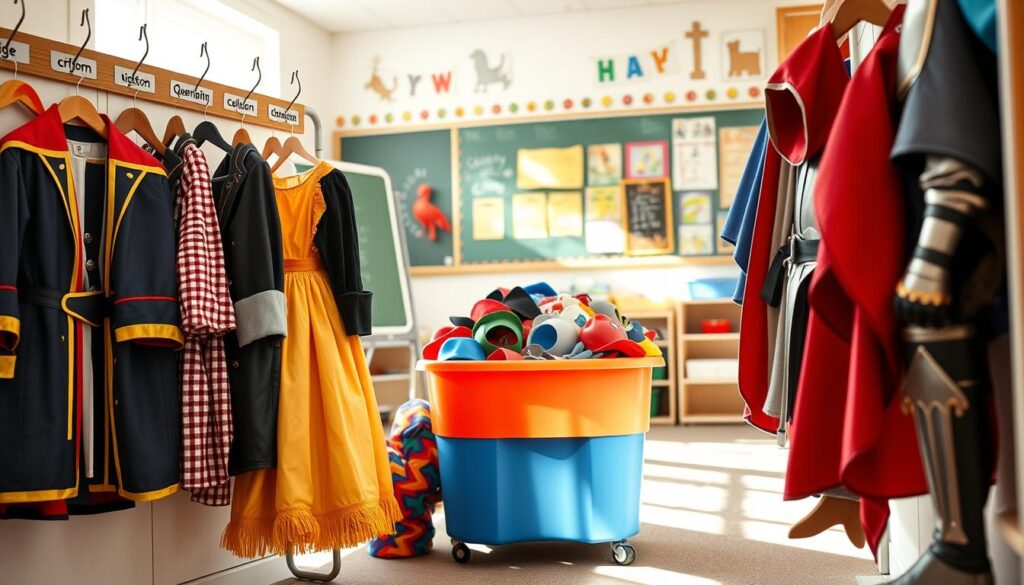
We’re exploring the world of containers. There’s a big debate about using clear bins or fabric bags. And then there’s the question of how to label things: by era, book, or size? Your labeling system is like your own set of rules.
The ultimate checklist we’ll create goes beyond just the main items. It includes the important extras like safety pins and fabric tape. Those simple white tees are incredibly valuable.
This is your guide to managing the chaos. We’ll use logic to organize everything, one labeled bin at a time. Are you ready to build your kit?
Bins, labels, laundering plan
The end of a historical costume project isn’t the show itself. It’s the care after it’s over. You’re like a museum curator, left to organize and store the costumes for their next adventure.
This detail is what makes a project last. Let’s dive into the steps to keep your costumes in top shape.
The Great Bin Debate: Choosing Your Time Capsule
Your storage is like a time capsule for costumes. Pick the wrong one, and you’ll find moldy clothes next year. The best container protects without being too hard to use.
Plastic Totes: The Pragmatic Fortress
Clear plastic bins are great for classroom storage. They’re easy to stack, see-through, and keep out dust and pests. But, they don’t let air in, which can harm natural fibers. Use silica gel packets to keep moisture away.
Canvas Bags: The Breathable Archive
For wool or heavy cotton costumes, use canvas bags. They let air in, preventing that musty smell. Think of them as garment bags for your classroom. They’re flexible but save space when empty.
Under-Bed Storage: The Space-Saving Time Machine
Consider long, flat bins for under-bed storage. They’re perfect for folded items like tunics and aprons. This turns unused space into a hidden storage area, great for small classrooms.
The Art of the Label: Creating Your Visual Legend
A label is more than a name; it’s a way to find things fast. In the rush before activities, you need to find specific costumes quickly. Your labels should help everyone involved.
High-Tech vs. Low-Tech Labeling
The Dymo label maker gives a professional look. Its labels last long and are easy to read. But, painter’s tape and Sharpie are cheaper and quicker. Color-code by era or type for easy sorting.
Visual Legends for Pre-Readers
Not all helpers can read. Create simple visual labels. A Roman column means “Ancient Rome,” and a castle means “Medieval.” This lets younger students help with setup and cleanup.
The Laundering Plan: Post-Adventure Decontamination
Modern educational costumes are often machine-washable, which is great. But, stains and stickiness need a plan.
Have a cleaning plan ready after the event. It’s the key to keeping costumes in good shape for future use.
The Stain Removal Battlefield
Keep a stain removal kit handy. Use a stain stick for collars, shout for grass, and a soft toothbrush for embroidery. Treat stains before storing, not before wearing. This way, you can wait to clean items without setting stains.
The Universal Stickiness Protocol
Some stains, like sticky residue, are hard to solve. A quick lint roller or damp microfiber cloth can help. This isn’t just cleaning; it’s preventative conservation.
Your cleaning plan turns costume care into a lesson. It teaches responsibility and preservation. The knight’s tabard goes back to its archive, ready for its next adventure. It’s the system, not the clothes, that makes the magic last.
Budget Builder
Let’s talk money. Time travel shouldn’t cost a fortune. This project is about smart money management.
Is it better to buy a ready-made outfit or make one yourself? Ready-made clothes are quick but might not last. DIY clothes are cheaper, personal, and can be changed easily. It’s a choice between speed and style.
My plan is simple. It’s like a budget guide for looking great. Spend 70% of your budget on thrift stores for unique finds. Use 20% for craft supplies like felt and fabric paint. Save 10% for that special item that makes your look pop, like real Roman sandals.
This isn’t just about saving money. It’s about being clever with what you have. You can look amazing without spending a lot. The best part? You’ll have a story to tell, not just a purchase.
Thrift + craft store swaps
Most historical costume budgets are tight, like a medieval peasant’s purse. But, you can create historical wonders without spending much. All you need is vision, scissors, and a fresh eye for thrift store finds.
This guide will show you how to turn thrift store finds into historical treasures. It’s about seeing the hidden value in every item. Every piece has the chance to become something special.
Take a pillowcase, for example. It looks like bedding to most, but to us, it’s a canvas for creativity. A blue hoodie can become Daddy Fox’s outfit from the Revolutionary War. An old sheet is not just linen; it’s a Roman toga waiting for a noble.
The Alchemist’s Translation Dictionary
For thrift store swaps, you need to learn a new language. You’re not buying clothes; you’re collecting raw materials. Let’s build your vocabulary.
In the men’s section, a plain dress shirt is not just for work. It’s the start of a pioneer woman’s blouse. Remove the collar, add some embroidery, and you’ve traveled back in time. The style is already fitting for the past.
Housewares are also goldmines. A vinyl tablecloth is perfect for a knight’s armor. Cut it for arms and a belt, and it’s ready for a jousting show. It costs just four dollars.
Scarves: The Costumer’s Treasure Trove
Never skip the scarf bin. It’s where magic happens on a budget. A scarf can be a Saxon warrior’s belt or a Grecian himation. A sheer scarf is a medieval veil or a Regency-era fichu.
A bag of assorted scarves is a great investment. They offer a wide range of textures, colors, and patterns. They cover more historical ground than any timeline.
Here’s a quick guide to retrain your shopping brain:
- Grandpa Sweater (bulky knit): Medieval peasant, Viking settler.
- Knit Vest (tweed or solid): Victorian newsboy, 1920s scholar.
- Maxi Skirt (flowing fabric): Renaissance noblewoman, prairie settler.
- Belted Robe or Duster Coat: Colonial statesman, wizard, judge.
- Baseball Cap (remove brim): Perfect base for adding paper or fabric to create any historical hat form.
Focus on shape and fabric, not labels. A simple shape can be transformed into different eras. A plain cotton dress becomes a Civil War gown with an apron and shawl. A brown leather belt can be a Roman soldier’s cingulum or a cowboy’s gun belt.
Craft store swaps complete the equation. Thrift stores give you the basics, while craft stores add the details. Felt makes medieval pouches and pilgrim hats. Acrylic paint and sponge brushes age fabric instantly. Jute rope becomes authentic-looking cordage for various uses.
The real win is not just saving money. It’s about engaging students in creation. When they see a hoodie become a character’s coat, they learn history is about resourcefulness and creativity. It’s about making do with what you have, which is the most historically accurate lesson.
Inclusive Options
Let’s dive into history’s story. It’s not just one old book. It’s a huge library open to everyone. And everyone should have a way to enter it as the hero, not just a side note.
We need to break free from old, binary fashion rules. Why can’t a knight wear a dress, or royalty surprise us? Stories like “The Boy in the Dress” and “Sparkle Boy” show us how to create a wardrobe for all.
True inclusion is more than just clothes. It’s about how they feel, look, and fit everyone. It’s about making things that work for everyone, with a bit of humor. The aim is simple yet big: a place where every young person sees their future, not limits.
Designing for everyone makes things better for all. It’s not just right; it’s smart. It turns a closet into a place where any story can start.
Hijab‑friendly headwear, wheelchair‑friendly robes
Inclusive costume design makes history lessons for everyone. It’s about changing costumes to fit people, not the other way around. This approach boosts creativity and meets every student’s needs.
It’s like solving historical puzzles. How can a medieval peasant’s wimple and a modern hijab work together? Or, can a pioneer’s journey include a wheelchair? The answers are surprisingly beautiful.
Designing Headwear That Honors Faith and History
Traditional headgear often forces a choice: wear it as-is or skip it. We can do better. Our goal is to blend historical accuracy with respect for the student’s identity.
The Modular Approach
Consider breaking headwear into parts. A medieval wimple can be a base with optional veils. Use strategic closures like hidden snaps or magnets instead of pins.
For a Roman veil, choose breathable, lightweight linens that fit over head coverings without bulk. The Pioneer sunbonnet gets a modern twist with a longer back flap for coverage and style.
Fabric and Function
- Material Selection: Choose natural fibers like cotton and linen for comfort and breathability.
- Adjustable Systems: Use tie-back systems with extra length or elastic for a secure yet comfy fit.
- Respectful Styling: Place decorative elements like embroidery or beading where they’re visible but modest.
Reimagining Robes for Mobility and Dignity
Traditional robes can be a hazard for wheelchair users. They catch in wheels and limit movement. The solution is to redesign robes from the ground up.
Strategic Redesign Principles
First, recognize the problem: robes are made for standing figures. The wheelchair is part of the student’s silhouette. It should be included in the character’s look.
Practical adaptations include:
- Shorter Hemlines: Design robes that end above the footrests to prevent catching.
- Cape Alternatives: Swap full gowns for capes or mantles that drape from the shoulders without leg entanglement.
- Velcro Openings: Create side or back openings with Velcro for easy dressing and comfortable sitting.
The Wheelchair as Character Extension
This is where creativity really shines. Decorate the wheelchair to make it part of the historical setting:
- For medieval royalty: drape rich fabrics over the sides to create a throne-like appearance.
- For a pioneer wagon: attach simple wooden-looking panels to the frame.
- For a Roman chariot: add removable decorative elements to the wheels and back.
This isn’t a compromised costume—it’s an enhanced character presentation that respects reality and expands historical imagination.
True inclusion in historical reenactment means every student can join history’s stage without leaving anything behind. When we design with flexibility and respect, we create historians, not just costumes.
FAQ
Q: What is the timeline for learning to read?
A: The timeline for learning to read can vary from child to child. Typically, children start learning to read in preschool or kindergarten, around the age of 5 or 6. By the end of first grade, most children can read simple texts. By the end of second grade, they can read more complex texts. By the end of third grade, they can read chapter books.
Q: How can I support my child’s reading development?
A: You can support your child’s reading development by creating a reading-friendly environment at home. This includes having a dedicated reading area with books and comfortable seating. You can also read together with your child and engage in conversations about the stories. Encourage your child to explore different genres and authors to broaden their reading experience.
Q: What are some effective reading strategies for children?
A: Some effective reading strategies for children include phonics instruction, which focuses on sounding out words. This can be done through phonics games and activities. Another strategy is sight word recognition, which involves memorizing common words. Reading aloud to your child and engaging in conversations about the stories can also enhance their reading skills.
Q: How can I assess my child’s reading progress?
A: You can assess your child’s reading progress by observing their reading habits and listening to their reading. Look for signs of improvement, such as increased fluency and accuracy. You can also use reading assessments and progress monitoring tools to track their progress. Keep in mind that every child learns at their own pace, so be patient and celebrate their achievements along the way.
Q: What are some tips for teaching reading to children?
A: Some tips for teaching reading to children include making reading fun and engaging. Use interactive and engaging reading materials, such as picture books and interactive e-books. Create a positive reading environment by encouraging your child to explore different genres and authors. Be patient and celebrate their achievements along the way.
Q: How can I help my child overcome reading challenges?
A: If your child is facing reading challenges, it’s important to address them in a supportive and non-judgmental way. Work with your child’s teacher to identify the specific challenges they are facing and develop strategies to overcome them. Provide additional support and practice at home, such as reading aloud together and engaging in conversations about the stories. Encourage your child to explore different genres and authors to broaden their reading experience.
Q: What are some strategies for teaching reading to children?
A: Some strategies for teaching reading to children include phonics instruction, sight word recognition, and reading aloud. Phonics instruction focuses on sounding out words, while sight word recognition involves memorizing common words. Reading aloud to your child and engaging in conversations about the stories can also enhance their reading skills.
Q: How can I support my child’s reading journey?
A: You can support your child’s reading journey by creating a reading-friendly environment at home, using effective reading strategies, and assessing their progress. Encourage your child to explore different genres and authors, and celebrate their achievements along the way. By providing a supportive and nurturing environment, you can help your child develop a lifelong love for reading.
FAQ
Q: What is the significance of the 2024 US Presidential Election?
A: The 2024 US Presidential Election is a critical event that will shape the future of the country. It will determine the direction of the nation, the policies that will be implemented, and the leadership that will guide the country for the next four years.
Q: Who are the main candidates running for the 2024 US Presidential Election?
A: The main candidates running for the 2024 US Presidential Election include Joe Biden, Donald Trump, and several other notable figures. Each candidate has their own platform, vision, and policies that they believe will benefit the country.
Q: What are the key issues that will be addressed during the 2024 US Presidential Election?
A: The 2024 US Presidential Election will address a range of key issues, including healthcare, education, economic growth, national security, and climate change. These issues will be at the forefront of the campaign and will shape the policies and decisions made by the next president.
Q: How can I stay updated on the latest news and updates about the 2024 US Presidential Election?
A: To stay updated on the latest news and updates about the 2024 US Presidential Election, you can follow reputable news sources, such as CNN, Fox News, and The New York Times. You can also follow the official social media accounts of the candidates and the election commission to get real-time updates.
Q: What are the voting requirements and deadlines for the 2024 US Presidential Election?
A: The voting requirements and deadlines for the 2024 US Presidential Election vary by state. It is important to check with your local election office or visit the official website of your state’s election commission to find out the specific requirements and deadlines for voting in your area.
Q: How can I make an informed decision when casting my vote in the 2024 US Presidential Election?
A: To make an informed decision when casting your vote in the 2024 US Presidential Election, it is important to research the candidates, their policies, and their track records. You can also attend debates, town halls, and other campaign events to get a firsthand understanding of their positions and vision for the country.
Q: What is the role of the Electoral College in the 2024 US Presidential Election?
A: The Electoral College plays a significant role in the 2024 US Presidential Election. It is a system established by the Founding Fathers to ensure that smaller states have a voice in the election process. Each state is allocated a certain number of electoral votes based on its population, and the candidate who wins the most votes in a state gets all of its electoral votes.
Q: How can I participate in the democratic process and contribute to the 2024 US Presidential Election?
A: There are several ways to participate in the democratic process and contribute to the 2024 US Presidential Election. You can register to vote, volunteer for your preferred candidate, donate to their campaign, and spread the word about the importance of voting. Every action counts, and your participation can make a difference in shaping the future of the country.